





Walk
From the Concorde square to the Eiffel Tower
Paris, France
Walk
From the Concorde square to the Eiffel Tower
Paris, France
8.9 km
Distance
3h40
Durée
19
Audios
Loop
Parcours
Shutterstock
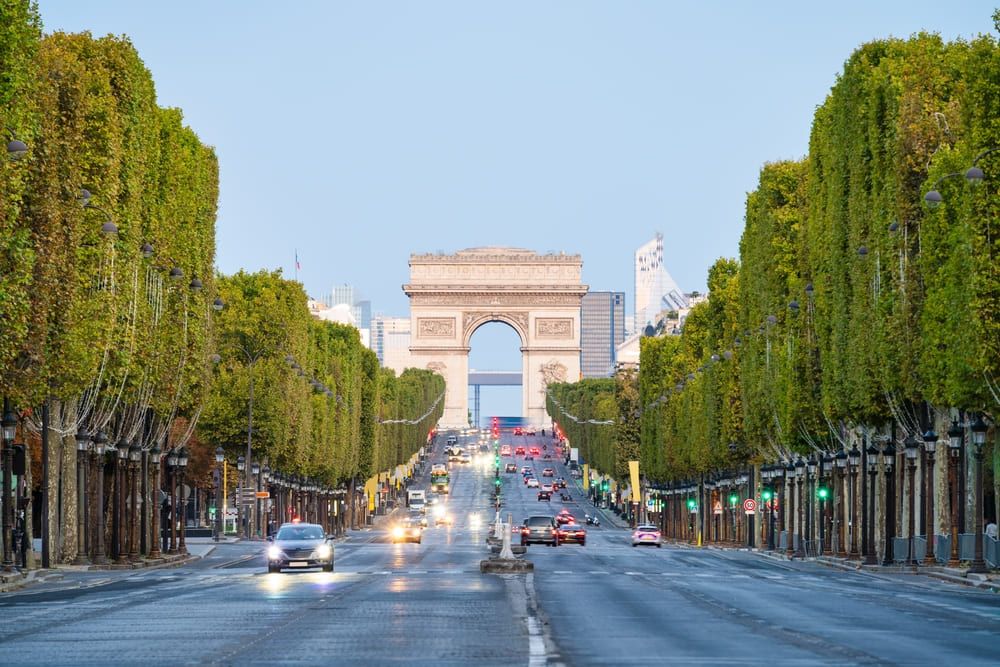
The Paris audio-guided tour takes you up the Champs-Élysées, the avenue often hailed as the most beautiful in the world, which links the Place de la Concorde to the Place de l'Étoile over nearly two kilometres.
The avenue owes its layout to the landscape architect André Le Nôtre, creator of the gardens of Versailles, charged in the seventeenth century with extending the perspective of the Tuileries garden. On an area then marshy, he designed a great tree-lined avenue, first named the Grand Cours. The name Champs-Élysées appeared in 1694 and became official in 1709; in Greek mythology, the Elysian Fields designate the abode of virtuous souls, a kind of paradise. The avenue was also the scene of great moments of History: the march of the women towards Versailles in 1789, the parade of the Liberation in 1944, or the jubilation of sporting victories. Lined with listed monuments, it today hosts great brands and national events.
Going up the avenue, one passes from the gardens at the lower Champs-Élysées to the prestigious shop windows that lead to the Arc de Triomphe. Twice a year, the sun sets in the perfect axis of the monument, offering a rare spectacle to lucky walkers. A place of celebration and memory, the scene of the 14 July parade and the arrival of the Tour de France, the avenue embodies on its own a part of the soul of Paris.
The Champs-Élysées extend from the Place de la Concorde to the Place de l'Étoile, in the 8th arrondissement of Paris. The avenue can be walked freely on foot at all hours; shops and restaurants follow their own hours.
The landscape architect André Le Nôtre, in the seventeenth century, who laid out a great tree-lined avenue to extend the perspective of the Tuileries.
From Greek mythology, where the Elysian Fields are the abode of virtuous souls; the name appeared in 1694 and became official in 1709.
Aucun avis pour le moment
