





Walk
All hands on deck !
Saint-Malo, France
Walk
All hands on deck !
Saint-Malo, France
6.6 km
Distance
2h45
Durée
30
Audios
Loop
Parcours
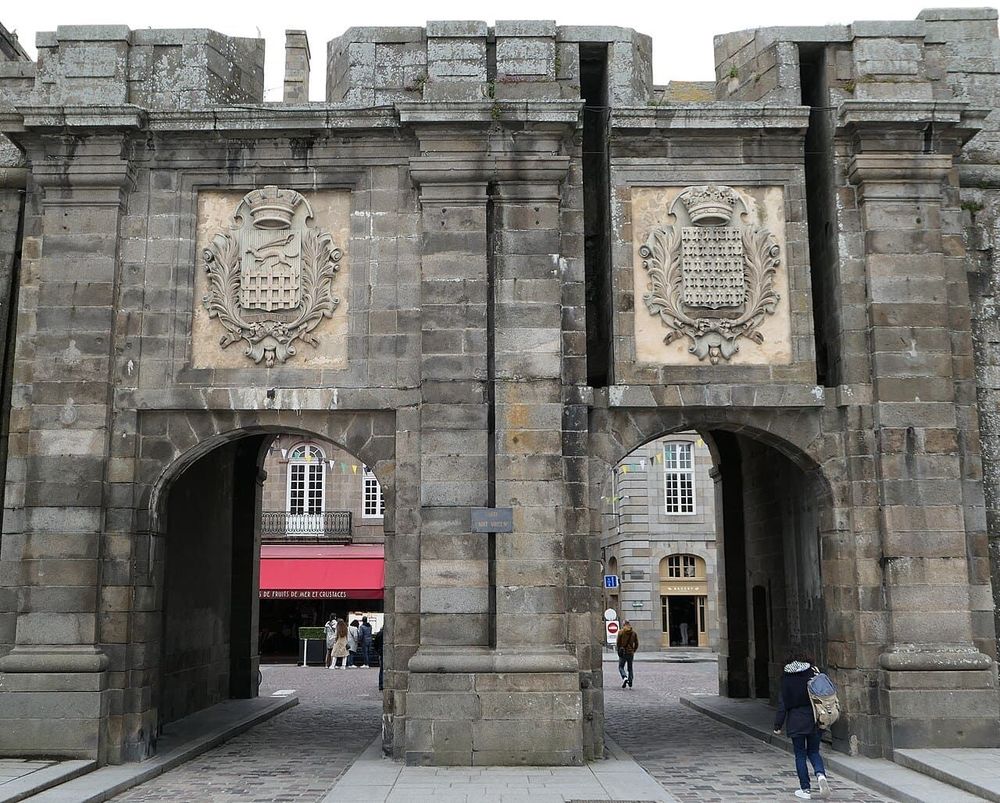
©Flothar CC BY-SA 4.0. <https://creativecommons.org/licenses/by-sa/4.0/deed.fr>via Wikipedia Commons
Place Chateaubriand and the Saint-Vincent Gate form the main entrance of Saint-Malo intra-muros. The Saint-Malo audio-guided tour stops here to evoke this lively square and its great gate, the threshold of the corsair city.
The Saint-Vincent Gate is the main entrance gate of Saint-Malo intra-muros, opening onto Place Chateaubriand. This lively square, which bears the name of the Malouin writer, is lined with terraces, the castle and its towers. A meeting point between the walled town and the port, it is the threshold through which you enter the corsair city and an unavoidable place of passage.
You admire the Saint-Vincent Gate, the castle and its towers, and you enjoy the liveliness of Place Chateaubriand, lined with terraces. It is the main entrance of the walled city and the ideal starting point for the visit of the corsair city. A lively stop, on the threshold of the walled town.
Place Chateaubriand and the Saint-Vincent Gate lie at the entrance of Saint-Malo intra-muros, reachable on foot. They are public spaces freely accessible at all times; the cafés and shops of the square have their own hours. It is the natural starting point of a walk in the walled town and on the ramparts.
It is the main entrance gate of Saint-Malo intra-muros, opening onto Place Chateaubriand, the threshold of the corsair city.
At the entrance of Saint-Malo intra-muros, near the castle.
Aucun avis pour le moment
