




Walk
From the Concorde square to the Eiffel Tower
Paris, France
Walk
From the Concorde square to the Eiffel Tower
Paris, France
8.9 km
Distance
3h40
Durée
19
Audios
Loop
Parcours
Shutterstock
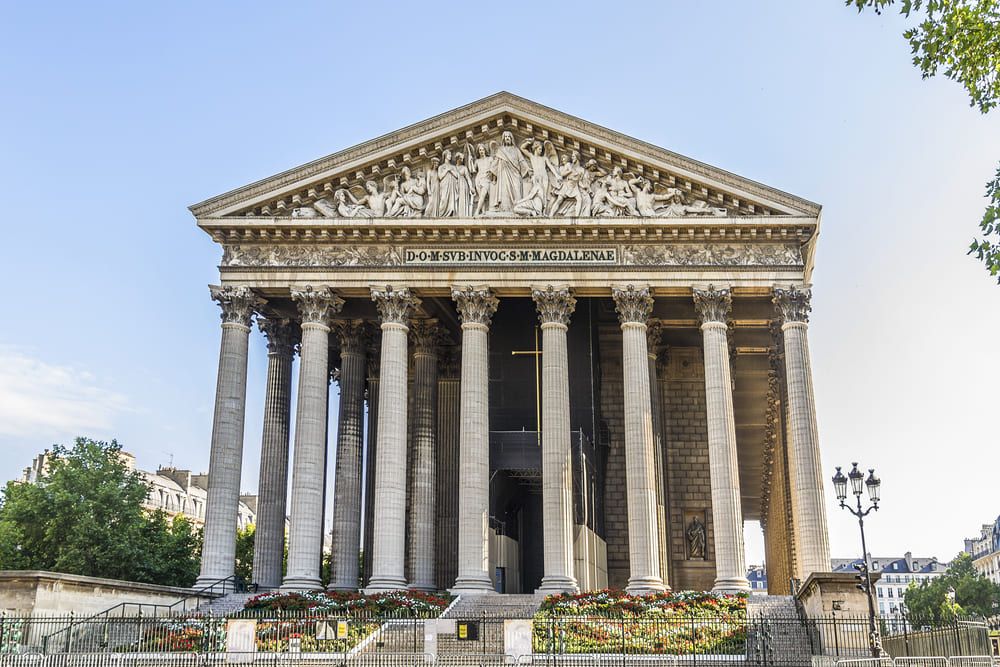
The Paris audio-guided tour presents you with the Church of the Madeleine, a surprising neoclassical temple raised on the square of the same name, whose eventful history crossed several regimes before it became a place of worship.
The first stone was laid by Louis XV in 1763, for a church in the shape of a Latin cross topped with a dome. The Revolution interrupted the works and the building was nearly to host in turn a library, an opera, the Bank of France or the Stock Exchange. Napoleon, after Austerlitz, wanted to make it a temple to the glory of his Grand Army and chose the project of Pierre-Alexandre Vignon, inspired by ancient temples. But after the Russian campaign of 1812, the project was abandoned; Louis XVIII even considered installing a railway station there. Finally, in 1842, seventy-eight years after the first stone, the building was consecrated to Catholic worship. Without cross or bell tower, it presents itself as a Greek temple girded with fifty-two Corinthian columns.
The building surprises with its silhouette of an ancient temple, rare for a church. Inside, the sober and luminous nave, little laden with ornaments, invites contemplation. From the top of its steps, the view extends in a line towards the Place de la Concorde and the National Assembly, in one of the finest axes of Paris. It is a place at once spiritual and astonishing by its architecture.
The Church of the Madeleine is on the Place de la Madeleine, in the 8th arrondissement of Paris. A place of worship open to visitors, it is discovered with respect for the services; the opening hours are to be checked on site.
Because Napoleon first wanted to make it a temple to the glory of his army; the chosen project, inspired by Antiquity, gave it its fifty-two Corinthian columns.
In 1842, seventy-eight years after the laying of the first stone by Louis XV in 1763.
Aucun avis pour le moment