





Walk
The Plantagenet City
Le Mans, France
Walk
The Plantagenet City
Le Mans, France
2 km
Distance
1h00
Durée
21
Audios
Loop
Parcours
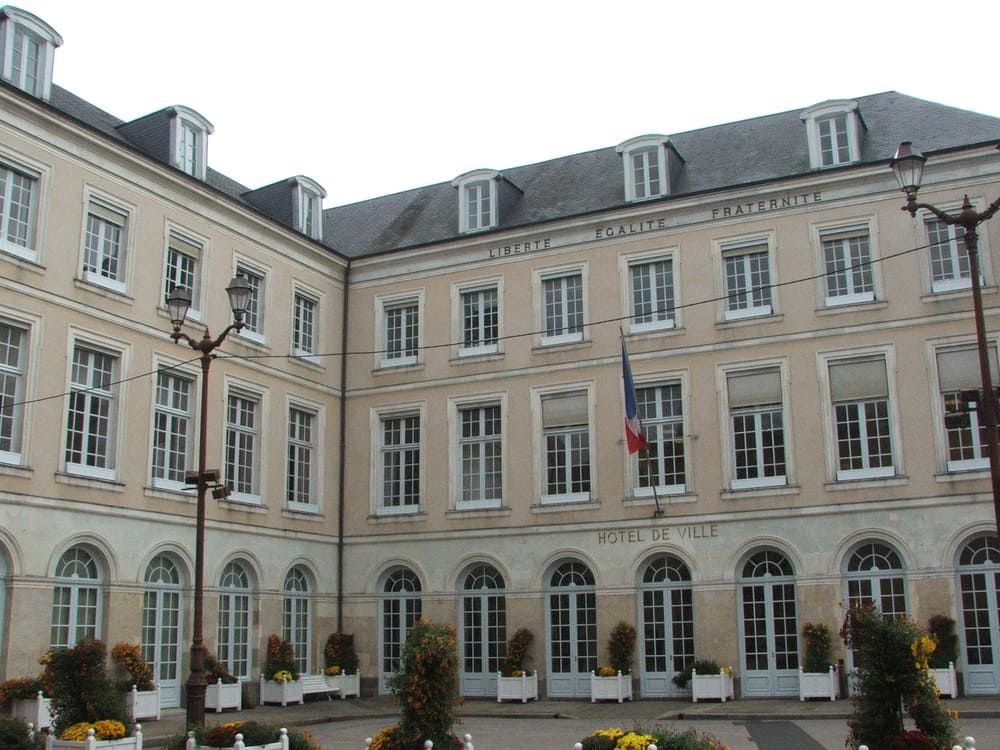
©Le Mans CC BY-SA 3.0. <https://creativecommons.org/licenses/by-sa/3.0/deed.fr>via Wikipedia Commons
The town hall of Le Mans is part of a fine heritage ensemble, at the foot of the Plantagenet City, where more than two thousand years of history coexist. The Le Mans audio-guided tour stops here to evoke this exceptional site, backed against the Gallo-Roman wall, neighbour of the collegiate church of Saint-Pierre-la-Cour, former chapel of the counts of Maine and of the Plantagenets.
You are here in front of a fine heritage ensemble, at the foot of the Plantagenet City, there where more than two thousand years of history coexist. Under your steps, the earth rests on the former Gallo-Roman wall of the third century. Look around you: the gardens are tiered along this thousand-year wall, unique in France by its polychromy, where light stones and pink bricks alternate. On your left, admire the slender silhouette of the collegiate church of Saint-Pierre-la-Cour, that it is fitting to evoke with respect. Built from 969, it was the chapel of the counts of Maine, then of the Plantagenets, this powerful dynasty that reigned over England and a great part of France. Its two-level chevet, added in the thirteenth century, draws its inspiration directly from the Sainte-Chapelle of Paris. Formerly, it sheltered the relics of Saint Scholastica, patroness of Le Mans, and was in turn a place of worship, an arsenal, then a school; it today hosts exhibitions in its lower chapel, whose medieval vaults have miraculously survived. The town hall itself, built in the eighteenth century, integrates into this ensemble that marries ancient, medieval and modern heritage, at the heart of the municipal power of Le Mans. With its terraced gardens and its view over the old town, this site illustrates marvellously the stratification of eras that makes the richness of Le Mans. A heritage ensemble and a municipal seat, the town hall is a fine stop of the discovery of Le Mans.
Here you discover a fine heritage ensemble at the foot of the Plantagenet City, backed against the polychrome Gallo-Roman wall of the third century and its terraced gardens; you admire the collegiate church of Saint-Pierre-la-Cour, former chapel of the counts of Maine and of the Plantagenets inspired by the Sainte-Chapelle, and the town hall of the eighteenth century, seat of the municipal power. The town hall is a heritage site of Le Mans. It is a fine stop, to be explored on foot.
The town hall lies at the foot of the Plantagenet City, along the Gallo-Roman wall, in the centre of Le Mans, reachable on foot. You admire the ensemble and the gardens freely; the collegiate church of Saint-Pierre-la-Cour hosts exhibitions according to the hours in force, which vary. It is best to enquire before coming.
It is a church built from 969, that was the chapel of the counts of Maine then of the Plantagenets; its two-level chevet, added in the thirteenth century, draws its inspiration from the Sainte-Chapelle of Paris, and it formerly sheltered the relics of Saint Scholastica, patroness of Le Mans. A place of worship become in turn an arsenal and a school, it today hosts exhibitions, and is discovered with respect.
At the foot of the Plantagenet City, along the Gallo-Roman wall, in the centre of Le Mans, in France.
Aucun avis pour le moment
