





Walk
The Black Diamond of Auvergne
Clermont-Ferrand, France
Walk
The Black Diamond of Auvergne
Clermont-Ferrand, France
5.3 km
Distance
2h10
Durée
22
Audios
Loop
Parcours
Shutterstock
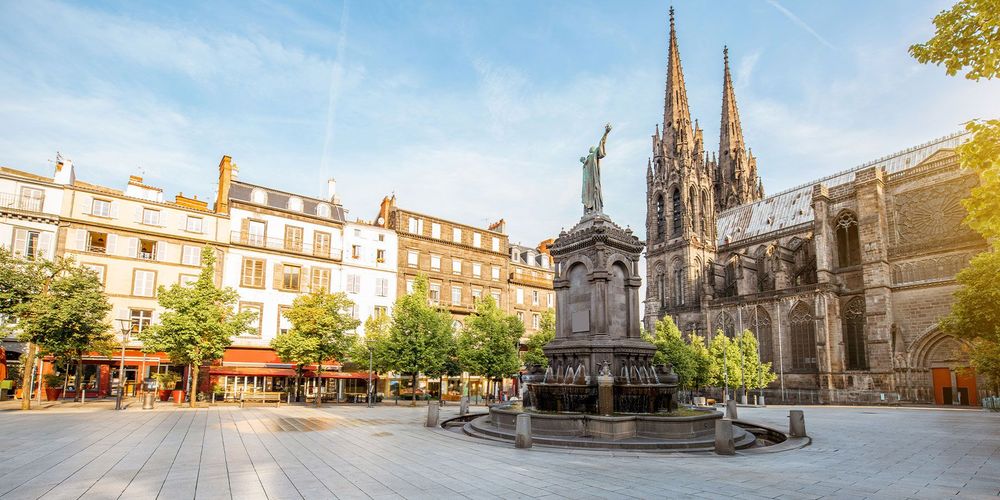
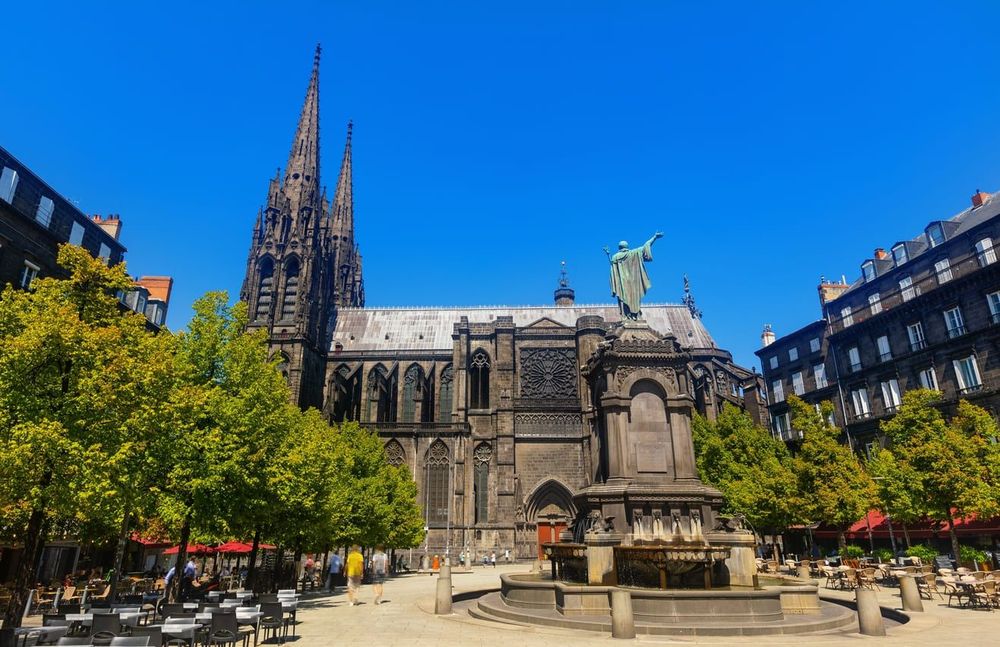
The cathedral of Notre-Dame-de-l'Assomption is the emblem of Clermont-Ferrand, a Gothic masterpiece entirely built in black lava stone that dominates the city with its two spires. The Clermont-Ferrand audio-guided tour stops here, with respect, to evoke this "cathedral of the coalmen", built from the thirteenth century and completed by Viollet-le-Duc, whose interior shelters one of the finest collections of medieval stained glass of France.
A true emblem of the city, the cathedral required more than seven centuries to be completed and was quickly nicknamed the "cathedral of the coalmen", so much its colour is dark. Dressed all in black, it was built from the thirteenth century on the site of a former Romanesque cathedral. It displays a Gothic style of the North, inspired by the Sainte-Chapelle of Paris. It is the architect Jean Deschamps who directed its construction, by the will of the bishop Hugues de la Tour, who decided in 1248 to raise a new cathedral after the passage of the Normans. It was built in Volvic stone, this volcanic stone that gives it its so particular colour: it is moreover the only great cathedral composed of this rock. Severely struck during the Revolution, it had to undergo numerous restorations. It is only at the end of the nineteenth century that Viollet-le-Duc, the famous architect of Notre-Dame of Paris and of the city of Carcassonne, added to it a neo-Gothic façade surmounted by two spires, that give it its current grandeur. Inside, you discover, in contemplation, one of the finest collections of medieval stained glass of France, mural paintings of the twelfth to the fifteenth century and marble sarcophagi of the fourth and fifth centuries.
Here you discover the emblem of Clermont-Ferrand, a Gothic masterpiece of the thirteenth century entirely built in black lava stone of Volvic, nicknamed the "cathedral of the coalmen", that Viollet-le-Duc endowed with its façade and its two spires; inside, in contemplation, one of the finest collections of medieval stained glass of France, mural paintings and old marble sarcophagi. The cathedral is an unmissable place of prayer, to be visited with respect. It is a fine stop, to be explored on foot.
The cathedral of Notre-Dame-de-l'Assomption dominates the historic centre of Clermont-Ferrand, at the summit of the central knoll, and forms the backdrop of the place de la Victoire, reachable on foot. It is a place of worship in activity, whose access is made in the respect of the services and of contemplation; the hours of visit vary according to the season. It is best to enquire before coming and to adopt correct attire.
Because it is built in Volvic stone, a volcanic stone that gives it its characteristic dark colour, which earned it the nickname of "cathedral of the coalmen"; it is moreover the only great cathedral composed of this rock. Built from the thirteenth century in a Gothic style inspired by the Sainte-Chapelle, it was completed at the end of the nineteenth century by Viollet-le-Duc, who added to it its façade and its two spires.
At the summit of the central knoll, dominating the historic centre of Clermont-Ferrand, facing the place de la Victoire, in France.
Aucun avis pour le moment
