




Duchess Anne’s House

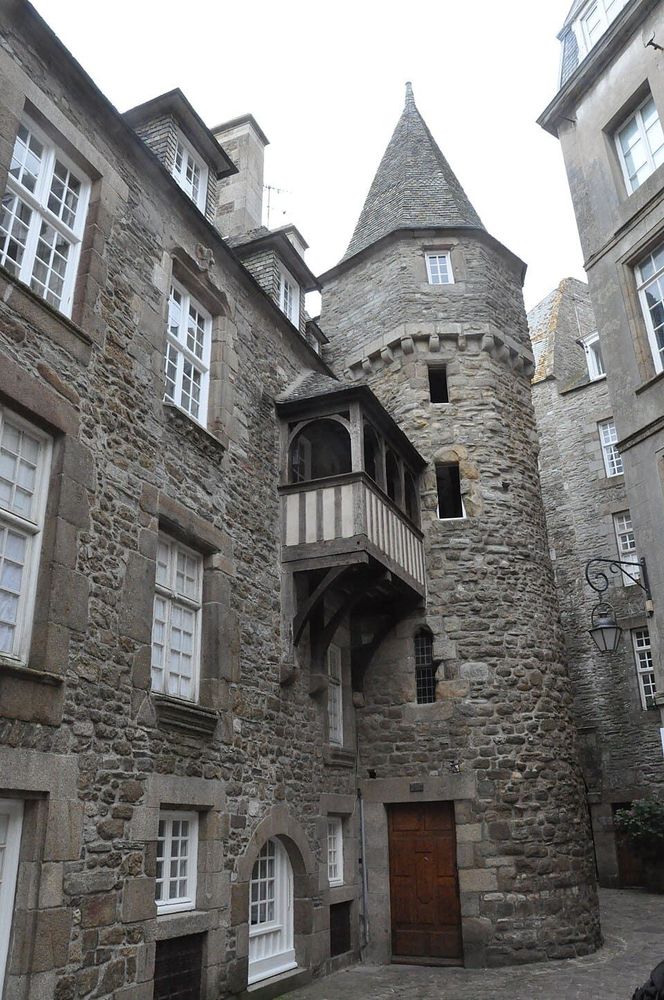
©Philippe Alès CC BY-SA 3.0. <https://creativecommons.org/licenses/by-sa/3.0/deed.fr>via Wikipedia Commons

Coming into view now is the so-called House of Duchess Anne, easy to recognize by its pointed turret and old balcony. This building once formed part of Saint-Malo’s original enclosure and is all that remains of the entrance to the former Château Gaillard, demolished in 1573. Catherine de’ Medici is said to have stayed here in 1570, and Duchess Anne of Brittany supposedly lodged here when she came to check on the progress of her castle’s construction. As a witness to Saint-Malo’s illustrious past, the building is, of course, listed as a historic monument. You hear the name Anne of Brittany all the time—but beyond the fact that she was twice Queen of France, what do you really know about her? That alone is unusual enough. Anne was born in 1477 at the Castle of the Dukes of Brittany in Nantes. She was the daughter of the last duke, Francis II, and Margaret of Foix, Princess of Navarre. Her father wanted to preserve the independence of his duchy against French pressure, so he sought allies by promising her hand to various European princes. But after suffering defeat against the French army, he was forced to sign a treaty stating, among other things, that the duchess could not marry without the consent of the King of France. And yet in 1490, she married Maximilian I of Habsburg, heir to the Holy Roman Empire. France saw that as both an insult and a direct breach of the treaty. Rennes, where Anne was staying, was swiftly besieged. After two months, the city surrendered, and Anne was forced to marry Charles VIII to restore peace and protect her duchy. That is how, at just fifteen years old, she became Queen of France. She had several sons, but all died in infancy. The king also died, leaving her widowed at twenty-one and childless. She then became Duchess of Brittany once again. But her marriage contract was clear: if the king died without heirs, she would have to marry his successor. That is exactly what happened in 1499, when she married the new King of France, Louis XII. This time, however, she was able to negotiate the terms. She had no intention of giving up her title as duchess again. So she became Queen of France once more while still remaining Duchess of Brittany. She also arranged that after her death, the duchy would pass to her second son rather than the eldest, whose destiny was tied to France—clear proof of her wish for a free and independent Brittany. When she died in 1514, the duchy passed instead to her daughter Claude of France, who would also marry a king: Francis I. That, in short, is the story of Anne’s life, marriages, and political battles, and why she became one of the most famous female figures in French history. But to understand how Brittany was ultimately joined to France, you need one more piece of the story. Queen Claude did not share her mother’s strength or her unwavering attachment to Breton independence. On her deathbed, she agreed that the duchy should go to her eldest son, not the second as Anne had wished. Brittany then came under the authority of a representative of the French king. The nobility lost privileges, but the duchy understood that the future belonged to strong, united states. In 1532, the Edict of Union of Nantes was signed. The fleur-de-lis replaced the ermine, and Brittany became a province of the Kingdom of France. That was a bit of a historical detour—but now continue along Rue de la Corne de Fer to reach our next stop on Place de la Poissonnerie.

+1 million de voyages avec Ryo

Explore cities with our audio guides. Wander the most beautiful streets, savor every story.

Google Play

Your pace, our audio guides

Google Play