





Walk
The city of three rivers
Mont-de-Marsan, France
Walk
The city of three rivers
Mont-de-Marsan, France
2.1 km
Distance
1h00
Durée
21
Audios
Loop
Parcours

Anonyme CC BY-SA 3.0 <https://creativecommons.org/licenses/by-sa/3.0/deed.fr>via Wikipedia Commons
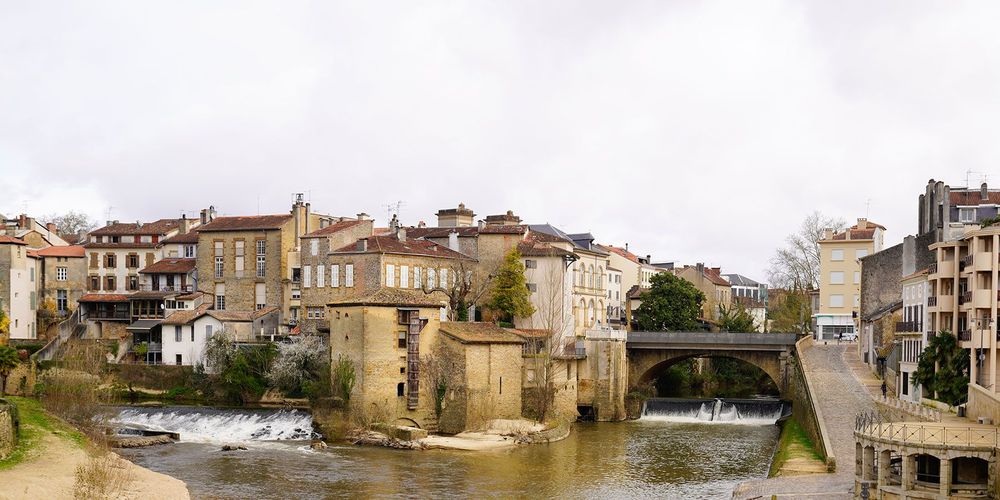
The Mont-de-Marsan audio-guided tour offers you a privileged view, from the banks, over the confluence of the Midou and the Douze and over a group of old buildings: the former flour mill of the city.
In the Middle Ages, two fortified hydraulic mills, placed under the protection of the old castle, occupied the area. The Midou mill, probably built between the tenth and the twelfth century, transformed the cereals brought by boat, making the wealth of the city. The Douze mill, appearing at the end of the thirteenth century, reinforced this production. In 1840, the two mills were reconverted into a flour mill, which remained in service until 1963. The city then acquired the disused site and transformed it into an art gallery, "La Minoterie", before installing there the tourist office and a centre devoted to the memory of the Resistance and the Deportation.
From the banks, one admires the stone buildings of the former flour mill, witnesses of centuries of industrial history, at the meeting point of the two rivers. Become an art gallery and seat of the tourist office, the site illustrates the successful reconversion of an old heritage. It is a fine testimony of the milling and river past of Mont-de-Marsan.
The former flour mill is at the confluence of the Midou and the Douze, in Mont-de-Marsan, and can be contemplated from the banks, on the level. It today houses the tourist office, an art gallery and a memorial centre, which can be visited according to their own hours.
The site of two medieval hydraulic mills, reconverted into a flour mill in 1840, which transformed the cereals into flour.
The tourist office, an art gallery named "La Minoterie" and a centre devoted to the memory of the Resistance and the Deportation.
Aucun avis pour le moment
