





Walk
Sea & Steel
Saint-Nazaire, France
Walk
Sea & Steel
Saint-Nazaire, France
6 km
Distance
2h30
Durée
24
Audios
Loop
Parcours
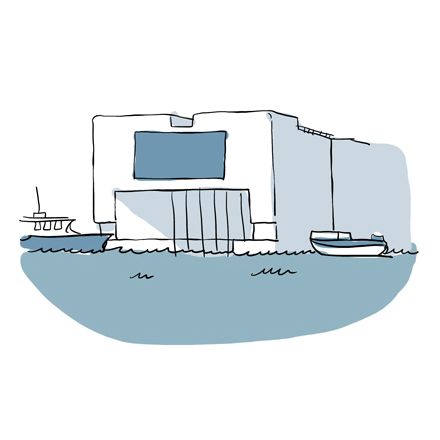
The Saint-Nazaire audio-guided tour presents you with the fortified lock, a powerful witness of the Second World War, neighbour of the submarine base.
Intimately linked to the history of the submarine base, located on the quay opposite, the fortified lock extends the German military device on the port. From 1941, Nazi Germany settled at several strategic points of the Atlantic seaboard to establish its submarines there. The works, colossal, mobilised a large workforce. Built between 1943 and 1944 to facilitate access to the Loire estuary, the fortified lock presents itself as a massive block of concrete, one hundred and fifty-five metres long and twenty-five metres wide, fitted with loopholes and designed to resist assaults. Today, this vestige is shared between two tourist sites: the submarine Espadon, a museum ship moored in the lock, and a centre devoted to wind energy produced at sea. A place charged with memory, to be travelled with gravity.
The fortified lock impresses with its defensive concrete architecture, its loopholes and its austere mass. A witness of the war, it today houses the submarine Espadon and a centre dedicated to offshore wind, and offers from its roof beautiful panoramas. It is a stage that mixes military memory and views on the energy of today.
The fortified lock is on the port of Saint-Nazaire, facing the submarine base. The sites it houses are generally subject to a charge and open according to hours to be checked on site; the rooftop terrace offers an open view over the port.
Between 1943 and 1944 by Nazi Germany, to facilitate the access of submarines to the Loire estuary.
The submarine Espadon, a museum ship, and a centre devoted to wind energy produced at sea.
Aucun avis pour le moment
