
Créé par Romane, le 17 nov. 2026
Votre guide Ryo
Saint-Nazaire, France
Sea & Steel
Parcours audioguidé pour visiter Saint-Nazaire en 1 jour
This tour of Saint-Nazaire immerses you in a place where industrial might meets the open breath of the ocean. Stand before the immense Saint-Nazaire Submarine Base, a vast concrete colossus now transformed into a cultural hub, before heading toward the completely reimagined seafront. Between the sweeping outline of the Saint-Nazaire Bridge spanning the estuary and the lively shipyards where some of the world’s largest ocean liners take shape, the city reveals a bold and resilient spirit. It’s a walk that moves between twentieth-century heritage and the hidden beaches along the coastal path, capturing the full energy of a city that looks firmly toward the open sea.
Quand partir à Saint-Nazaire ?
Jan.
9°
13
Feb.
10°
11
March
13°
10
April
15°
9
May
18°
10
June
22°
8
July
24°
7
Aug.
24°
7
Sept.
21°
8
Oct.
17°
11
Nov.
13°
13
Dec.
10°
13
Saint-Nazaire enjoys a temperate oceanic climate, marked by great mildness and constant maritime influences, with pleasant summers averaging around 23°C and temperate winters where the thermometer generally fluctuates between 4°C and 10°C. The most favorable period to explore the naval city and its beaches runs from June to September, offering optimal sunshine to visit Escal'Atlantic or walk along the coastal customs path (chemin des douaniers). The month of July is particularly recommended for enjoying the summer events on the seafront, while spring remains an excellent season to observe the bustle of the shipyards under a coastal light that is often spectacular and ever-changing.
Départ conseillé
No need to worry about where to begin! Our tours are designed as a loop, so you can jump in wherever you are. The navigation system and audioguide will automatically adjust to your location. However, if you happen to be nearby, we do have a preferred starting point: square des Pétanqueurs
Parking à proximité
Free parking Ecluse fortifiée: avenue des Frégates Paid parking des Antilles: rue de la Guyane
The Ecluse fortifiée car park is free and lets you park right at the foot of attractions like the Espadon submarine or the EOL Offshore Wind Visitor Centre, but there are very few spaces and it fills up quickly during the tourist season. A good alternative is the Antilles car park, close to the seafront, which offers more spaces and is still within easy walking distance of the main sights. Beyond that, Saint-Nazaire has plenty of enclosed car parks such as those by the Town Hall, the Market Halls or the station, all secure and easy to access, with one hour free on weekdays and two hours free on Saturdays. Street parking is also regulated but free on Sundays, public holidays and in the evenings, which makes it both practical and flexible depending on your needs.
À savoir
During our tour, you’ll be walking through the Jardin des Plantes. To avoid any last-minute surprises, please note that the garden has specific opening and closing hours. If it happens to be closed when you arrive, you’ll need to continue the tour along Avenue de Béarn and then Rue de Santander.
Découvrez 24 lieux d'intérêt pour visiter Saint-Nazaire








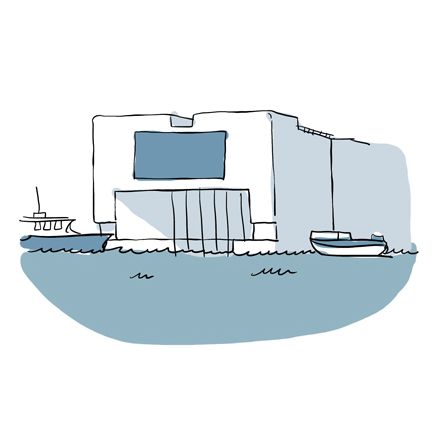


What to see in Saint-Nazaire on your 2h30 tour?
This 6 km loop takes about 2 h 30 and links 22 sights. It sets off at Petit-Maroc, facing the estuary, follows the seafront to the Jardin des plantes botanical garden, crosses the La Havane district and the town centre, then reaches the submarine base, the fortified lock and the Chantiers de l'Atlantique shipyards before looping back to the estuary past the Ecomusee. With the Ryo app in your ears, wartime memory, urban art and industrial adventure unfold at your own pace.
Information checked in November 2026 and subject to change.
1 - Operation Chariot Memorial
Facing the estuary, in the Petit-Maroc district, this plain memorial, flanked by French and British flags, honours the Allies who fell during a legendary raid. In 1940, Winston Churchill plans a strike against the Atlantic ports held by the Germans: the Saint-Nazaire basin, the only one able to shelter the battleship Tirpitz, becomes the target. At dawn on 28 March 1942, an explosive-packed destroyer rams the lock gate while commandos blow up the port installations, at a heavy human cost.
Free entry
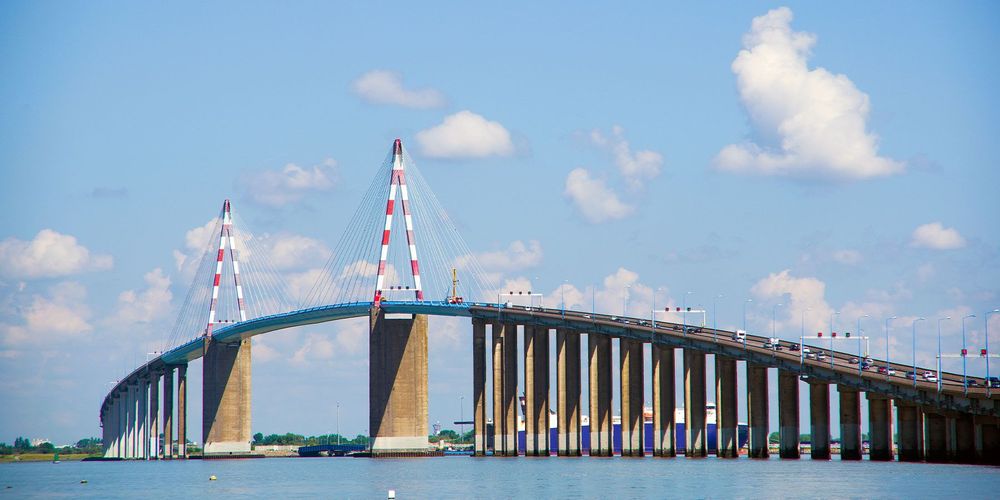
2 - View of the Saint-Nazaire Bridge
This viewpoint sits at the foot of a 19th-century lighthouse, at the tip of the harbour, with a clear view over the calm estuary and, beyond it, the vast Atlantic. From here you can make out the slender lines of the great suspension bridge linking the two banks, finished in the mid-1970s. Stretching 3,356 metres, it long stood as the longest bridge in France. Free to cross since 1994, once its toll was scrapped, it rises more than 60 metres above the water.
Free entry
3 - Old Pumping Station
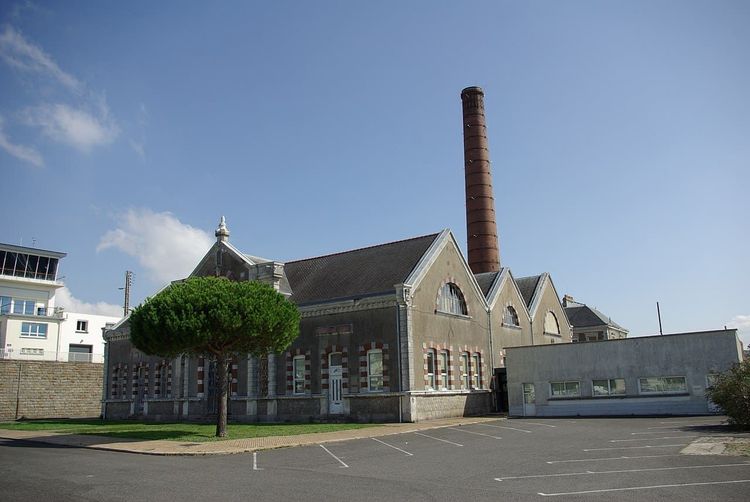
A rare industrial survivor of the bombings that flattened most of the city, this plant was built in the early 20th century. It combined a power station serving the harbour with a device meant to raise the water in the basins whenever evaporation let it drop too far, so ships could stay afloat. First driven by steam pumps, later by electric and diesel engines, it ran until the early 1990s and has carried, since 2001, listed-monument status, the only one of its kind in France.
Free to see from outside
4 - Foot, Sweater, Digestive System Sculptures
Three grey figures, up to seven metres tall, rise from the sand of the outer harbour: a bare foot, an empty sweater and a digestive system, half swallowed when the tide comes in. Unveiled in 2021 for the Estuaire trail run by Le Voyage à Nantes, which scatters artworks across 120 kilometres between Nantes and Saint-Nazaire, they are signed by the duo Dewar & Gicquel, who have sculpted four-handed since the 1990s. The foot suggests a bather, the sweater our need to get dressed, the organ our hidden vitality.
Free entry
5 - Commando square
Opened in July 2018, this south-facing square of over 4,500 square metres, facing the estuary, turned the seafront into the city's new living heart. Bars, restaurants, a splash pool under the pines and a play area near the beach draw families and regulars, while an impromptu stage livens up summer evenings. Named in memory of the heroic commandos of the 1942 raid, it is a reminder that this peaceful corner once staged a striking chapter of local military history.
Free entry
6 - Customs Officers' Path - GR34
The route here follows a short stretch of the Customs Officers' Path, the GR34, which traces the whole Breton coastline for over 2,000 kilometres and links, among other stages, Saint-Nazaire to Pornichet. Recently voted the French favourite hiking trail, this balcony over the ocean takes its name from the agents who once watched here for smugglers; today you are more likely to spot fishing huts on stilts, a familiar sight along this stretch of Atlantic coast, amid sea spray and the scent of pines.
Free entry
7 - American War Memorial
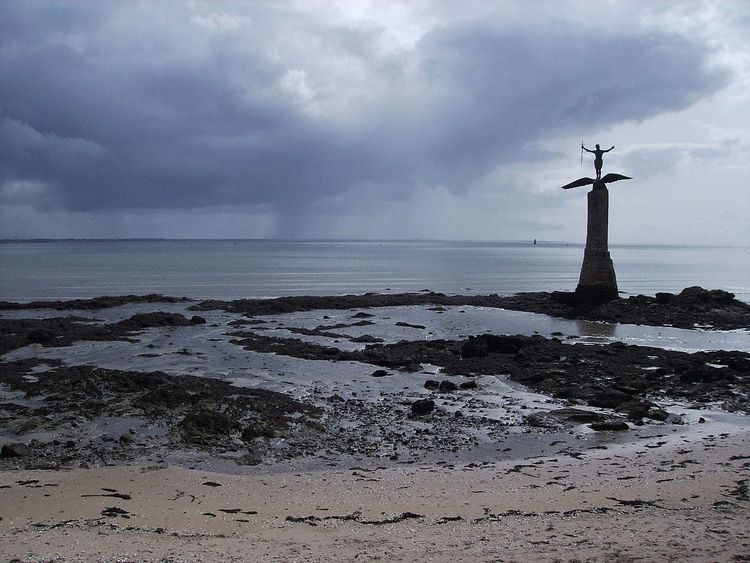
Facing the ocean where American reinforcements once landed, this monument marks the United States' entry into war against Germany in April 1917. Chosen as a landing port, Saint-Nazaire took in nearly 200,000 men within two years, whose works permanently reshaped the city. Made by American sculptor Gertrude Vanderbilt Whitney in the 1920s, destroyed by the occupiers and rebuilt in 1989, it pairs a spread-winged eagle with a sword-bearing man, symbols of friendship across the Atlantic.
Free entry
8 - Botanical Garden
Designed in the 1880s by a landscaper from Nantes, this English-style park sits on a former dune, facing the Loire estuary. Lawns, winding paths and over 300 species, including century-old trees, a rose garden and both Atlantic and Mediterranean plants, make for a pleasant stroll. It also holds a granite arch, a remnant of a vanished chapel, and a stele honouring sixteen people killed in 2003 in a construction accident during the assembly of the Queen Mary 2.
Free entry
9 - La Havane District
A survivor of a city more than 80 percent destroyed, this small quarter feels like another world within a few steps, thanks to its 19th-century architecture. Saint-Nazaire once dreamed big, looking seaward as its liners sailed off to Central America: its streets still bear names of faraway ports, Santander, Veracruz or Havana. Fine bourgeois townhouses in mixed styles, Norman, Basque, Art Nouveau or neoclassical, line the lanes, telling of the shipowners of old, far from the city's usual, more industrial image.
Free entry
10 - Saint-Nazaire Church
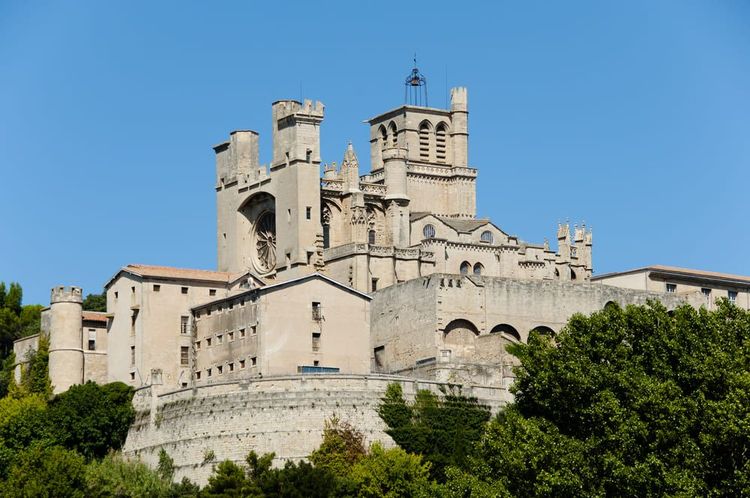
This town-centre church has lived three lives. The first dates to the 16th century, when a place of worship rose on the ruins of an old priory. In 1891, the town council replaced it with a larger, Neo-Byzantine building. The bombings of 1945 then wrecked it: on their return, residents prayed before a makeshift altar of planks, in the bitter cold. Rebuilt three times larger over the following decade, it now stands in stone and stained glass, open to all free of charge.
Free entry
11 - The Grand Café
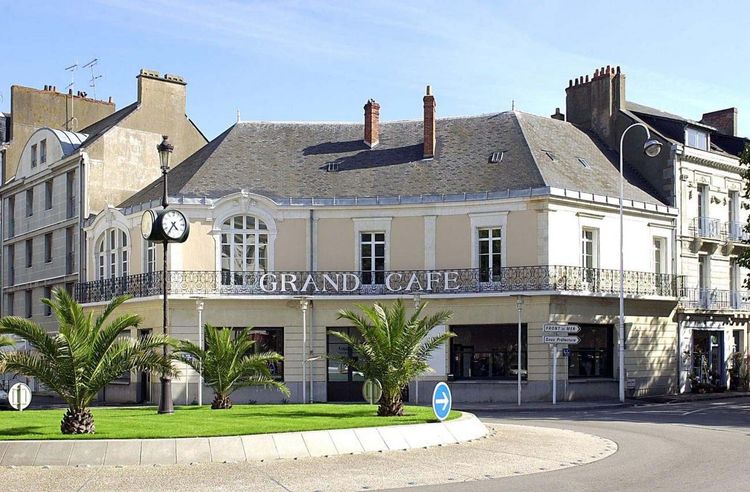
Opened in 1864 right in the town centre, this old café had no ordinary founder: its first owner was the father of Aristide Briand, the French lawyer and statesman, a repeat government minister under the Third Republic and winner of the 1926 Nobel Peace Prize. Auction room, design office, restaurant until 1969: the building changed purpose several times before the town bought it in 1994 and later turned it into a contemporary-art venue, labelled a nationally significant art centre by the Ministry of Culture.
Free entry
12 - Tintin in Saint-Nazaire
In one of Hergé's albums, The Seven Crystal Balls, Tintin, Snowy and Captain Haddock stop in Saint-Nazaire while tracking down Professor Calculus. A local fan club has installed six giant enamelled-metal comic panels, five metres tall, set up right where the story unfolds. Beyond the comic-book wink, they recall the era when the city led the way for crossings to Central America, making for a playful detour through its streets.
Free entry
13 - Submarine Base
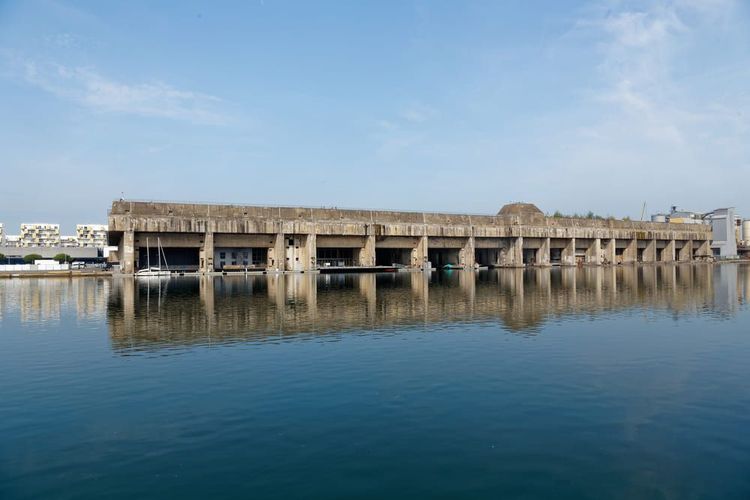
This mass of reinforced concrete went up in just sixteen months, in 1941, when Nazi Germany had five shelters of this kind built along the coast to keep its submarines safe from Allied raids. Three hundred metres long, topped with a roof built to withstand bombs, the fortress held fourteen pens, workshops, offices and quarters for around a hundred men, stationed there until May 1945. Left derelict after the war, it now hosts exhibitions and tourist activities, explored pen by pen.
Free to see from outside
14 - Escal'Atlantic
Between 1862 and the eve of the Second World War, Saint-Nazaire was a major transatlantic port, cradle of liners such as the Normandie or the France, launched thanks to entrepreneurs who drove the local shipbuilding boom. Opened in April 2000 inside the submarine base, Escal'Atlantic extends that saga over roughly 3,500 square metres: period objects, multimedia displays and rebuilt cabins immerse visitors in the daily life of travellers from another era, ending with a descent in a lifeboat.
Paid entry (about €15) · Allow 1 h
15 - Street Art in Saint-Nazaire
For several years now, artists from across the globe have been leaving their mark on the city's walls, during the summer festival Les Escales, which has gathered international creators every year since 2015. Along the streets, huge murals follow one another, signed by graffiti artists hailing from Chile, the United States, Australia or Brazil, each honouring their own culture. Among the standout pieces, the striking gaze of an Aboriginal boy, painted in 2018 by Australian artist Matt Adnate, turns the city into an open-air gallery.
Free entry
16 - Simone Veil Theater
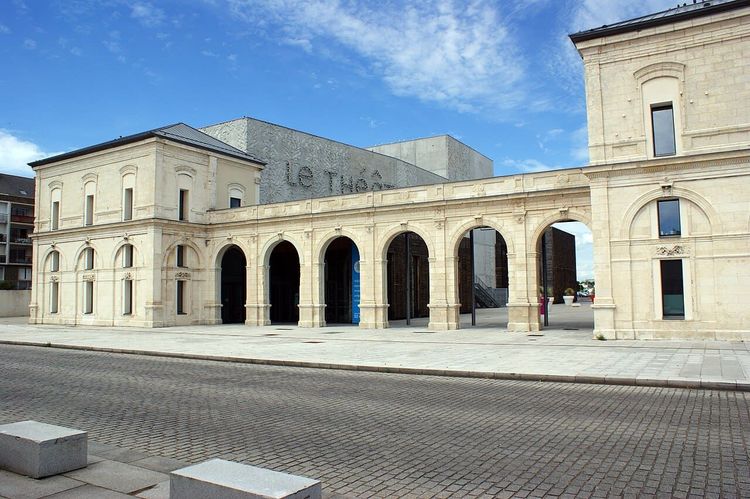
A railway station when it opened in 1867, at the end of the line connecting the capital to the Nazaire port, the building served trains until 1955. Bought by the town in 1978, it became a theatre around the turn of the 2000s, blending an older front with antique touches and a modern extension. Part of the national network of stages under the Ministry of Culture, it hosts dance, music and circus, and its first show, in 2012, already nodded to its railway past with a telling title.
Free entry
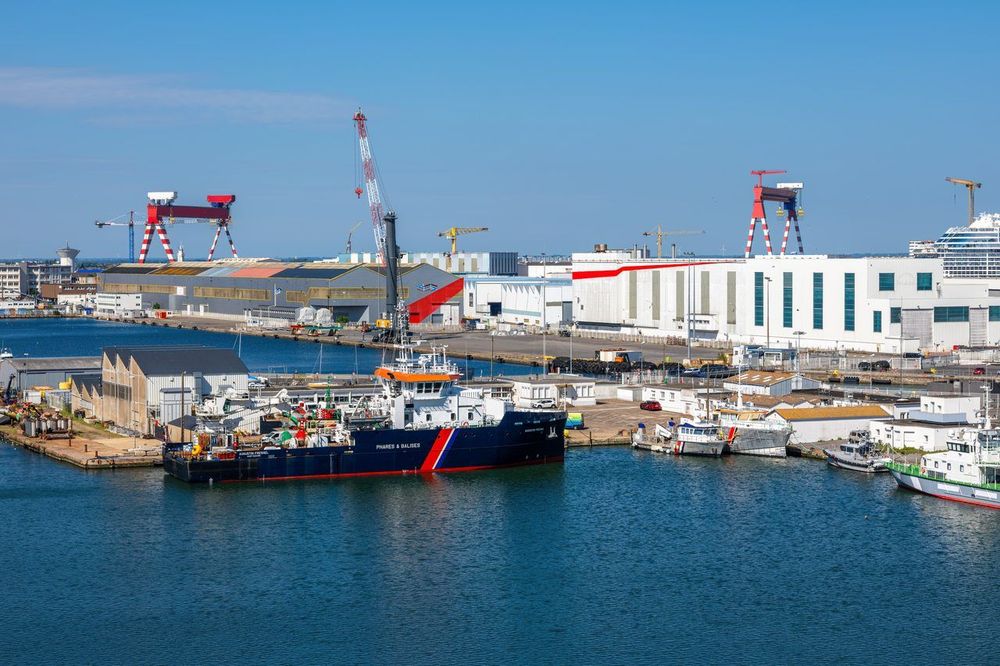
17 - Chantiers de l'Atlantique
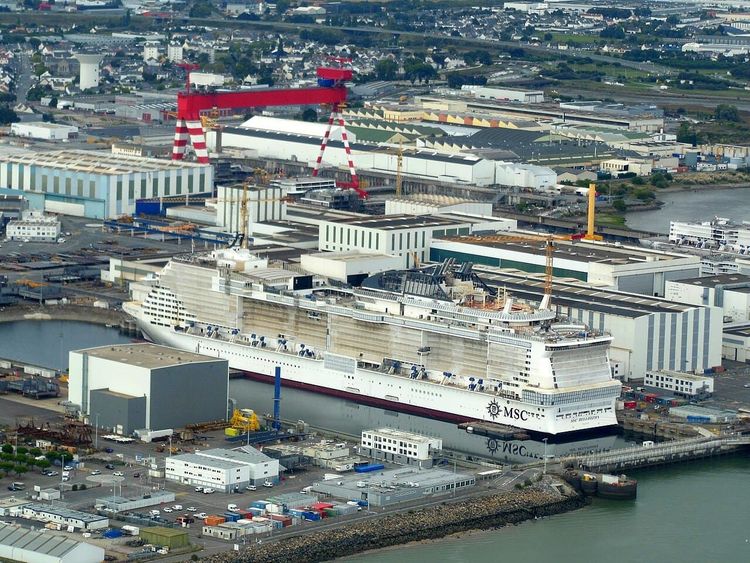
The ballet of cranes dominating the Saint-Nazaire skyline belongs to the Chantiers de l'Atlantique shipyards, which have built several of the planet's biggest vessels for more than 160 years, from the Normandie to the France. It all started in the 1800s, once Napoleon III had the port modernised into a pioneer of transatlantic crossings. Early in 1862, the Scot John Scott struck a deal with the Pereire brothers to build five liners, teaching a rural workforce used to timber the craft of metal hulls.
Paid entry (about €21) · Allow 2 h
18 - Fortified Lock
An extension of the German defences set up at the port from 1941, this concrete lock was built in 1943 and 1944 so submarines could reach open water more easily. Measuring 155 metres by 25, pierced with gun slits, it stands as a massive block designed to withstand attack. The site now holds two very different attractions: the museum ship Espadon, moored inside it, and a centre devoted to offshore wind energy.
Free to see from outside
19 - Espadon Submarine

The last of the Narval class, designed in France in the 1950s, this submarine served for twenty-five years on observation and training duties. It made history in May 1964: with 65 men aboard and its sister ship, it became the first French submarine able to cruise beneath the polar ice, past the Arctic Circle. Decommissioned in 1985, this 77-metre steel giant, moored in the fortified lock, has offered an immersive tour full of striking sound effects since its 2021 restoration.
Paid entry (about €13) · Allow 45 min
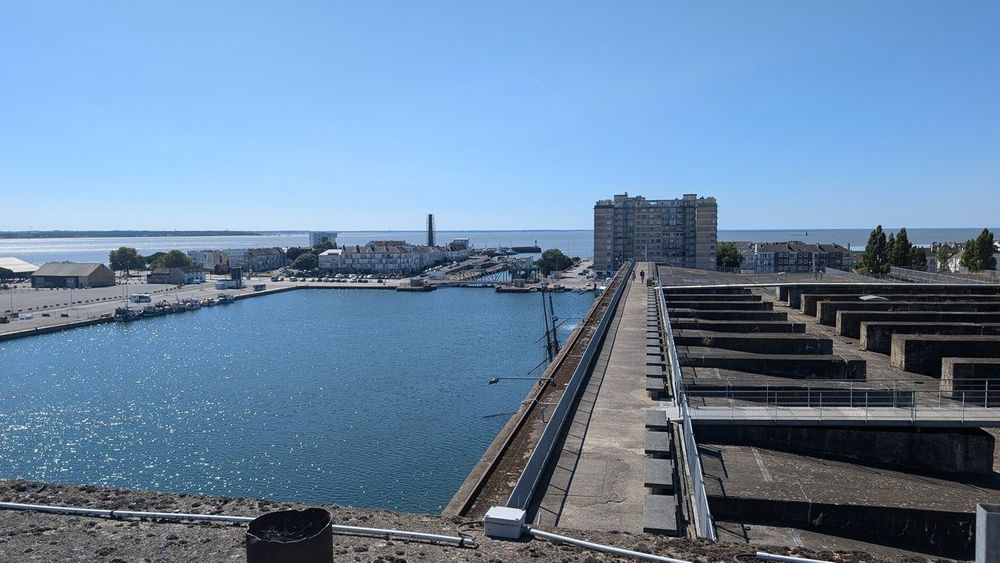
20 - Terrace of the Fortified Lock
Reached by a short flight of steps, the roof of the fortified lock opens onto a full panorama over the great suspension bridge, the harbour district and the shipyard basin. Facing the estuary, an old gun from the Campbeltown, the destroyer sacrificed in the 1942 raid, recalls the site's military past. On the other side, toward the Joubert lock, red and white geometric shapes spread over nearly 2 kilometres form an anamorphosis by Swiss artist Felice Varini, which only reads as one image from a single, precise spot.
21 - Ecomuseum
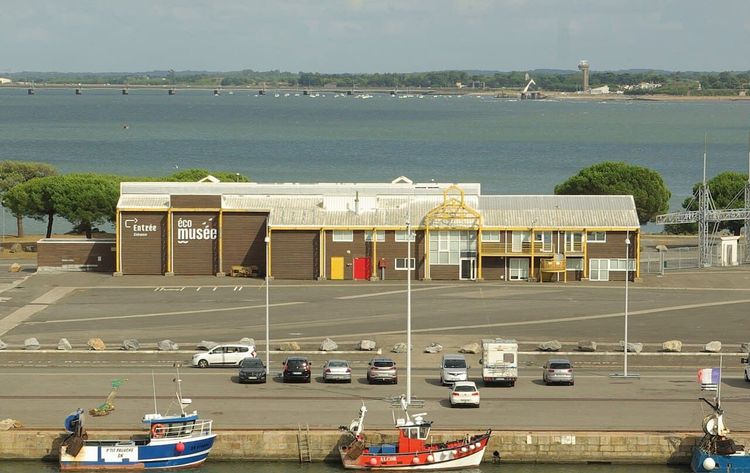
Born in 1988 out of a municipal wish, this museum traces, from prehistory to today, the story of the port, its industries and its moments of both joy and darkness. The birth of the harbour, the rebuilding after the wars and the rise of metalworking rank among the saga's main chapters, told through thousands of objects, models and documents. Lasting about 45 minutes, weaving permanent and temporary displays together, the visit shows how this city, rebuilt twice within a century, shaped its character.
Paid entry (about €6) · Allow 45 min
22 - Memorial to the Abolition of Slavery
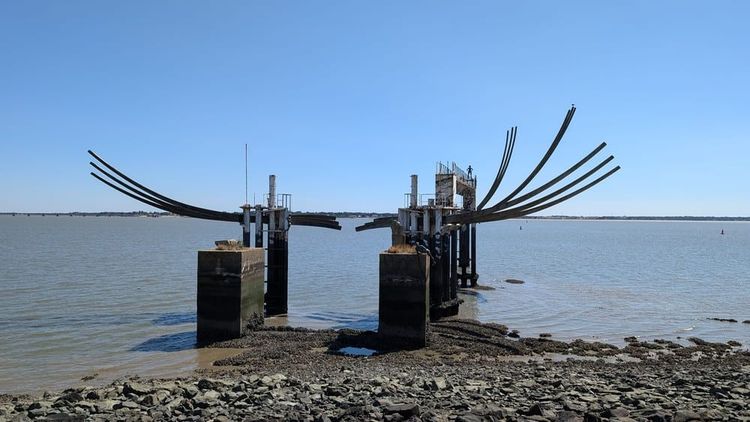
On the 10th of May, the nation remembers the slave trade and slavery, a day set in 2001 when France became the first country to call these practices crimes against humanity. Saint-Nazaire was the first mainland French town to raise a work honouring the victims. A sculptor from Réunion and Madagascar, Jean-Claude Mayo, shaped it in 1989: its frame recalls the timbers of a long-vanished slave vessel, where three bronze figures depict the stages toward freedom, from the chained captive to the man finally standing tall.
Free entry
What to do in Saint-Nazaire in 2 or 3 days?
Two and a half hours are enough to walk the 22 sights of central Saint-Nazaire, from Petit-Maroc to the Ecomuseum, over 6 km. With 2 or 3 days on hand, there's time to watch the working port and reach the beaches.
The next day, step inside what the route only passes by: Escal'Atlantic, in the submarine base, then the base's free rooftop terrace, facing the shipyard cranes. In the afternoon, set time aside for the guided coach tour of Chantiers de l'Atlantique along the slipways; failing that, walk on to Méan-Penhoët, the former workers' district built for the shipyard employees. If you leave that evening, our itinerary for a weekend in Saint-Nazaire helps plan these two days.
The third day heads out to Saint-Marc-sur-Mer, the beach where Jacques Tati filmed Les Vacances de Monsieur Hulot, then follows the Customs Officers' Path (GR34) along the coast. The full sequence, keeping indoor visits for a rainy day, is covered in our complete guide to visiting Saint-Nazaire in 3 days.
Which neighbourhoods does the tour cross?
The walk starts at the tip of Petit-Maroc, facing the estuary, then reaches the rebuilt town centre and the Ville-Port district around the submarine base.
It begins at Petit-Maroc, at the tip of the port, where the Vieux Môle lighthouse looks out over the Loire estuary and the Saint-Nazaire bridge, before following the start of the Customs Officers' Path towards the American War Memorial (stops 1 to 7).
Next comes the Botanical Garden, then the La Havane district and the rebuilt town centre, around Saint-Nazaire Church and the Grand Café (stops 8 to 12).
The last stretch enters the Ville-Port, around the submarine base and Escal'Atlantic, runs along Chantiers de l'Atlantique and the Fortified Lock, where the Espadon Submarine is open to visit, before returning towards the estuary past the Ecomuseum (stops 13 to 22).
How much does it cost to visit Saint-Nazaire?
Of the route's 22 stops, fourteen are freely open and three, including the submarine base, are seen from the outside. Among the others, three sites charge for entry, and Chantiers de l'Atlantique can only be approached on a guided tour:
- Escal'Atlantic, inside the submarine base, for €15;
- the Espadon Submarine, for €13;
- the Ecomuseum, for €6;
- the guided coach tour of Chantiers de l'Atlantique, for €21.
To visit several sites, the PASS Renversant, at €30 and valid for a year, gives access to Escal'Atlantic, the Espadon Submarine, the Ecomuseum and the EOL wind centre, among other sites in the city.
Information checked in November 2026 and subject to change.
Where to stop for a bite along the tour?
For lunch with a view, pick one of the tables facing the port and the basins, which the route skirts in its final stretch: seafood cooking, market-driven menus and a relaxed atmosphere. Oysters, small coastal catch and shellfish take pride of place, often cheaper than in La Baule.
For something simpler, head to the covered market: open several mornings a week, it's a good place to put together your own platter or grab a few galettes on the go. On the gastronomic side, a few addresses make a point of using Guérande salt and fish landed at Le Croisic.
What to do in Saint-Nazaire with children?
Saint-Nazaire works well with children, between a submarine to explore and sheltered beaches.
Inside the Espadon Submarine, you move compartment by compartment through narrow gangways, a very physical format that younger visitors tend to love, unless they're claustrophobic. The Botanical Garden, by the sea, rounds out the visit with its lawns, tall trees and play areas.
For swimming, Saint-Marc beach, more sheltered than the one in the centre, remains the simplest choice with young children: the water stays shallow near the shore, and a few nearby shops make it easy to put together a meal without planning ahead. Our guide to visiting Saint-Nazaire in 3 days covers the whole itinerary, day by day.
What should you know before visiting Saint-Nazaire?
The Botanical Garden, on the route, keeps its own opening and closing hours: if it's already shut by the time you pass, the itinerary continues via Avenue de Béarn and then Rue de Santander, without losing the thread of the walk.
To visit Chantiers de l'Atlantique, booking as early as possible is wise during busy tourist periods, ID in hand, since slots are limited. As for climate, Saint-Nazaire enjoys pleasant summers around 23°C and mild winters between 4°C and 10°C: June to September is the best period, July for the seafront events, spring for watching the shipyards in full swing under a changing coastal light.
What to see around Saint-Nazaire?
Saint-Nazaire also opens onto the hinterland: the Brière marsh, about twenty kilometres from the centre, is the second-largest marsh in France.
Four neighbouring walks complete the trip. Guérande, 18 km away, a medieval town ringed by ramparts, blends cobbled lanes and renowned salt marshes; Nantes, 49 km away, is best discovered on foot between the Dukes of Brittany castle and the quays of the Loire. Further on, Vannes, 60 km away, keeps its centuries-old ramparts, the half-timbered façades of the cathedral quarter and its harbour, and Auray, 73 km away, charms with its historic centre and the Saint-Goustan harbour.
Le plein d'inspirations
Explorez le monde en totale liberté, à pied au cœur des villes ou au fil des routes. Nos guides audios transforment chaque destination en une découverte culturelle immersive et unique.










FAQ for visiting Saint-Nazaire
When is the best time to visit Saint-Nazaire?
The ideal time to discover Saint-Nazaire runs from June to September, when the temperate oceanic climate offers optimal conditions for exploring the town. Summer temperatures pleasantly hover around 23°C, perfect for enjoying the beaches and the customs officers' path. July proves particularly lively with numerous festivities on the seafront. Spring is also an excellent choice, notably for watching the activity of the shipyards under a shifting and spectacular maritime light. Winters stay mild, ranging between 4°C and 10°C, allowing visits all year round, even if seaside activities are naturally more limited.
How many days do you need to visit Saint-Nazaire?
Two to three days are the ideal length of time to fully appreciate Saint-Nazaire. A first day will let you explore the town centre, the submarine base and the reinvented seafront. The second day will be perfect for discovering the shipyards, Escal'Atlantic and walking the customs officers' path along the secret beaches. If you have an extra day, you can deepen your discovery of the industrial heritage, visit the museums or simply enjoy the beaches. Walkers will particularly appreciate taking their time to grasp the unique atmosphere of this port city, between industrial heritage and ocean breeze.
Where can you park in Saint-Nazaire?
Saint-Nazaire has many parking solutions suited to visitors. The town centre offers several public car parks, notably near the submarine base and the seafront, generally paid during the day. The car parks near the beaches often remain free, especially outside the summer season. For a visit to the historic centre and the main monuments, favour the central car parks that then let you discover everything on foot. On-street parking is possible but regulated depending on the zone. Remember to check the display panels to find out the pricing conditions, which vary according to the neighbourhoods and the times of year.
How do you get around in Saint-Nazaire?
Saint-Nazaire is easy to get around thanks to its well-organised transport network. The urban buses efficiently serve the main neighbourhoods and tourist sites, with regular lines linking the town centre to the beaches and the industrial areas. Walking remains the ideal way to explore the historic heart and the seafront, as the distances between the major attractions are relatively short. Cycling is an excellent alternative, with dedicated bike lanes, notably along the coast. Rental services are generally available in the town centre. For longer journeys or towards the shipyards, public transport or a private car remain recommended.
What can you do in Saint-Nazaire for free?
Saint-Nazaire offers many free activities to discover its unique character. Stroll along the redeveloped seafront and admire the impressive silhouette of the Saint-Nazaire bridge. The beaches invite you to relax and the customs officers' path offers a magnificent coastal walk. The exterior of the submarine base is worth the detour for its monumental architecture. Watch the port activity from the quays and let yourself be impressed by the view of the shipyards. The local market lets you immerse yourself in the Nazairian atmosphere. The historic districts rebuilt after the war reveal a singular architecture to discover on an enriching urban walk.
What are the absolute must-see sights in Saint-Nazaire?
The emblematic sites of Saint-Nazaire tell the fascinating history of this port city. The submarine base, a concrete colossus converted into a cultural venue, is a must-see visit. Escal'Atlantic plunges you into the world of transatlantic liners. The shipyards, where the largest ships in the world are born, impress with their gigantic scale. The reinvented seafront offers a pleasant walk with views over the estuary. The Saint-Nazaire bridge is worth the detour for its majestic structure. For a complete, narrated discovery of these emblematic places, the Ryo audioguide offers a dedicated route that accompanies you in your exploration of the town.
How do you visit the Saint-Nazaire shipyards?
The Saint-Nazaire shipyards, birthplace of the largest ocean liners in the world, are generally visited as part of organised tours. Access to the facilities requires prior booking for reasons of safety and industrial activity. The guided tours allow you to discover the different stages of ship construction and to get as close as possible to these sea giants under construction. The duration varies depending on the circuits offered. Certain times of the year offer special opportunities during ship launches. To round off this experience, Escal'Atlantic offers an immersion in the history of Nazairian shipbuilding through permanent exhibitions accessible all year round.
Is Saint-Nazaire part of Brittany?
Saint-Nazaire belongs administratively to the Pays de la Loire region and the Loire-Atlantique department, not to present-day administrative Brittany. However, this question raises a fascinating historical and cultural debate. Historically, Loire-Atlantique was part of the Duchy of Brittany until 1941. Many people from Saint-Nazaire retain Breton cultural ties, visible in certain traditions and the local architecture. The town is geographically located at the mouth of the Loire, a strategic position between Breton and Ligerian influences. This multiple identity enriches the character of Saint-Nazaire, an open port city that has managed to develop its own personality, between Breton maritime heritage and Ligerian industrial dynamism.
Can you visit the Saint-Nazaire submarine base?
Yes. This vast block of concrete, built during the Second World War to shelter German submarines, remained standing because it proved impossible to demolish, and the city has gradually given it a new life. You can walk freely along the pens, and an outside ramp leads up to the landscaped roof terrace: the view stretches over the harbour, the shipyards and the Loire estuary.
Inside, the building now houses cultural venues, exhibitions and performance spaces, as well as the entrance to the submarine Espadon moored in the neighbouring lock. Together they give a very tangible reading of the town's history, between destruction and reconstruction. The Ryo audio guide offers a dedicated Saint-Nazaire route linking the base, the port and the seafront.
Where can you swim in Saint-Nazaire?
The town lines up a long succession of beaches between the port and the Chémoulin headland, linked by a coastal path. On the town side, Monsieur Hulot beach, made famous by the cinema, and the beach at Villès-Martin are the easiest to reach on foot or by bus. Heading west, Sainte-Marguerite, Porcé and Saint-Marc alternate sheltered coves, rocks and wider stretches of sand.
Swimming is supervised in high season at the main sites, and the tides uncover broad foreshores that are ideal for gathering shellfish. Out of season, these beaches remain lovely for walking: the old customs officers' path follows the shoreline, offering views over the estuary and, on a clear day, across to the opposite bank.
What to do in Saint-Nazaire over a weekend or 3 days: which itinerary covers the port, beaches and coastline?
With two days, spend the first on industrial heritage: the submarine base and its rooftop terrace, Escal'Atlantic, the Ville-Port, and a view over the shipyards (guided tours by reservation). The second day is for the seafront, the beach and the 3,356-metre Saint-Nazaire–Saint-Brevin bridge.
With an extra day, add the coastline and excursions to Guérande or La Baule. Everything can be done on foot or by bike from the station, and Nantes is only 40 to 50 minutes away by train.
To plan your stay, read the 2-day itinerary between concrete and steel and the 3-day plan covering the port, beaches and coastline.
Vos commentaires, idées et suggestions
Aucun avis pour le moment