© Shutterstock
 Votre guide Ryo
Saint-Nazaire in 3 Days: Complete Guide to the Submarine Base, Beaches and Brière (2026)
Saint-Nazaire isn't known as a tourist stop. Yet climb onto the roof of the submarine base on a Saturday morning, facing the shipyard cranes, and the picture flips within seconds: a city almost entirely razed in 1945 has become one of the most spectacular ports on the Atlantic coast. Visiting Saint-Nazaire in 3 days lets you hold both sides together, the industrial and military heritage on one hand, the beaches and gardens on the other, without ever rushing. The Ryo audio-guided tour of Saint-Nazaire traces this thread in 23 commented stops between concrete, steel and sea spray, so you miss nothing.
The programme comes down to a few concrete landmarks: a free 300-metre-long rooftop terrace set on a World War II bunker, a real 78-metre submarine you explore compartment by compartment, the beach where Jacques Tati filmed Monsieur Hulot's Holiday, released in 1953, and a city rebuilt within a decade after losing 85% of its buildings. Three days are enough to string these experiences together without hurry, with a real break by the water on the second day and a nature outing on the Douaniers path to finish.
Why Visit Saint-Nazaire in 3 Days?
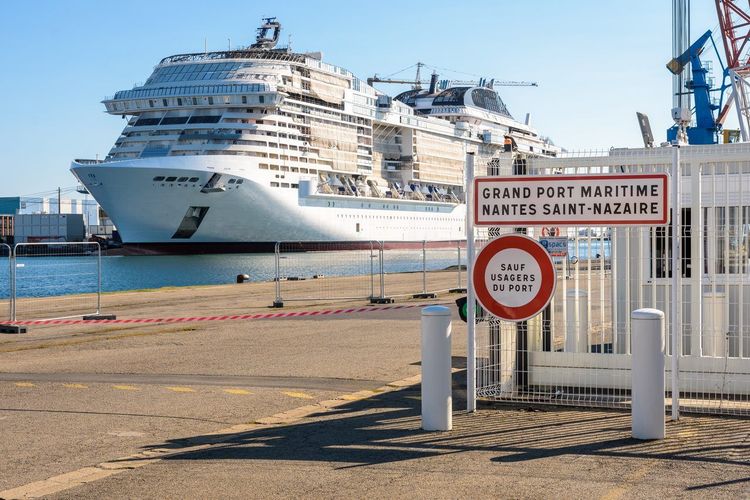
Saint-Nazaire lives first and foremost from its port. The Loire estuary widens here into one of the great industrial basins of the Atlantic coast, with the Chantiers de l'Atlantique assembling some of the world's largest cruise ships a few hundred metres from the city centre. You don't visit Saint-Nazaire the way you visit a museum city: you come to watch a living port at work, with its cranes, its hulls under construction and its container ship traffic.
This port identity has an unexpected flip side: the city has very little old heritage. Bombed and then besieged until May 1945, it had to be rebuilt almost entirely in the 1950s, which gives it a face unique in France today, made of rhythmic concrete façades, open blocks and clear perspectives towards the basin. It is an openly embraced 20th-century heritage that few French cities can claim with such coherence.
Three days let you cover this double identity without spreading yourself too thin: one day for the industrial and military waterfront (submarine base, submarine, shipyards), one day to breathe between beach and garden, and a last one to head out to Saint-Marc-sur-Mer and the coast. You can swap the order depending on the weather, but keeping the indoor visits for a rainy day remains the most profitable reflex.
Day 1: The Port and the Submarine Base
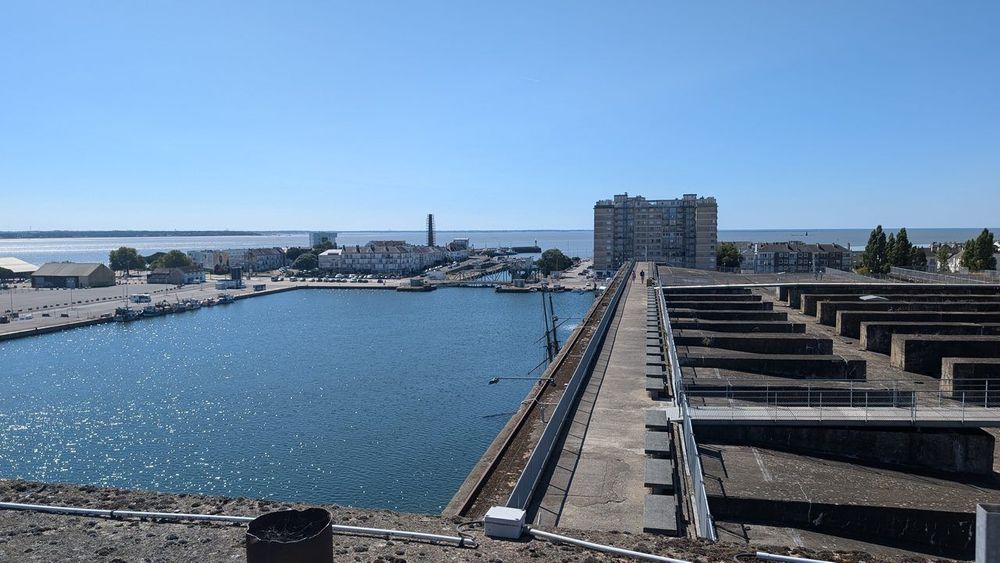
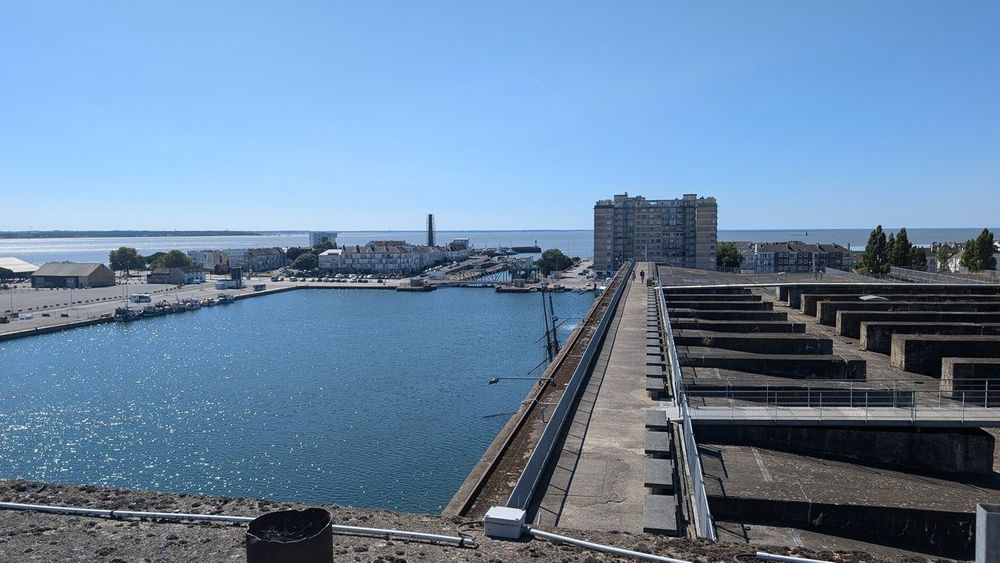
Start early, because the submarine base structures the whole day. This German bunker, 300 metres long, 130 metres wide and 18 metres high, built between 1941 and 1943 to shelter U-boats, withstood dozens of Allied bombings without giving way, while the city around it was 85% destroyed. Today its rooftop terrace is open and free, with a direct view over the basin, the cranes of the Chantiers de l'Atlantique (Avenue de la Vieille Ville, 44600 Saint-Nazaire, rated 4.2/5 on Google from 103 reviews) and, depending on the period, the hull of a cruise ship under construction. Go up as soon as access opens: the low morning light over the estuary is worth the detour.
Inside the base, Escal'Atlantic recreates the world of the great transatlantic liners that made the port famous, from the Normandie to the France: corridors, first-class cabins, promenade deck and engine room, over several levels that recreate the atmosphere of a crossing. Allow 1.5 hours for the visit, a little more if you linger over the models and period objects.
Right next door, moored in the fortified lock, the Espadon submarine can be explored from the inside, compartment by compartment, with an audioguide included in the ticket. This 78-metre vessel was the first French Navy submarine to dive under the ice pack, in May 1964 in the Norwegian Sea, with 65 men on board. It has been open to the public in Saint-Nazaire since 1987, and the narrowness of the passageways gives a very concrete idea of life underwater. Children love this very physical format, as long as they aren't claustrophobic.
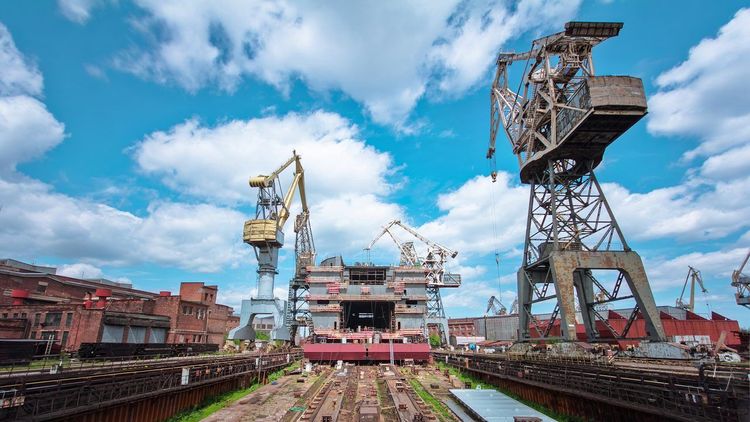
In the afternoon, set aside time for the Chantiers de l'Atlantique. The site is not freely accessible, but Saint-Nazaire Renversante, the organisation that manages the city's visitor sites, runs guided coach tours that run alongside the slipways and the Joubert lock, where the liner Normandie was completed in the 1930s. This is where the world's largest cruise ships come out today, and seeing a hull several hundred metres long just a few metres away remains impressive. Book this slot several days in advance in high season: departures are limited and go quickly.
If time is short, these four sites remain the absolute must-sees of Saint-Nazaire and alone justify a full day. To keep the thread between them, the Ryo audio guide to Saint-Nazaire devotes separate stops to the base, the panoramic roof and the surroundings of the shipyards: 23 audios and 2.5 hours of listening over 6 km, enough to link the sites without passing the same spot twice.
Day 2: The Seafront, the Beach and the Jardin des Plantes
After a day of concrete, change the pace. Saint-Nazaire's seafront runs along the estuary for several kilometres, between seaside villas, reconstruction-era buildings and an open view of the mouth of the Loire. The pedestrian promenade is completely flat, ideal on foot or by bike.
The beach stretches just below. The sand is fine, swimming is supervised in season, and the sight of cargo ships heading up the estuary offshore gives your swim a backdrop few seaside resorts can offer. Beyond, some twenty beaches and coves line the municipality's coast as far as Saint-Marc-sur-Mer.
Around midday, take a break at the Jardin des Plantes, set by the sea between rue de Pornichet and boulevard du Président-Wilson. Created in 1886 by the landscape architect François Aubry, this English-style garden unfolds lawns, tall trees and winding paths down to the beach, and its original gates have stood for nearly 140 years. Redeveloped in the 1990s when the city chose to turn back towards the sea, it is the ideal spot for a shaded picnic, with playgrounds for children.
End the day heading towards the Saint-Nazaire bridge (Route du Pont, 44600 Saint-Nazaire, rated 4.4/5 on Google from 1,757 reviews), visible from almost every high point in the city. Opened in 1975 and toll-free since 1994, it links Saint-Nazaire to Saint-Brevin-les-Pins over more than 3.3 kilometres, which made it one of the longest bridges in France when it was built. You can't cross it on foot, but watching it from the seafront or from the roof of the submarine base at sunset remains one of the most photographed moments of the trip.
Between the beach and the garden, slip in a listening break: the Ryo audioguide bridges these two atmospheres, with anecdotes about the reconstruction led by the architect Noël Le Maresquier, who redrew the city almost from scratch.
Day 3: Saint-Marc-sur-Mer and the Douaniers Path (GR34)
The third day moves away from the centre to reach Saint-Marc-sur-Mer, a seaside district about 6 km to the west, still famous thanks to Jacques Tati. It was on this beach, in front of the Hôtel de la Plage, that the director filmed Monsieur Hulot's Holiday, and a statue of the character still gazes at the sea from the sand. The atmosphere is clearly more holiday resort than the port-focused Saint-Nazaire of the first day, with its old villas and small marina.
From the beach, the Douaniers path (GR34) runs along the coast to the west, towards Pornichet and La Baule, and to the east towards the centre. The route alternates rocky points, coves and overhanging stretches, with views that change at every bend. A 5 to 7 km section is enough for a half-day walk, with no special equipment: good shoes, water, and an eye on the tide times if you plan to go down into the coves.
Prefer cycling? Rental shops in town and trails along the coast let you cover more ground in less time. As a family with young children, the more sheltered Saint-Marc beach remains the simplest base: fine sand, shallow water near the shore, and enough shops nearby to improvise a lunch without logistics.
To extend your time on the water, the neighbouring coves are well suited to paddleboarding and kayaking, especially in the calm morning hours. And if you feel like passing through the port again before hitting the road, the short version of the Ryo audio-guided tour loops in 1.5 hours over 3.1 km around the base, the Espadon, the fortified lock and the shipyards, with 16 audios: perfect for a late morning or a final afternoon.
Historical Heritage: From the Industrial Era to Reconstruction
Understanding Saint-Nazaire means knowing three eras that physically overlap in the city. The first, the industrial era, starts in the mid-19th century with the opening of the floating dock, the transatlantic lines and then the first shipyards, which turned a fishing village into a working-class city oriented towards the great liners.
The second era, the Second World War, shifts the city into another register. The Germans built the submarine base between 1941 and 1943 to make it a strategic foothold on the Atlantic. In March 1942, the British raid of Operation Chariot targeted the Joubert lock, the only dock capable of receiving the battleship Tirpitz. The city then became a priority target for Allied bombing, which destroyed 85% of its buildings without ever seriously damaging the base itself, so thick is its concrete slab. A lesser-known fact: the "Saint-Nazaire pocket" held by the German garrison only surrendered on 11 May 1945, three days after Germany's official capitulation.
The reconstruction, the third phase, spans the entire 1950s. Chief architect Noël Le Maresquier redrew the city on a geometric grid, with concrete buildings marked by visible frames, in a spirit close to what Auguste Perret was doing in Le Havre at the same time. The result is a homogeneous city centre, sometimes judged austere, but which today constitutes a rare testimony of post-war urban planning in France.
Since the 1990s and 2000s, a cultural revival has transformed the Ville-Port district and the base itself, which now hosts the LiFE, a contemporary art space, and the VIP concert hall in its bays. To go further, the Écomusée de Saint-Nazaire (Avenue de la Vieille Ville, 44600 Saint-Nazaire, rated 4.1/5 on Google from 651 reviews) (6 euros) completes the visit with collections devoted to the port, the shipyards and daily life during the Occupation, a few minutes' walk from the submarine base.
It is this narrative thread, industrial port then besieged pocket then reconstruction, that the Ryo audio tour unfolds on site, stop after stop, rather than summarising it in a museum room.
Where to Stay in Saint-Nazaire
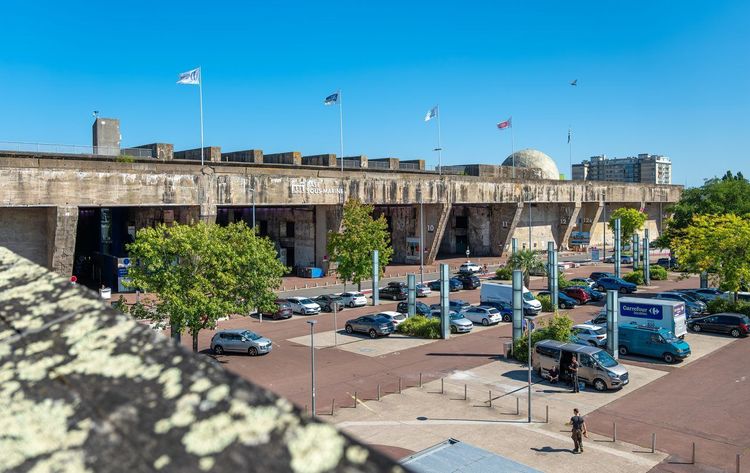
Two areas clearly stand out. The city centre and the Ville-Port district, around the submarine base, concentrate most of the hotels and have the advantage of being within walking distance of all the day-one sites. It's the most practical choice if you don't have a car, with direct access to the station and bus lines.
Saint-Marc-sur-Mer, on the other hand, is better if you want to sleep with your feet in the sand and favour the seaside atmosphere. There are a few beachfront hotels and residences, quieter in the evening, but they require a bus or car trip to reach the centre. It's a good compromise if your stay is more focused on day 3 (beach, GR34) than on the industrial visits.
In between, a few places along the seafront let you keep a foot in each world, with a view of the estuary when you wake up. Book early in July and August: the hotel offering remains modest compared to La Baule, about twenty minutes by road, where the choice is much wider.
Where to Eat: Restaurants and Local Specialities
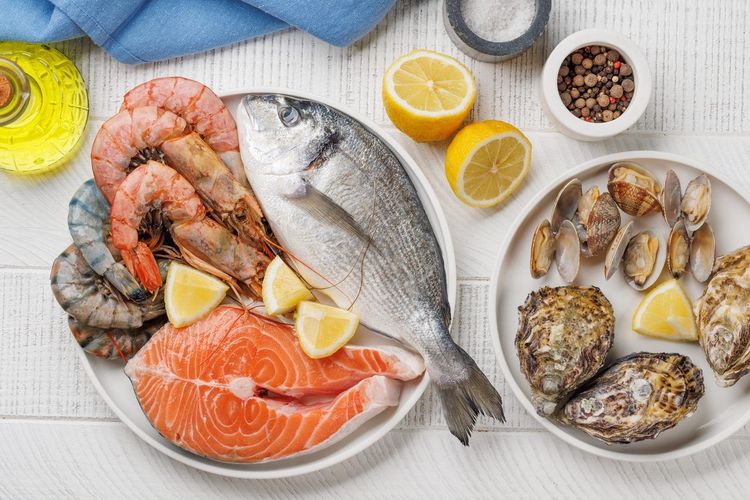
As for food, Saint-Nazaire makes the most of its estuary location. Around the basin, in the Ville-Port district, brasseries and fish restaurants dominate, with menus centred on local coastal produce: sole, sea bass, grilled sardines and seafood platters.
In Saint-Marc-sur-Mer, the offering narrows to a few more casual beachfront places, ideal for a quick lunch between two swims: crêperies, mussels and fries and takeaway sandwiches are more than enough after a morning on the Douaniers path.
To taste the peninsula's produce, look for oysters and Guérande salt on menus: the salt marshes, about twenty minutes away, feed a good part of the local gastronomy. The covered market in the city centre also lets you put together a picnic to take to the Jardin des Plantes or the beach. And don't leave without trying a galette-saucisse or a kouign-amann, a reminder that historic Brittany begins here.
How to Get to and Around Saint-Nazaire
By train, Saint-Nazaire has its own station, linked to Nantes in about 45 minutes and to Paris-Montparnasse in just under 3 hours by direct TGV, or with a connection in Nantes depending on the timetable. It's the simplest option if you don't plan to rent a car on site.
By car, allow about 50 minutes to 1 hour from Nantes via the N165, and the same from Nantes Atlantique airport, the closest. From the south bank of the Loire, the Saint-Nazaire bridge lets you arrive directly via Saint-Brevin-les-Pins.
Once there, the city is easy to get around. The STRAN bus network, with its high-frequency hélYce lines, serves the whole urban area, including Saint-Marc-sur-Mer. For trips between the day-one sites, all concentrated around the submarine base, walking remains the fastest solution: no trip takes more than 15 minutes.
Cycling is another relevant option, with rental shops in the city centre and routes running along the seafront to Saint-Marc-sur-Mer, a trip of about twenty minutes that avoids the vagaries of bus timetables.
When to Go and Practical Info (Prices, Budget)
The ideal period runs from April to September, when the beach and the Douaniers path become truly pleasant. July and August guarantee the best weather but also the most crowds at the indoor sites, where the guided tour slots at the Chantiers de l'Atlantique go quickly. Spring and early autumn offer a good compromise, with less crowded visits and more flexible hotel rates.
As for budget, here are the 2026 adult prices for the sites run by Saint-Nazaire Renversante: Escal'Atlantic 15 euros, Espadon submarine 13 euros, Écomusée 6 euros, and 21 euros for the guided tour of the Chantiers de l'Atlantique. Ages 4-17 pay half price. If you plan to do everything, the Pass Renversant (30 euros adult, 15 euros junior) gives unlimited access for one year to Escal'Atlantic, the Espadon, the Écomusée and the EOL centre devoted to offshore wind power. The submarine base rooftop terrace, for its part, is free all year round.
Opening hours vary by season: sites open in February and close for part of the winter outside school holidays, with closing days in low season. Check the shipyard tour slots before fixing your schedule, as they are more limited than the others. Bank cards are accepted everywhere, but bring a little cash for the market and some shops in Saint-Marc-sur-Mer.
Nearby: Extending Your Stay from Saint-Nazaire
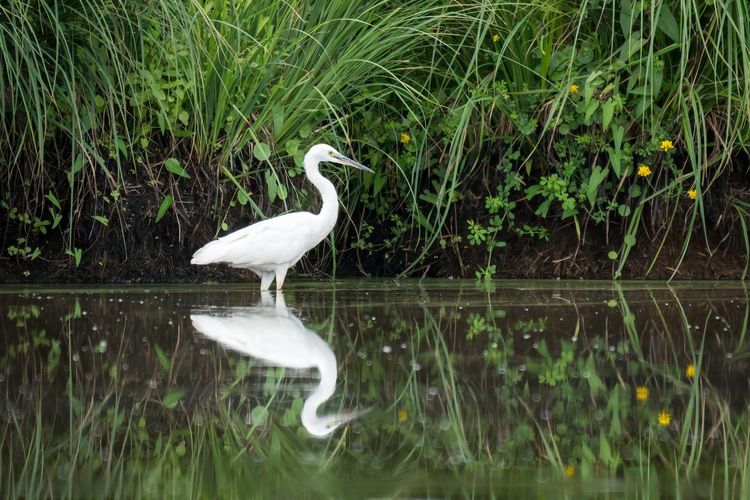
If you have an extra day, the Brière Regional Nature Park opens up less than 20 minutes from the centre. This 56,500-hectare territory contains 21,200 hectares of wetlands, making it the second-largest marsh in France after the Camargue. It can be explored on foot or by chaland, the traditional flat-bottomed boat, among thatched cottages and canals, an atmosphere radically different from that of the port.
To the west, La Baule and its great sandy bay complement a beach-focused stay well, 15-20 minutes by road from Saint-Marc-sur-Mer. Guérande, with its fortified medieval town and its salt marshes, can be visited in half a day and lets you bring back fleur de sel directly from the salt workers.
To go further, the region also opens towards the Loire Valley and its châteaux, about two hours away by road. The Ryo audio-guided tour of the Loire châteaux lets you extend your stay inland if you have a few extra days planned, with the same stop-by-stop listening principle as the Saint-Nazaire tour.

FAQ
How many days do you need to visit Saint-Nazaire?
Three days cover the essentials: the port and the submarine base, the seafront and the Jardin des Plantes, then Saint-Marc-sur-Mer and the Douaniers path. Two days are enough for an overview if you focus on the indoor visits and the beach closest to the centre.
How do you get to Saint-Nazaire?
By train, the city has its own station, about 45 minutes from Nantes and just under 3 hours from Paris. By car, allow about 1 hour from Nantes or Nantes Atlantique airport via the N165.
Where should you stay in Saint-Nazaire?
The city centre and the Ville-Port district suit you if you prioritise sightseeing, with all the day-one sites within walking distance. Saint-Marc-sur-Mer is better for a stay focused on the beach and the coastal path.
What is the best time to visit Saint-Nazaire?
From April to September to enjoy the beach and the GR34. July and August offer the best weather but also the biggest crowds on guided tours, which should be booked in advance.
What are the prices for visiting the submarine base and Escal'Atlantic?
The submarine base rooftop terrace is free. In 2026, Escal'Atlantic costs 15 euros per adult and the Espadon submarine 13 euros, with half price for ages 4-17. The Pass Renversant at 30 euros gives unlimited access for one year to the four visitor sites.
How do you get around Saint-Nazaire without a car?
The STRAN bus network serves the whole urban area, including Saint-Marc-sur-Mer. The city-centre sites are easy to reach on foot, and cycling is a good option for getting to the coast.
Saint-Nazaire in 3 Days: Our Conclusion
Three days in Saint-Nazaire are enough to understand why this city, long seen as a mere industrial stop, deserves a longer look. Between history-laden concrete, unspoiled beaches and a marsh close by, the programme changes register every day without ever losing its common thread.
To keep that thread in mind on site, without juggling several paper guides, start the Ryo audio-guided tour of Saint-Nazaire: 23 audios to listen to at your own pace, from the roof of the submarine base to the shipyards, between passing container ships.