






Walk
Into the world of the silk weavers
Lyon, France
Walk
Into the world of the silk weavers
Lyon, France
4.4 km
Distance
2h00
Durée
17
Audios
Loop
Parcours
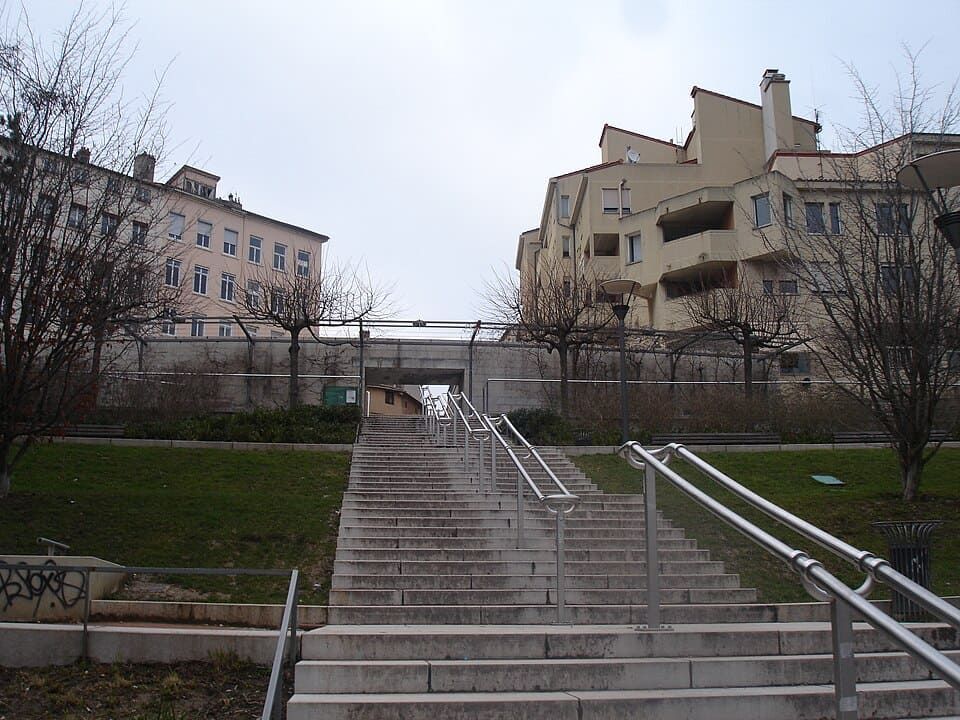
©Frachet CC BY-SA 3.0. <https://creativecommons.org/licenses/by-sa/3.0/deed.fr>via Wikipedia Commons
The Lyon audio-guided tour invites you to a break at the garden of the Grande-Côte, a terraced esplanade prized by the inhabitants of the Croix-Rousse.
This esplanade laid out in levels, paved with Montalieu limestone, is a meeting place appreciated by the inhabitants. Its plots of greenery host black, white, plane-leaved and paper mulberry trees, witnesses of the important silk industry of the Croix-Rousse: the mulberry is indeed the main food of silkworms. These trees, native to Asia, recall that silk was discovered in China nearly five thousand years ago, and that its trade, long kept secret, gave birth to the famous Silk Road connecting Asia to Europe.
The garden of the Grande-Côte offers a green and peaceful terraced stop, with its mulberry trees that recall the silk past of the Croix-Rousse. It is a place of relaxation appreciated by the inhabitants, which combines greenery, history and viewpoints over the city. A pleasant interlude along the walk on the hill.
The garden of the Grande-Côte is on the slopes of the Croix-Rousse, in Lyon. A public terraced garden, it can be walked freely, according to opening hours that may vary with the season; it includes levels and stairs.
Because the mulberry feeds the silkworms; it recalls the importance of the silk industry in the Croix-Rousse.
In China, nearly five thousand years ago; its trade gave birth to the Silk Road connecting Asia to Europe.
Aucun avis pour le moment
