





Walk
Among Stones and Great Wines
Beaune, France
Walk
Among Stones and Great Wines
Beaune, France
2.5 km
Distance
1h10
Durée
20
Audios
Loop
Parcours
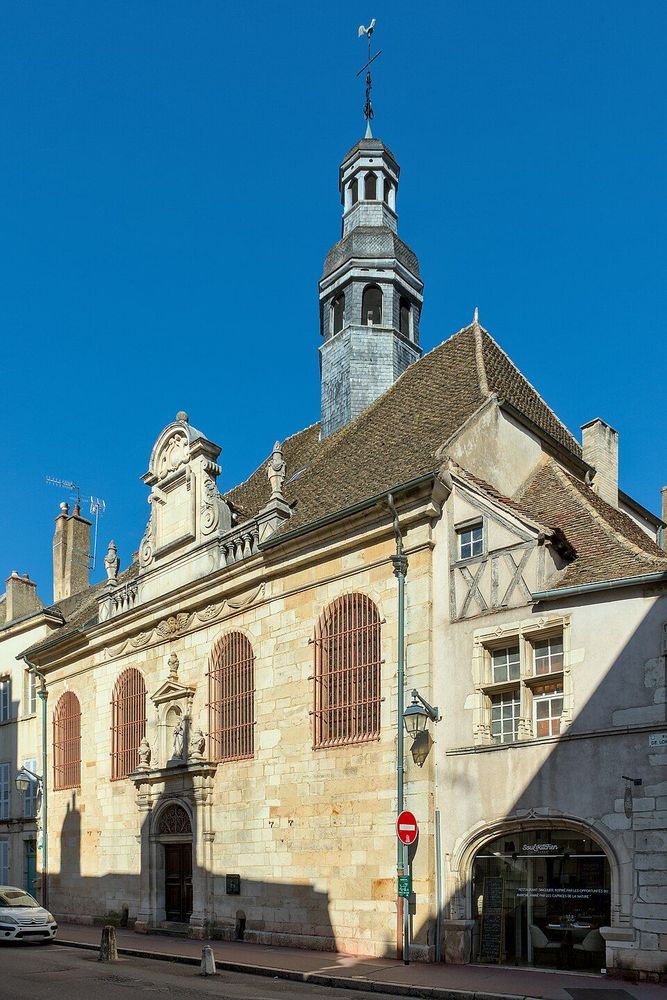
©Benjamin Smith - CC BY-SA 4.0. https://creativecommons.org/licenses/by-sa/4.0/
The Beaune audio-guided tour stops you before the Hospice de la Charite, a discreet place but deeply rooted in the town's history of solidarity. Founded in the 17th century by a couple of benefactors, it bears witness to a long tradition of welcoming the most destitute.
Founded in 1645 by Antoine Rousseau and Barbe Deslandes, the Hospice de la Charite was intended to welcome the elderly, the poor and orphans, in a period still marked by epidemics and great hardship. Unlike the famous Hotel-Dieu, intended for the sick, it was devoted to welcoming able-bodied destitute people, particularly women. The complex is organised around an inner courtyard, in the sobriety proper to this kind of establishment.
The Hospice de la Charite, with its inner courtyard and plain buildings, illustrates the hospital and charitable history of Beaune, an extension of that of the Hospices. The place, which today continues a vocation of welcome and care, can be seen from the outside with respect, keeping in mind the spirit of charity that presided over its foundation.
The Hospice de la Charite is in the centre of Beaune. As the building continues a function of welcome and care, it is not a tourist visit site: its facade and entrance can be seen from the street, with discretion and respect for the place. To learn more about the town's hospital history, the Hotel-Dieu offers a complete tour.
It was founded in 1645 by Antoine Rousseau and Barbe Deslandes, to welcome the elderly, the poor and orphans.
The Hotel-Dieu cared for the sick, while the Hospice de la Charite mainly welcomed able-bodied destitute people, particularly women.
Aucun avis pour le moment
