





Walk
Among Stones and Great Wines
Beaune, France
Walk
Among Stones and Great Wines
Beaune, France
2.5 km
Distance
1h10
Durée
20
Audios
Loop
Parcours
Shutterstock
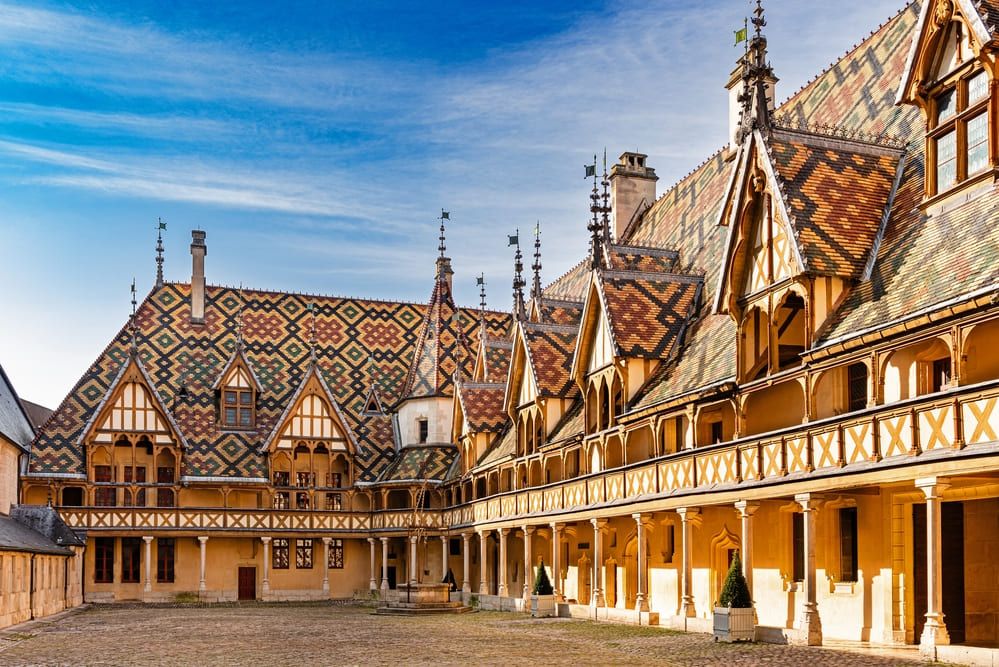
The Beaune audio-guided tour leads you before one of the treasures of Burgundian heritage: the Hospices de Beaune, also called Hotel-Dieu. Behind a plain facade lies a masterpiece of Flamboyant Gothic architecture, born of a vocation of care and charity.
The Hospices were founded in 1443 by Nicolas Rolin, chancellor of the Duke of Burgundy, and his wife Guigone de Salins, to welcome and care for the most destitute, in a period marked by poverty and epidemics. A hospital for centuries, the Hotel-Dieu bears witness to an exceptional charitable commitment and a constant concern for the well-being of the sick, in a setting designed for light and harmony.
The spectacular inner courtyard is lined with timber-framed galleries, carved dormers and pointed gables, crowned by the famous Burgundian glazed-tile roofs with their colourful geometric patterns, visible only from the inside. There you discover the great Room of the Poor, the old pharmacy and the polyptych of the Last Judgement by Rogier van der Weyden, a masterpiece of Flemish painting.
The Hospices de Beaune are on Place de la Halle, in the heart of the historic centre. The visit of the Hotel-Dieu, now a museum, is ticketed and subject to hours that vary by season; it is best to plan ahead, as the site is very busy. The Hospices are also known for their charity wine sale, held each autumn.
They were founded in 1443 by Nicolas Rolin, chancellor of the Duke of Burgundy, and his wife Guigone de Salins, to care for the most destitute.
The glazed-tile roofs, the great Room of the Poor, the old pharmacy and the polyptych of the Last Judgement by Rogier van der Weyden.
Aucun avis pour le moment
