





Walk
A Journey Through History
Compiègne, France
Walk
A Journey Through History
Compiègne, France
4.5 km
Distance
1h50
Durée
18
Audios
Loop
Parcours
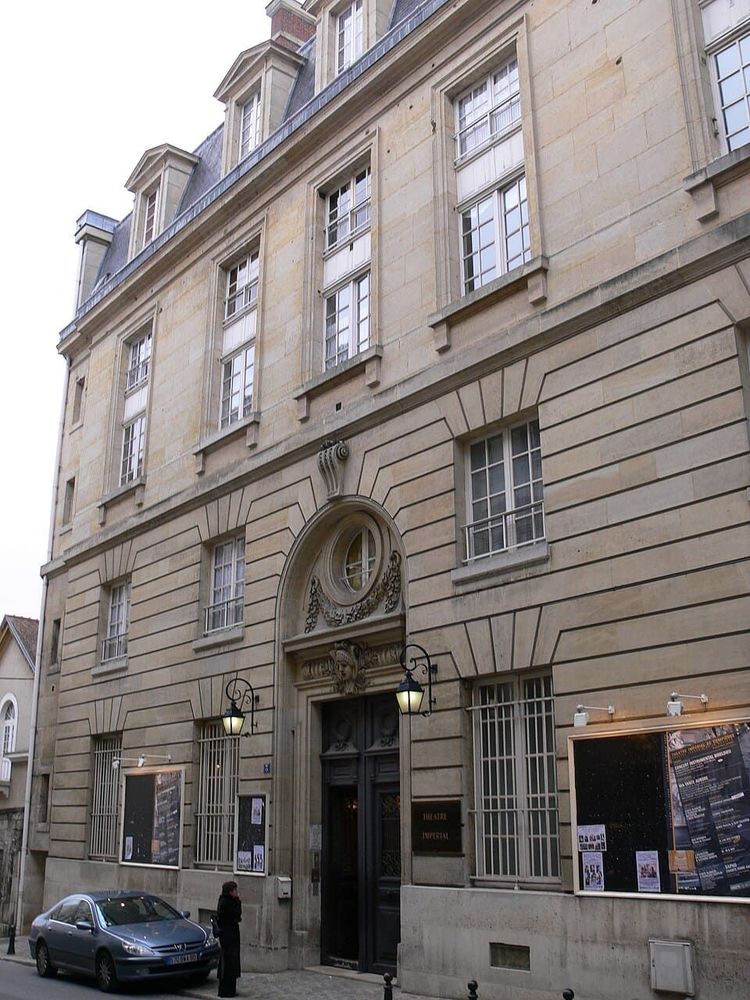
©Andreas Praefcke BY-SA 3.0. https://creativecommons.org/licenses/by-sa/3.0/deed.fr
The Imperial Theatre of Compiègne is an elegant theatre wanted by Napoleon III, renowned for its exceptional acoustics. The Compiègne audio-guided tour stops here to evoke this place of entertainment with a singular destiny, long unfinished before becoming a renowned lyric stage.
The Imperial Theatre of Compiègne was wanted by Napoleon III, who wished to endow his preferred residence with a hall of entertainment worthy of his court. Its construction was launched in the 1860s, near the palace, in an elegant style in harmony with the palace. But the history of the building is singular: interrupted by the fall of the Second Empire and the war of 1870, the construction site remained unfinished for more than a century, the interior remaining in a raw state. It is only at the end of the twentieth century that the theatre was finally completed and inaugurated, revealing an Italian-style hall of great beauty and, above all, of exceptional acoustics, considered one of the best of France. Today, the Imperial Theatre hosts a rich programme of operas, concerts and shows, attracting music lovers. A witness of the imperial ambition and a lyric jewel, the Imperial Theatre is a fine stop of the discovery of Compiègne.
You admire the elegant theatre wanted by Napoleon III in the 1860s near the palace, remained unfinished for more than a century after the fall of the Second Empire before being completed at the end of the twentieth century, revealing an Italian-style hall of exceptional acoustics that hosts operas and concerts. The Imperial Theatre is a lyric jewel of Compiègne. It is a stop to be discovered, to be explored on foot.
The Imperial Theatre lies near the palace, in the heart of Compiègne, reachable on foot. The shows, operas and concerts follow their own programme and hours, which vary. It is best to check the agenda before coming.
Wanted by Napoleon III in the 1860s, it remained unfinished for more than a century after the fall of the Second Empire, before being completed at the end of the twentieth century; it then reveals an Italian-style hall of exceptional acoustics, among the best of France.
Near the palace, in the heart of Compiègne, in the Oise, in France.
Aucun avis pour le moment
