





Walk
The City of Six Harbors
Lorient, France
Walk
The City of Six Harbors
Lorient, France
4.5 km
Distance
1h50
Durée
24
Audios
Loop
Parcours
©Fab5669, CC BY 4.0 httpscreativecommons.orglicensesby4.0, via Wikimedia Commons
Lorient’s present-day City Hall rises before you, an imposing civic complex completed in July 1960. The former City Hall was completely destroyed by fire in 1943, beginning a long period of displacement for the municipal administration. At the time of the Liberation, the city government found temporary refuge near Auray.
It returned to Lorient in September 1945 and moved temporarily into a former boys’ school on Quai des Indes, in premises that had received only rudimentary repairs. Municipal departments remained there for fifteen long years. In 1955, when the City Council approved the final plans for the new building, it made a historic decision that would reshape Lorient: rather than rebuild City Hall on its original site, the council chose to move it here, making it a defining feature of the new city center laid out under the Reconstruction plan.
Take a closer look at the architecture of this vast complex. The building is divided into two distinct sections. To the northeast, a civic block houses the administrative offices.
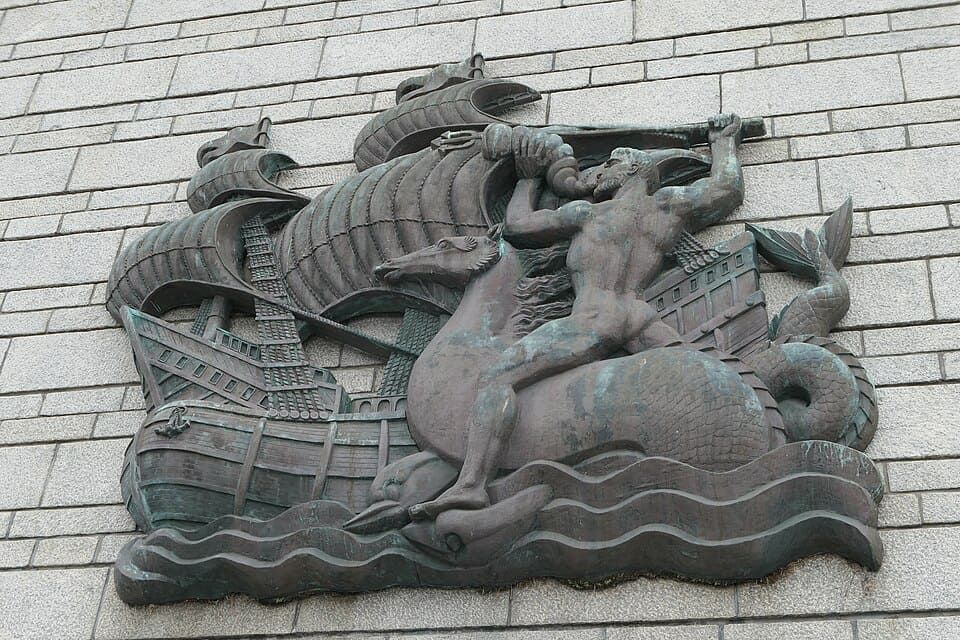
To the south, another wing contains the reception rooms and the Council Chamber, distinguished by the city’s large coat of arms and twelve tall vertical windows. The coat of arms depicts Neptune, god of the sea, armed with his trident and riding a mythological sea horse. He guides a large three-masted sailing ship, a reference to the Compagnie des Indes of 1666.
The building also conceals a fascinating detail beneath its foundations. Taking advantage of the sloping ground, the architects incorporated a former German World War II bunker into the basement. Today, it serves as an archive storage room—a striking reminder that Lorient has never forgotten its past.
Aucun avis pour le moment
