





Walk
The City of Painters
Collioure, France
Walk
The City of Painters
Collioure, France
3 km
Distance
1h30
Durée
22
Audios
Loop
Parcours
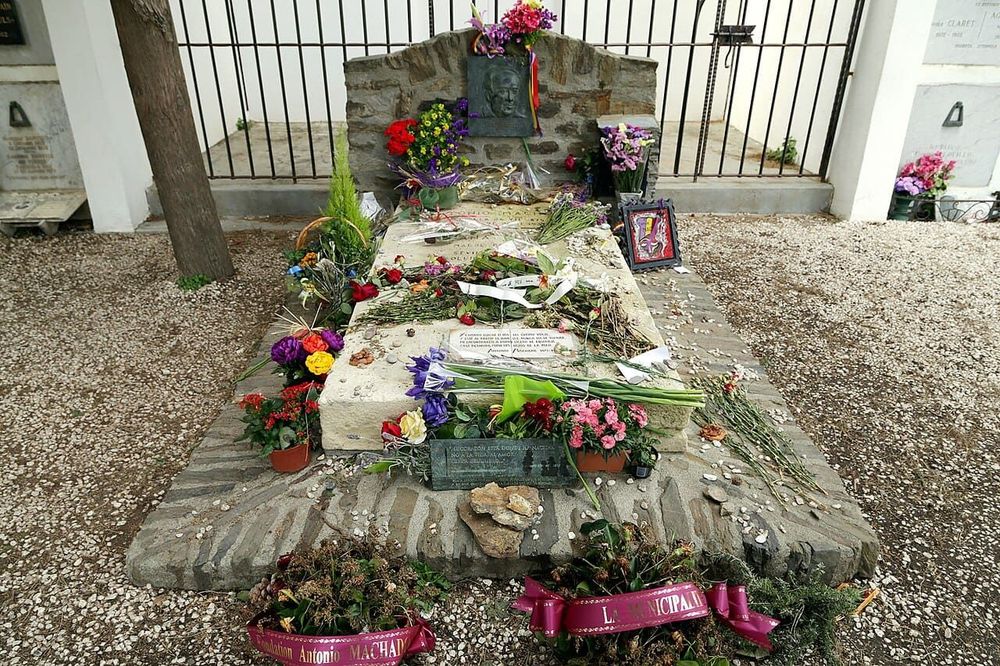
©Quinok CC BY-SA 4.0. <https://creativecommons.org/licenses/by-sa/4.0/deed.fr>via Wikipedia Commons
In the cemetery of Collioure rests Antonio Machado, one of the greatest Spanish poets of the twentieth century. His tomb, simple and always covered with flowers, has become a place of contemplation and pilgrimage. The Collioure audio-guided tour stops here as before one of the town's most moving symbols, at the crossroads of Spanish history and the Catalan land of Roussillon.
Born in Seville in 1875, Machado lived through the Spanish Civil War writing for freedom and the Republic. In January 1939, when Barcelona fell, he fled his country among nearly half a million Spaniards: this was the Retirada. Exhausted, he reached Collioure on 22 January, where he was taken in at Casa Quintana. He died there a few weeks later, in February 1939, thus unwittingly choosing this little fishing town as his final resting place.
The tomb lies in the small cemetery of Collioure, near the harbour. Plain, it is almost always covered with flowers, republican flags and messages left by visitors, many of them Spanish, who come to honour the poet's memory. A letterbox there sometimes gathers words addressed to Machado: a deeply moving detail that shows the place he still holds in people's hearts, on both sides of the border.
The cemetery of Collioure lies near the harbour, reachable on foot from the centre; Antonio Machado's tomb is one of the first you come across and is generally well signposted. Access to the cemetery is free, with respect for the place and its calm. As cemetery opening hours may vary with the season, it is best to plan the visit during the day.
Fleeing Francoist Spain during the Retirada in 1939, the exhausted poet found refuge in Collioure, where he died in February 1939; he was buried there, making the town a place of memory of the Republican exile.
It is in the small cemetery of Collioure, near the harbour, a few minutes' walk from the centre, and is generally well signposted there.
Born in Seville in 1875, Antonio Machado is one of the greatest Spanish poets of the twentieth century, committed to freedom and the Republic, who died in exile in Collioure in 1939.
Aucun avis pour le moment
