





Walk
Retracing the history of the Red City
Albi, France
Walk
Retracing the history of the Red City
Albi, France
3.5 km
Distance
1h40
Durée
27
Audios
Loop
Parcours
©Frédéric Neupont — CC BY-SA 4.0. <https://creativecommons.org/licenses/by-sa/4.0/deed.fr>via Wikipedia Commons
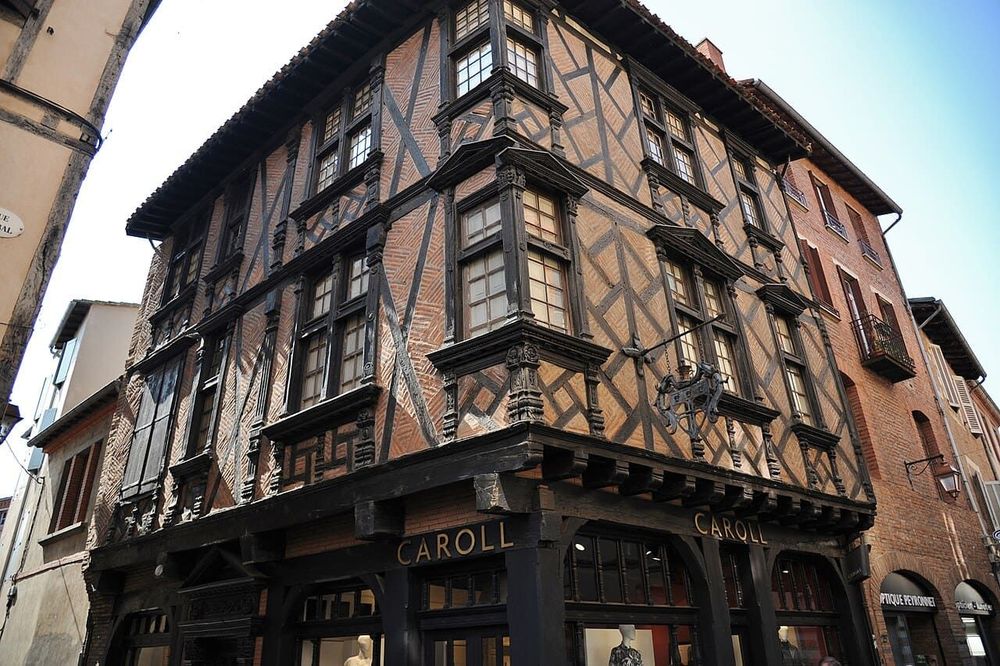
The Enjalbert house is an emblematic Renaissance residence of Albi, remarkable for its half-timbered façade. The Albi audio-guided tour stops here to evoke this sixteenth-century house, a jewel of the heritage of the red city.
Dating from the sixteenth century, the Enjalbert house is one of the most remarkable residences of Albi. It is difficult to remain indifferent to its appearance: its façade charms by the alternation of wood and brick, its sculpted half-timbering and its overhangs characteristic of the Renaissance. A witness of the prosperity of the city in the time of the pastel, it is one of the most photographed houses of the historic centre of the red city.
You admire the magnificent Renaissance façade, the alternation of wood and brick, the sculpted half-timbering and the overhangs of the Enjalbert house. It is one of the finest residences of the historic centre of Albi. It is a stop for lovers of architecture, to be explored on foot.
The Enjalbert house lies in the heart of the historic centre of Albi, reachable on foot. You admire its façade freely from the street; it is a residence whose interior access is not necessarily open. You discover it during a walk in the centre.
Its sixteenth-century Renaissance façade, with the alternation of wood and brick, its sculpted half-timbering and its overhangs, one of the finest of Albi.
In the heart of the historic centre of Albi, in the Tarn.
Aucun avis pour le moment
