



Walk
On the road to Alsace
Colmar, France
Walk
On the road to Alsace
Colmar, France
2.7 km
Distance
1h10
Durée
23
Audios
Loop
Parcours
Shutterstock
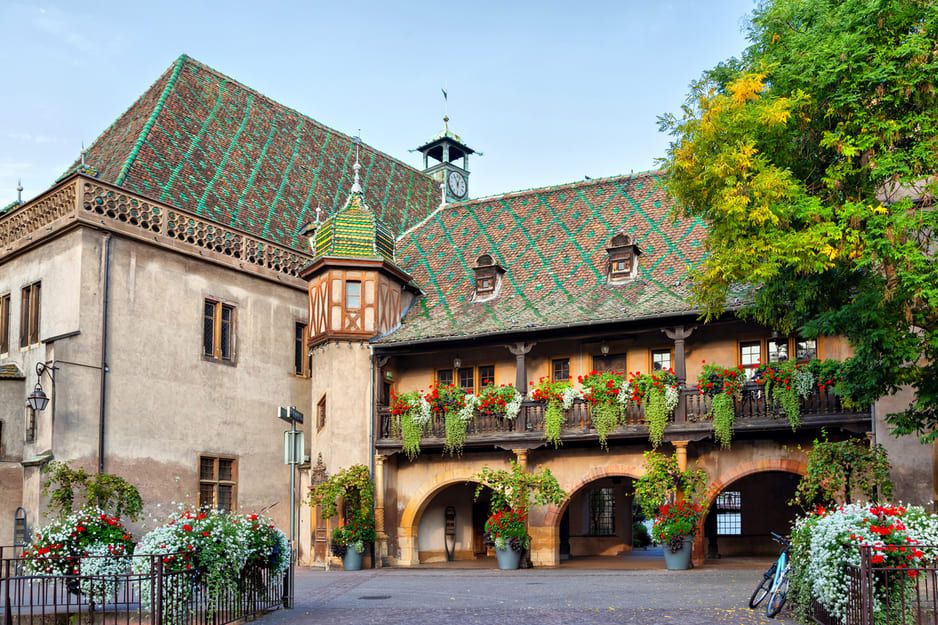
The Place de l'Ancienne Douane is one of the finest squares of Colmar, dominated by the Koïfhus, the former customs house. The Colmar audio-guided tour stops here to evoke this magnificent ensemble, adorned with half-timbered houses and a fountain by Bartholdi.
The Place de l'Ancienne Douane is one of the most picturesque and photographed of Colmar. It is dominated by the Koïfhus, the former customs house, the oldest public building of the town, built in the fifteenth century. This remarkable building, with a fine roof of colourful glazed tiles and a wooden gallery, served both as a warehouse and a place of collection of taxes on goods, as well as a meeting place. The square is lined with superb half-timbered houses and adorned in its centre with the Schwendi fountain, a work of the Colmar sculptor Auguste Bartholdi, which represents a figure holding a vine stock. A magnificent architectural ensemble, the Place de l'Ancienne Douane is a jewel of the historic heart of Colmar.
You admire the Koïfhus, the fifteenth-century former customs house with a roof of colourful glazed tiles, the oldest public building of the town, the superb half-timbered houses and the Schwendi fountain by Auguste Bartholdi. The Place de l'Ancienne Douane is a jewel of the heart of Colmar. It is a must-see stop, to be explored on foot.
The Place de l'Ancienne Douane lies in the heart of the old town of Colmar, reachable on foot. It is a public square freely accessible; the Koïfhus, the cafés and shops have their own hours. It is particularly beautiful and lively in fine weather.
The former customs house, the oldest public building of Colmar, built in the fifteenth century, with a fine roof of colourful glazed tiles; it served as a warehouse, a place of collection of taxes and a meeting place.
In the heart of the old town of Colmar, in France.
Aucun avis pour le moment