





Walk
Against wind and tide
Dieppe, France
Walk
Against wind and tide
Dieppe, France
5 km
Distance
2h00
Durée
23
Audios
Loop
Parcours
©Sygogne BY 3.0 <https://creativecommons.org/licenses/by/3.0/deed.fr>via Wikipedia Commons
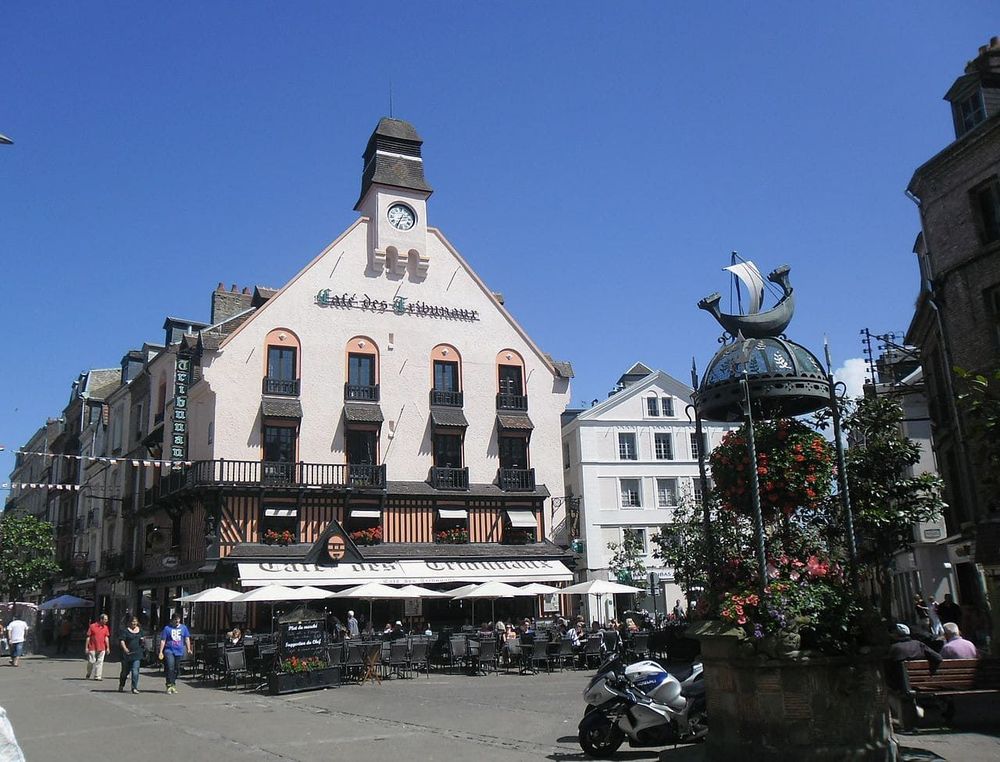
The Place du Puits-Salé is a central and lively square of Dieppe, at the crossroads of six streets, dominated by the famous Café des Tribunaux. The Dieppe audio-guided tour stops here to evoke this historic heart of the town, a place of meeting and passage with a Norman charm.
At the crossroads not of two, but indeed of six streets, the Place du Puits-Salé is without doubt one of the nerve centres of Dieppe. Its name comes from an old well whose water, close to the sea, was brackish, and which was formerly at this location. Located at the convergence of the main arteries of the town, including the pedestrian Grande Rue, the square has long been a place of meeting, passage and life, where the heart of Dieppe beats. It is dominated by the famous Café des Tribunaux, a magnificent building with the appearance of an old inn, which was a high place of Dieppe life and hosted in its time writers and artists, including some of the greatest names of painting and literature, attracted by the charm of the seaside town. Lined with shops, cafés and fine Norman façades, the square keeps a picturesque and authentic atmosphere. It is an excellent starting point to explore the town. A central square and heart of the town, the Place du Puits-Salé is a fine stop of the discovery of Dieppe.
Here you enjoy the central square at the crossroads of six streets, including the pedestrian Grande Rue, a nerve centre of Dieppe that takes its name from an old well with brackish water, dominated by the famous Café des Tribunaux with the appearance of an old inn, which hosted writers and artists, lined with shops and fine Norman façades. The Place du Puits-Salé is a heart of Dieppe. It is a fine stop, to be explored on foot.
The Place du Puits-Salé lies in the heart of Dieppe, at the crossroads of the main streets, reachable on foot. It is a freely accessible public space; the Café des Tribunaux and the shops have their own hours. The square is lively during the day and constitutes a good starting point to explore the town.
From an old well whose water, close to the sea, was brackish, that is to say salty, and which was formerly at this location; this central square at the crossroads of six streets is dominated by the famous Café des Tribunaux, which hosted in its time writers and artists attracted by the charm of the seaside town.
In the heart of Dieppe, at the crossroads of the main streets, in France.
Aucun avis pour le moment
