





Walk
The City of the Dukes
Nantes, France
Walk
The City of the Dukes
Nantes, France
6.4 km
Distance
2h30
Durée
31
Audios
Loop
Parcours
Shutterstock
The Nantes audio-guided tour takes you to Place Royale, one of the symbols of the city centre. Born at the end of the eighteenth century from the hand of the architect Mathurin Crucy, to whom we also owe the Graslin Opera, it unfolds an elegant classical perspective in the heart of the city.
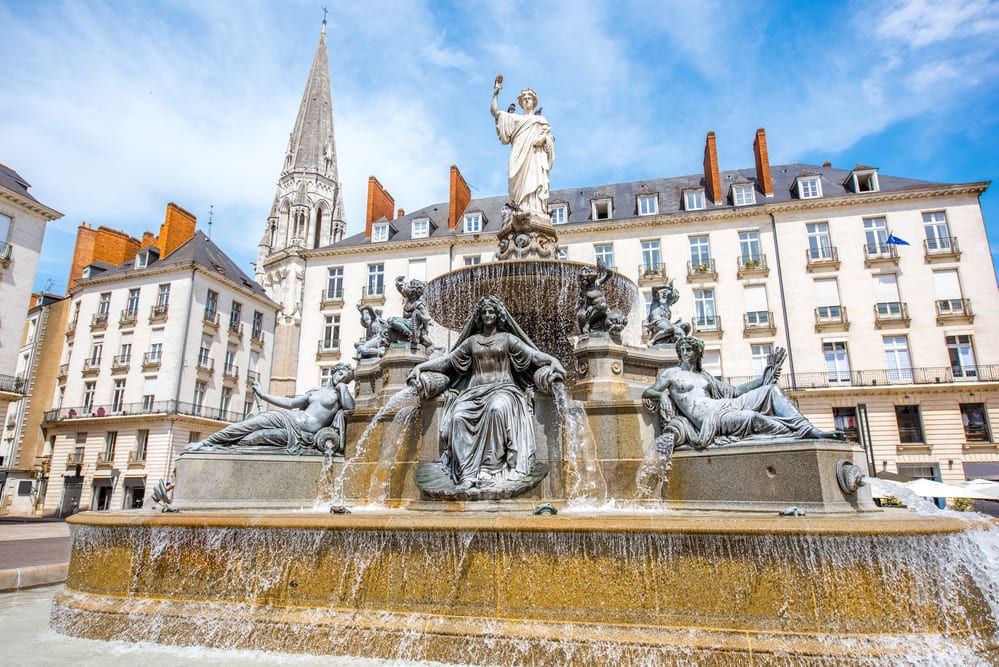
Designed in 1786 and laid out in 1790, the square occupies the space freed by the demolition of the former medieval wall. Before that, a bastion stood here, built around 1500 to defend the access of the Saint-Nicolas gate. Crucy delivered a square respecting all the classical codes of the time: rounded, framed by fine symmetrical façades from which perfect perspectives escape. Notably, it does not house a statue of a monarch, but a fountain.
At the centre stands a monumental fountain, inaugurated in 1865, which recalls the bond uniting Nantes with its river, its tributaries and the ocean. The city is figured there by a white marble statue surrounded by allegorical bronzes. Devoted to commerce from the start, the square is lined with fine façades with shops on the ground floors. It is a major landmark and a lively meeting place in the centre of Nantes.
Place Royale is in the heart of the city centre of Nantes, near Rue Crébillon and the Saint-Nicolas basilica. It is a public space freely accessible at all hours and on the level, served by the city's transport network.
The Nantes architect Mathurin Crucy, who designed it in 1786 on the space freed by the demolition of the former medieval wall.
Inaugurated in 1865, it figures the bond between Nantes, its river, its tributaries and the ocean, with a white marble statue of the city surrounded by allegorical bronzes.
Aucun avis pour le moment
