





Walk
A Journey Through History
Compiègne, France
Walk
A Journey Through History
Compiègne, France
4.5 km
Distance
1h50
Durée
18
Audios
Loop
Parcours
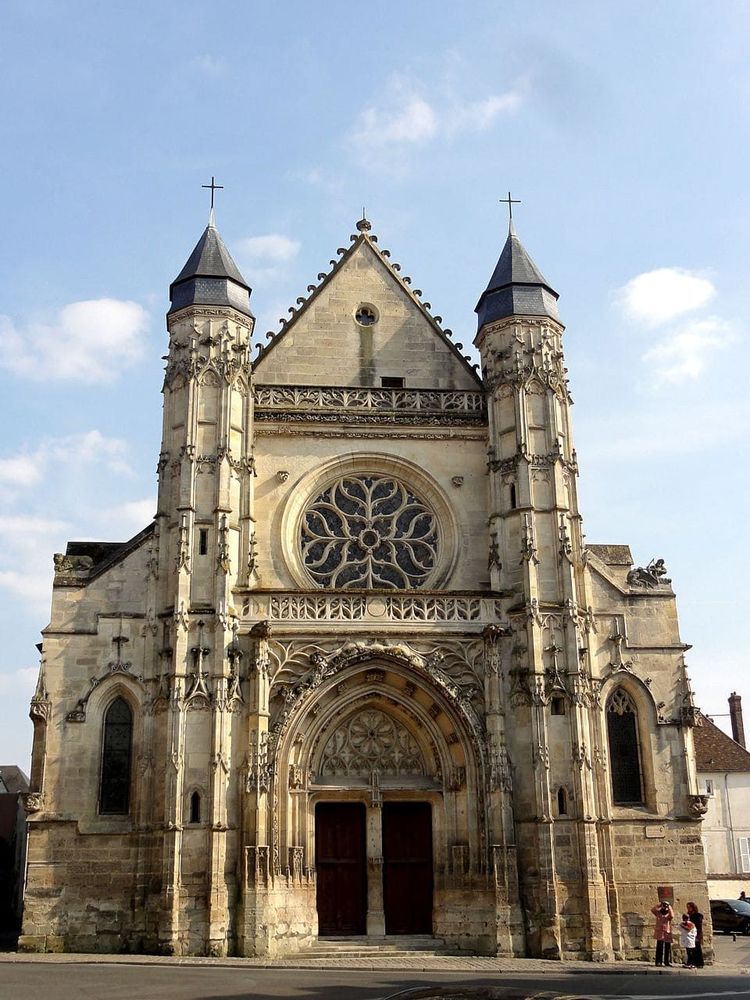
©P.poschadel CC BY-SA 3.0..jpg https://creativecommons.org/licenses/by-sa/3.0/deed.fr
The Church of Saint-Antoine is one of the oldest religious buildings of Compiègne, in the heart of the old town. The Compiègne audio-guided tour stops here, with respect, to evoke this sanctuary with medieval origins, a witness of the rich religious past of the town.
The Church of Saint-Antoine is one of the oldest places of worship of Compiègne, whose origins date back to the Middle Ages. Built and reworked from the twelfth to the sixteenth century, it mixes the Romanesque and Gothic styles according to the eras of its construction, and testifies to the long religious history of the town. Its façade, its bell tower and its sober architecture fit harmoniously into the fabric of the old town. Inside, the nave, the chapels, the stained-glass windows and the furniture reflect the devotion of the inhabitants over the centuries, and the building keeps precious heritage elements. Like the other churches of the town, Saint-Antoine was linked to the life of the parishioners and to the great moments of the local history, in this town dear to the kings of France. Restored and maintained, it perpetuates its spiritual vocation. An old sanctuary and a witness of the religious heritage of Compiègne, the Church of Saint-Antoine is discovered with respect.
You admire, with respect, one of the oldest places of worship of Compiègne, built and reworked from the twelfth to the sixteenth century, mixing Romanesque and Gothic, with a façade, a bell tower and sober architecture, and with an interior adorned with chapels, stained-glass windows and furniture reflecting the long devotion of the inhabitants. The Church of Saint-Antoine is an old sanctuary of Compiègne. It is a stop to be discovered with respect.
The Church of Saint-Antoine lies in the heart of the old town of Compiègne, reachable on foot. A place of worship, it can be visited with respect for services; entry is generally free, but hours vary. It is best to check them before coming and to respect the sacred character of the place.
One of the oldest places of worship of Compiègne, with medieval origins, built and reworked from the twelfth to the sixteenth century; it mixes the Romanesque and Gothic styles and testifies to the long religious history of the town, dear to the kings of France.
In the heart of the old town of Compiègne, in the Oise, in France.
Aucun avis pour le moment
