





Walk
The Gifted City
Montpellier, France
Walk
The Gifted City
Montpellier, France
3.5 km
Distance
1h30
Durée
21
Audios
Loop
Parcours
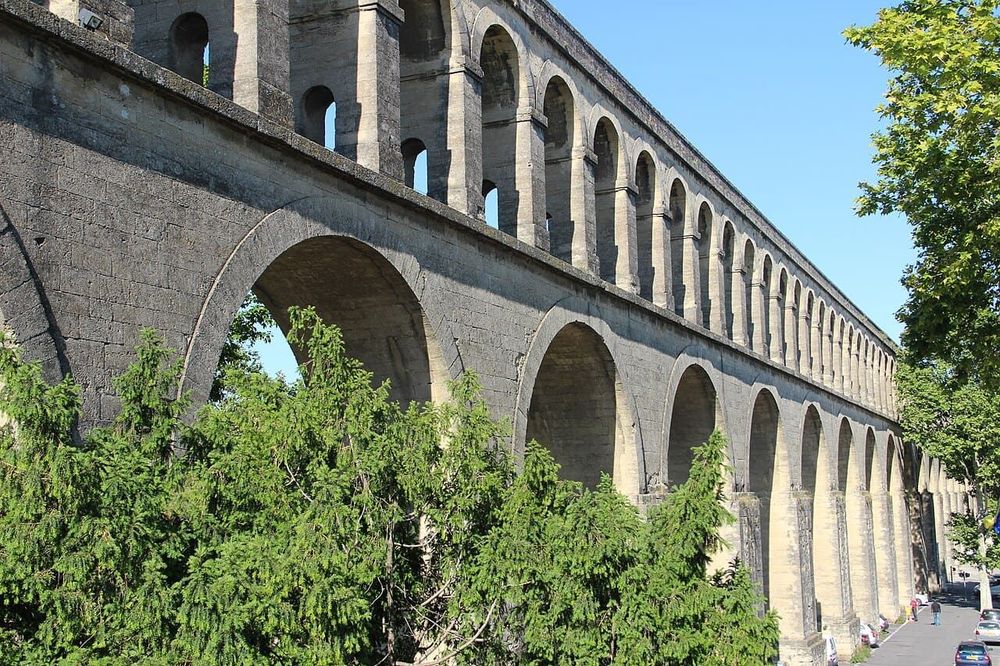
©Björn S. CC BY-SA 3.0. https://creativecommons.org/licenses/by-sa/3.0/
Supplying a city with water may seem ordinary today, but it was long a challenge for Montpellier. The Saint-Clément aqueduct, better known as the aqueduct of the Arceaux, brought the solution in the eighteenth century. The Montpellier audio-guided tour stops here to tell of this feat that changed the daily life of the inhabitants.
At its founding in the Middle Ages, Montpellier sorely lacked water, despite a few wells and fountains. To remedy this, the Saint-Clément aqueduct was built between 1753 and 1765 to carry the water of the Saint-Clément springs to the heart of the city. Inspired by Roman aqueducts, it spreads its stone arches over nearly a kilometre and ends at the Peyrou water tower, the climax of the structure.
The double row of arches of the aqueduct of the Arceaux composes one of the most photographed landscapes of Montpellier, especially at the foot of the Peyrou. Under its arches a lively market is regularly held, and the district that bears its name is prized for its atmosphere. It is a spectacular testimony to eighteenth-century engineering, to be discovered by looking up at its elegant tiers.
The Saint-Clément aqueduct lies west of the centre of Montpellier, at the foot of the Peyrou promenade, reachable on foot. It is an open-air monument, freely visible from the public space, with no ticket office. The Arceaux district regularly hosts a market; to enjoy it, it is best to check the market days, which may vary with the season.
To supply water to Montpellier, which had lacked it since the Middle Ages; it was built between 1753 and 1765 to bring the water of the Saint-Clément springs to the city.
It is the nickname of the Saint-Clément aqueduct, because of its long row of stone arches, the arceaux, which gave their name to the neighbouring district.
Aucun avis pour le moment
