





Walk
Capital of Porcelain
Limoges, France
Walk
Capital of Porcelain
Limoges, France
5.8 km
Distance
2h30
Durée
28
Audios
Loop
Parcours
Shutterstock
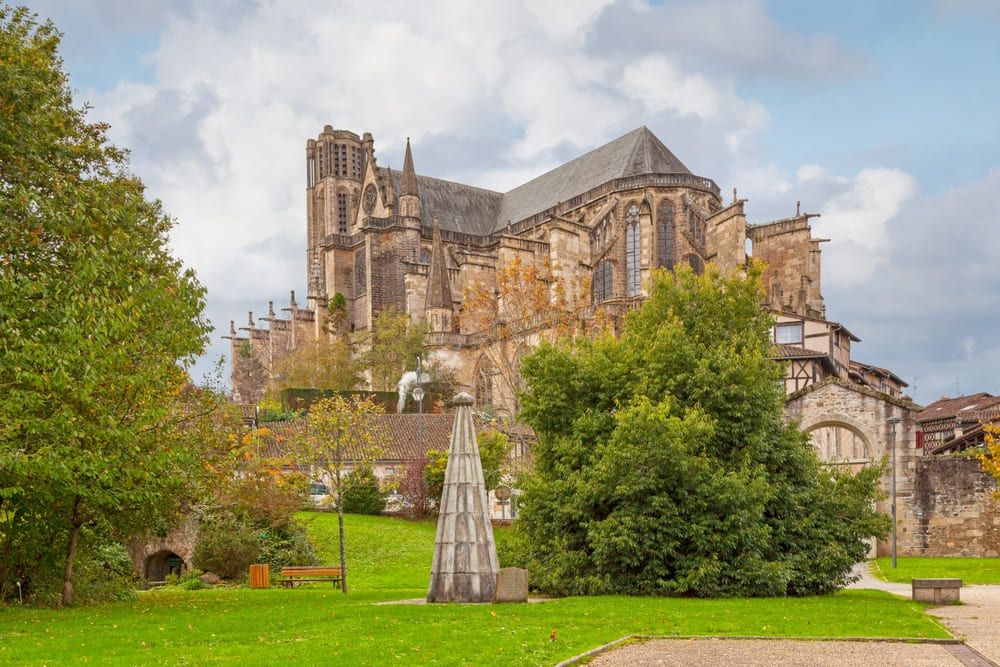
The Cathedral of Saint-Étienne is the Gothic jewel of Limoges, whose construction began in the thirteenth century on a site of worship of a thousand years. The Limoges audio-guided tour stops here, with respect, to evoke this vast sanctuary that dominates the town, famous for its bell tower and its Saint-Jean portal.
The Cathedral of Saint-Étienne of Limoges saw its construction begin in the thirteenth century, even if the eleventh has long been evoked. Recent excavations have allowed to think that there has always been a place of worship at this location, since the Christian origins of the town, which makes of it a sacred site of a thousand years. It is the only entirely Gothic cathedral of all the region, a true feat in a Limousin where people built above all in Romanesque style. Its construction, begun in the Middle Ages, spread over numerous centuries, until the completion of the façade in the nineteenth century, which explains the harmony of its Gothic style despite this long building site. The cathedral impresses by its dimensions, its vertiginous height, its slender vaults and its stained-glass windows. It keeps remarkable treasures, including its magnificent Saint-Jean portal, masterpiece of the flamboyant Gothic with finely sculpted stone lace, and a superb Renaissance rood screen inside. Its high bell tower, with a Romanesque base, dominates the town and is reflected in the Vienne. A jewel and pride of Limoges, it is the spiritual heart of the town. A Gothic cathedral and a thousand-year-old sanctuary, the Cathedral of Saint-Étienne is discovered with respect.
You admire, with respect, the only entirely Gothic cathedral of the region, whose construction began in the thirteenth century on a thousand-year-old site of worship and spread until the nineteenth century; it impresses by its height and its slender vaults, and keeps its magnificent Saint-Jean portal in flamboyant Gothic, a Renaissance rood screen and its high bell tower with a Romanesque base that dominates the town. The Cathedral of Saint-Étienne is the Gothic jewel of Limoges. It is a stop to be discovered with respect.
The Cathedral of Saint-Étienne stands on the heights of old Limoges, dominating the Vienne, reachable on foot. A place of worship, it can be visited with respect for services; entry is generally free, but hours vary. It is best to check them before coming and to respect the sacred character of the place.
Because it is the only entirely Gothic cathedral of the region, a feat in a Limousin of Romanesque tradition; its construction began in the thirteenth century on a thousand-year-old site of worship and spread until the nineteenth century, and it keeps its magnificent Saint-Jean portal in flamboyant Gothic, a Renaissance rood screen and its high bell tower with a Romanesque base that dominates the town.
On the heights of old Limoges, dominating the Vienne, in France.
Aucun avis pour le moment
