





Walk
Echoes of the Middle Ages
Sarlat-la-Canéda, France
Walk
Echoes of the Middle Ages
Sarlat-la-Canéda, France
1.1 km
Distance
1h00
Durée
16
Audios
Loop
Parcours
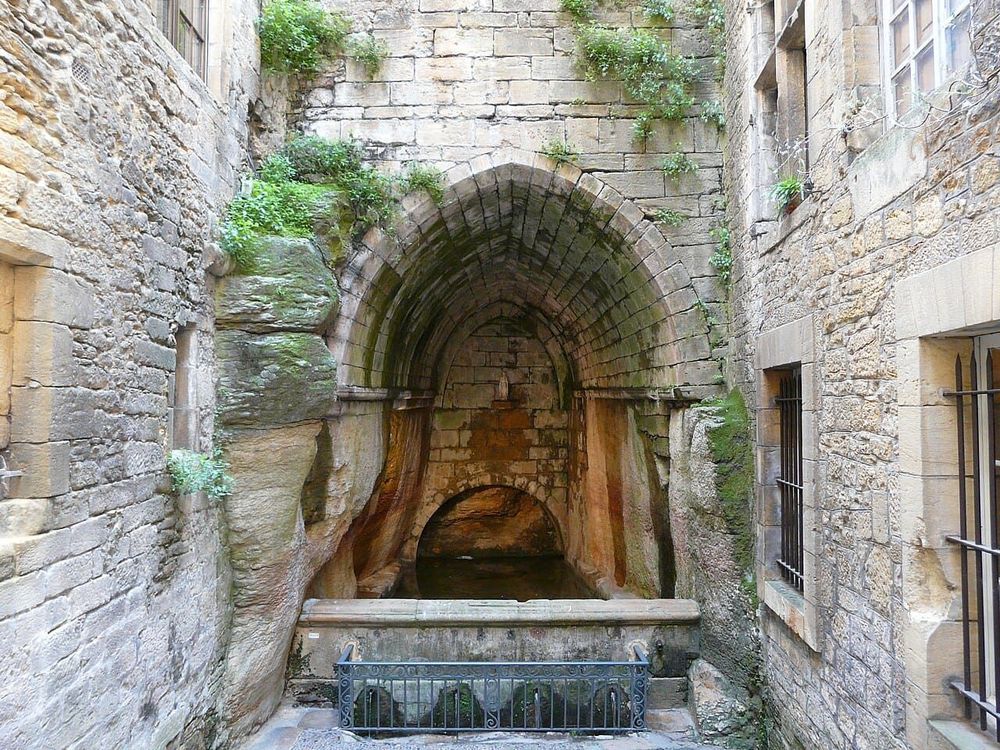
©Père Igor CC BY-SA 3.0. <https://creativecommons.org/licenses/by-sa/3.0/deed.fr>via Wikipedia Commons
A stop on the Sarlat audio-guided tour, the Sainte-Marie fountain is nestled in a natural grotto fitted out in the twelfth century. It is recognisable by its wide pointed arch vault and its four water mouths that still flow today.
For centuries, it was the city's only source of drinking water. Its name goes back to a tragedy: in 1279, the plague struck Sarlat and carried off half its population. The inhabitants then implored the Virgin in the church of Sainte-Marie. As the disease receded, a Marian niche was placed at the back of the spring in thanks, giving it its name.
A place of life and beliefs, the fountain also inspired traditions: travellers threw coins into it, quickly collected by the neighbourhood children. Approach with respect this ancient spring, a witness to the faith and daily life of the people of Sarlat through the centuries.
The Sainte-Marie fountain is on rue des Consuls, in the historic centre of Sarlat. Freely accessible, it can be discovered at any time.
From a Marian niche placed at the back of the spring after the receding of the 1279 plague.
For centuries it was the only source of drinking water in Sarlat.
Aucun avis pour le moment
