






Walk
The Royal City of Horses
Saumur, France
Walk
The Royal City of Horses
Saumur, France
3.2 km
Distance
1h30
Durée
19
Audios
Loop
Parcours
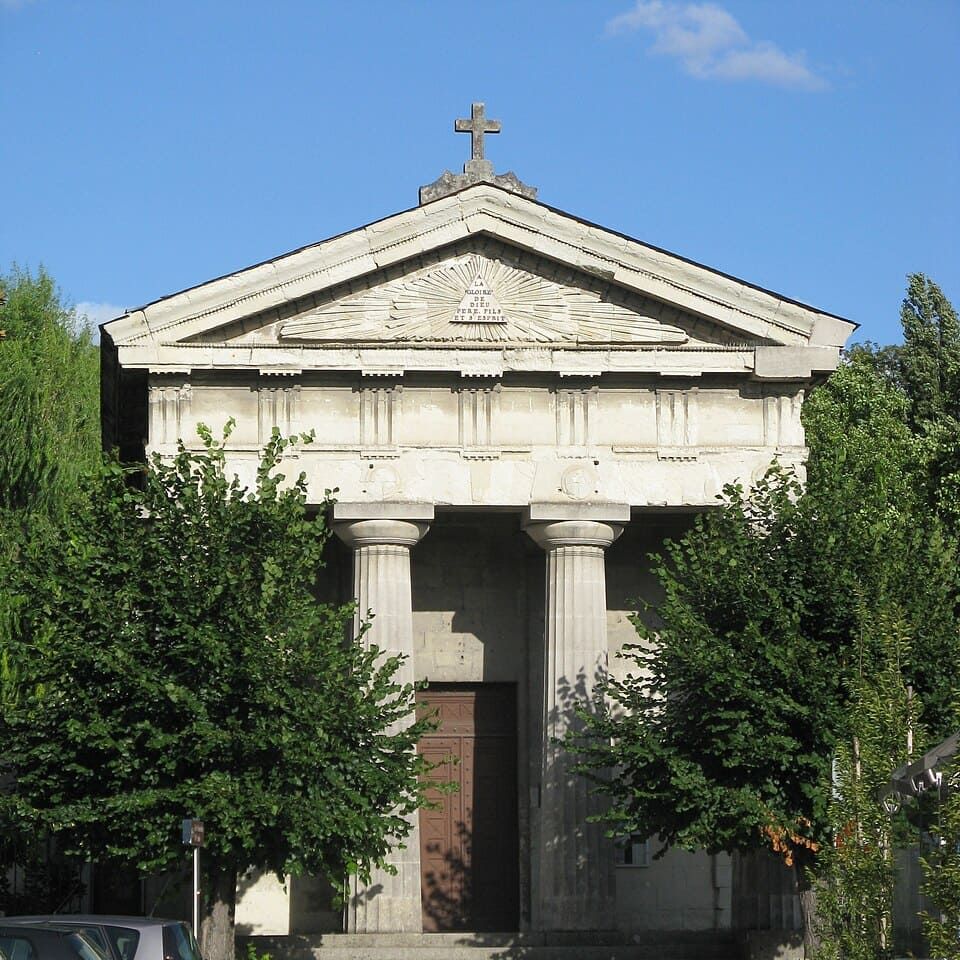
©David Berardan CC BY-SA 3.0. <https://creativecommons.org/licenses/by-sa/3.0/deed.fr>via Wikipedia Commons
The Protestant temple of Saumur is an elegant neoclassical building, a witness of the strong Protestant tradition of the city. The Saumur audio-guided tour stops here, with respect, to evoke this place of worship and the history of the Reformation in Saumur.
The Protestant temple of Saumur is a neoclassical building of great sobriety. Inspired by ancient temples, notably those of Paestum, it stands out by its columned portico, in keeping with the simplicity of Reformed worship. Saumur was, in the seventeenth century, a great home of French Protestantism, famous for its Protestant Academy which radiated throughout Europe. The temple testifies to this singular history and to the important place of the Reformation in the past of the city.
You admire the columned portico and the sober neoclassical architecture of the temple, inspired by the ancient temples of Paestum, in an atmosphere of contemplation. The Protestant temple testifies to the strong Reformed tradition of Saumur. It is a stop for lovers of heritage and religious history, to be discovered with respect.
The Protestant temple of Saumur lies in the heart of the city, reachable on foot. A working Reformed place of worship, it can be visited with respect for services; hours vary with celebrations. It is best to enquire before coming and to respect the character of the place.
Because the city was, in the seventeenth century, a great home of French Protestantism, famous for its Protestant Academy; the temple, inspired by ancient temples, testifies to it.
In the heart of Saumur, in the Maine-et-Loire.
Aucun avis pour le moment
