






Walk
Into the world of the silk weavers
Lyon, France
Walk
Into the world of the silk weavers
Lyon, France
4.4 km
Distance
2h00
Durée
17
Audios
Loop
Parcours
Shutterstock
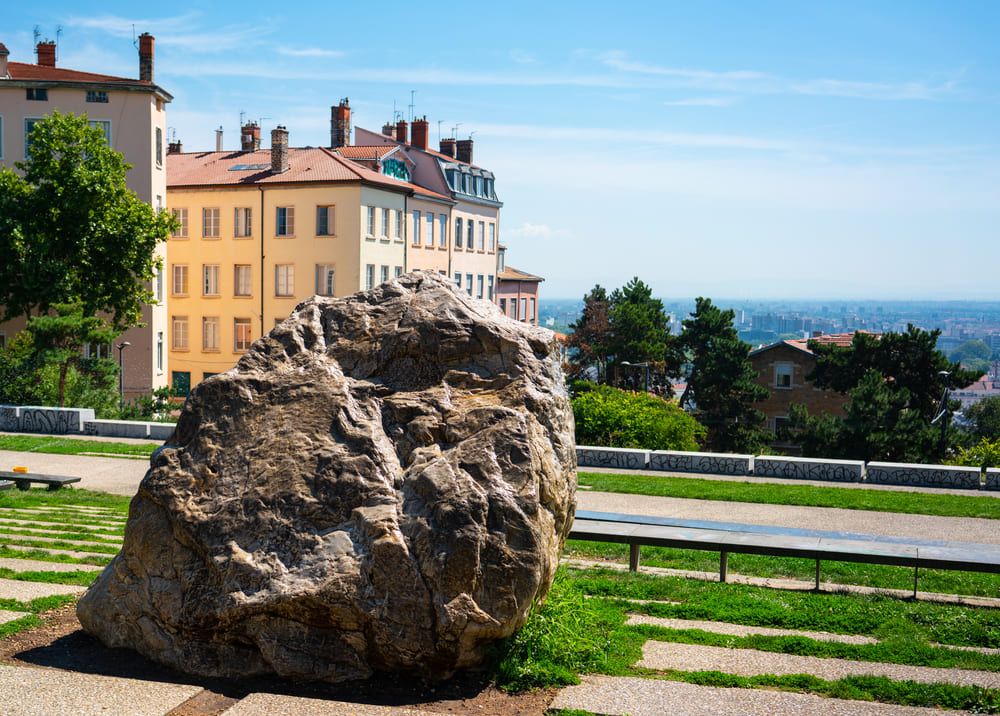
The Lyon audio-guided tour presents you with the Gros Caillou, a heavy rock symbol of the Croix-Rousse, set on the esplanade that bears its name.
This heavy rock is said to have travelled nearly two hundred kilometres to settle here some one hundred and forty thousand years ago, transported by the glaciers from the Alps. It was discovered in 1861 by workers who were digging a trench for the funicular connecting the Presqu'île to the Croix-Rousse: coming across this unbreakable rock, they had to extract it to continue the works. It is a quartzite. A legend surrounds it: the Gros Caillou is said to be the stone heart of an unscrupulous bailiff, Jean Tournette, condemned to push this heart until he found someone harder than him, as a metaphor for inhumanity.
The Gros Caillou, set on its esplanade, is one of the affective symbols of the Croix-Rousse, as much for its surprising geological origin as for the legend that surrounds it. The esplanade offers, as a bonus, a fine viewpoint over the city. It is an unusual and endearing stop, to be discovered along the walk on the plateau.
The Gros Caillou is on the esplanade of the same name, on the plateau of the Croix-Rousse, in Lyon. It can be contemplated freely at all hours and on the level; the esplanade offers a viewpoint over the city.
It is a quartzite come from the Alps, transported by the glaciers some one hundred and forty thousand years ago, discovered in 1861.
It is said to be the stone heart of an unscrupulous bailiff, as a metaphor for inhumanity.
Aucun avis pour le moment
