


Walk
Walking Through a Past That Shaped the Future
Saint-Étienne, France
Walk
Walking Through a Past That Shaped the Future
Saint-Étienne, France
4.5 km
Distance
1h45
Durée
15
Audios
Loop
Parcours
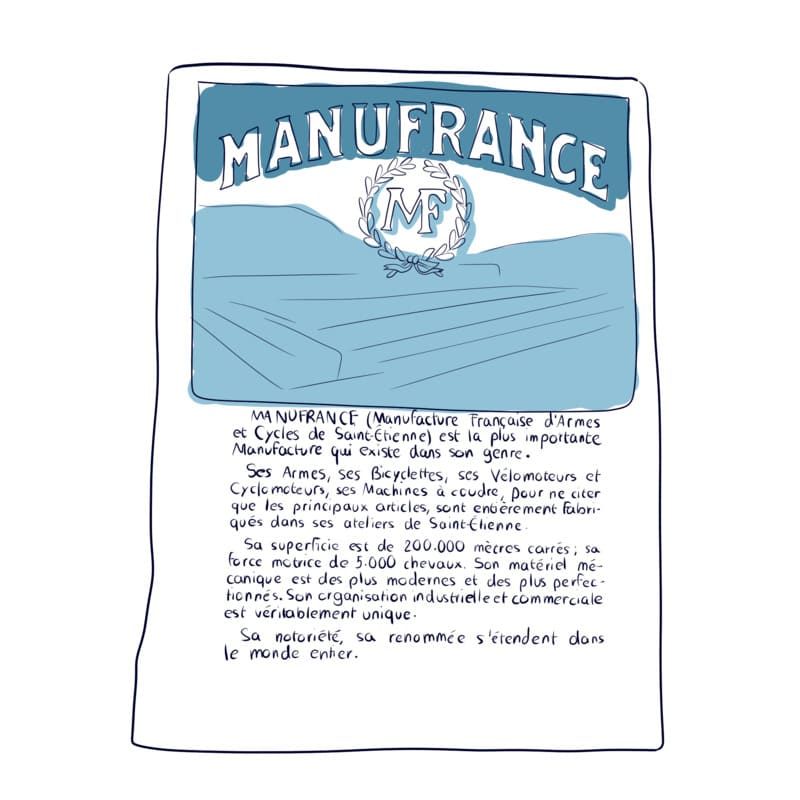
Saint-Étienne was one of the vastest industrial fabrics of France, shaped by the mine, the arm, the ribbon and the cycle. The Saint-Étienne audio-guided tour stops here to evoke this rich working-class past, that profoundly marked the town, its landscape and its identity, at the time of the industrial revolution.
We have left behind us the enclosure of the arms manufactory, but you remain in the heart of what was one of the vastest industrial fabrics of France. All around, in these sloping streets and these working-class districts, you guess the past of a town that was one of the great industrial capitals of the country. Saint-Étienne owed its power to several industries that made its renown. The coal first: the town was born and grew on one of the most important coal basins of France, whose mines fed the factories and made a numerous working-class population flow in. The armament next, with the famous arms manufactory. The ribbon and the passementerie, of which Saint-Étienne was the world capital, employing thousands of weavers and making the fortune of the manufacturers. The cycle finally, the town having been a great cradle of the bicycle industry in France. This industrial concentration shaped a town of labour, of chimneys and of miners' rows, marked by the working-class culture, the social struggles and a recognised technical know-how. Today, after the decline of these industries, Saint-Étienne has been able to reinvent itself around design and creation, while preserving the memory of this rich past. A working-class memory and an industrial heritage, the industrial past is an essential facet of the discovery of Saint-Étienne.
Here you discover the past of one of the great industrial capitals of France, in these sloping streets and these working-class districts: Saint-Étienne owed its power to the coal of its coal basin, to the armament of its manufactory, to the ribbon of which it was the world capital and to the cycle; a town of labour and working-class culture, it has been able, after the decline, to reinvent itself around design while preserving this memory. The industrial past is an essential facet of Saint-Étienne. It is a facet to be explored on foot.
The industrial heritage of Saint-Étienne is discovered over the town, reachable on foot, through its working-class districts, its heritage and its museums dedicated to the mine, the arm and the ribbon, that follow their own hours and conditions. It is best to inquire at the tourist office before coming.
Several great industries: the coal, the town having been born on one of the most important coal basins of France; the armament, with its famous arms manufactory; the ribbon and the passementerie, of which it was the world capital; and the cycle, of which it was a great cradle; this concentration made of Saint-Étienne one of the great industrial and working-class capitals of the country.
Over the working-class districts and the industrial heritage of Saint-Étienne, in France.
Aucun avis pour le moment