



Walk
A Thousand Years of History Along the Mayenne
Laval, France
Walk
A Thousand Years of History Along the Mayenne
Laval, France
3 km
Distance
1h15
Durée
18
Audios
Loop
Parcours
Shutterstock
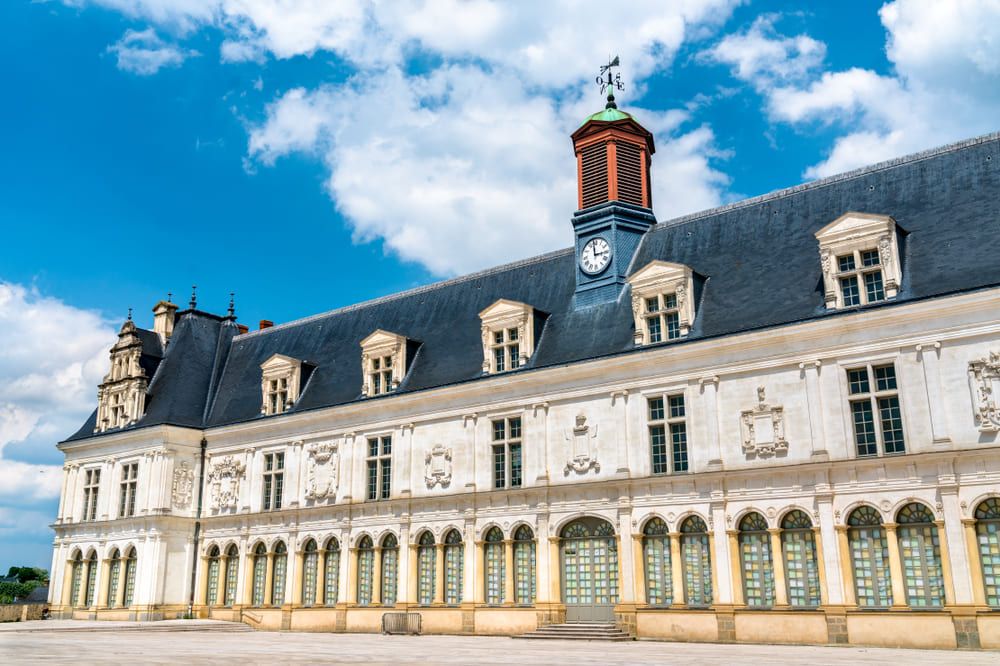
The Château-Neuf is the Renaissance residence that succeeded the old fortified castle of Laval, on the Place de la Trémoille. The Laval audio-guided tour stops here to evoke this fine clear building, conceived as a more comfortable and refined residence than the neighbouring medieval fortress.
You are on the Place de la Trémoille, facing a clear façade that catches the light. Let us forget for a moment the neighbouring old fortified castle: here stands its younger, the Château-Neuf. Why build a new one, so close to the old? Because over the centuries, the lords of Laval, like all the great of their time, aspired to more comfort and elegance than the austere medieval fortress could offer, conceived above all for the defence. In the Renaissance, the fashion was for fine luminous residences, ornate and pleasant to live in, inspired by Italian art. The Château-Neuf was thus built to offer a residence worthy of the rank of its owners, with its regular façade, its large windows and its careful decor, in the refined taste of the era. This building testifies to the passage from a defensive architecture to an architecture of prestige and pleasantness, reflection of the evolution of society and of the end of the Middle Ages. Over history, the building has known various uses and today shelters institutions, notably judicial. A Renaissance residence and a witness of the evolution of the castles, the Château-Neuf is a fine stop of the discovery of Laval.
You admire the Renaissance residence with a clear façade that succeeded the old fortified castle, on the Place de la Trémoille; built to offer the lords of Laval a more comfortable and refined residence than the austere medieval fortress, with its large windows and its careful decor in the Italian taste, it testifies to the passage from a defensive architecture to an architecture of prestige. The Château-Neuf is a witness of the evolution of the castles in Laval. It is a fine stop, to be explored on foot.
The Château-Neuf lies on the Place de la Trémoille, in the historic centre of Laval, reachable on foot. You admire its façade from the square; it is a building that shelters institutions, whose interior access follows its own conditions. You discover it during a walk in old Laval.
Because the lords of Laval aspired to more comfort and elegance than the neighbouring old fortified castle could offer, conceived for the defence; in the Renaissance, the fashion being for fine luminous residences inspired by Italian art, they had this Château-Neuf built with a clear façade and a careful decor, witness of the passage from a defensive architecture to an architecture of prestige.
On the Place de la Trémoille, in the historic centre of Laval, in France.
Aucun avis pour le moment