





Walk
The Latin Quarter : Sorbonne University, Pantheon and Luxembourg Gardens
Paris, France
Walk
The Latin Quarter : Sorbonne University, Pantheon and Luxembourg Gardens
Paris, France
5.7 km
Distance
2h15
Durée
23
Audios
Loop
Parcours
Shutterstock
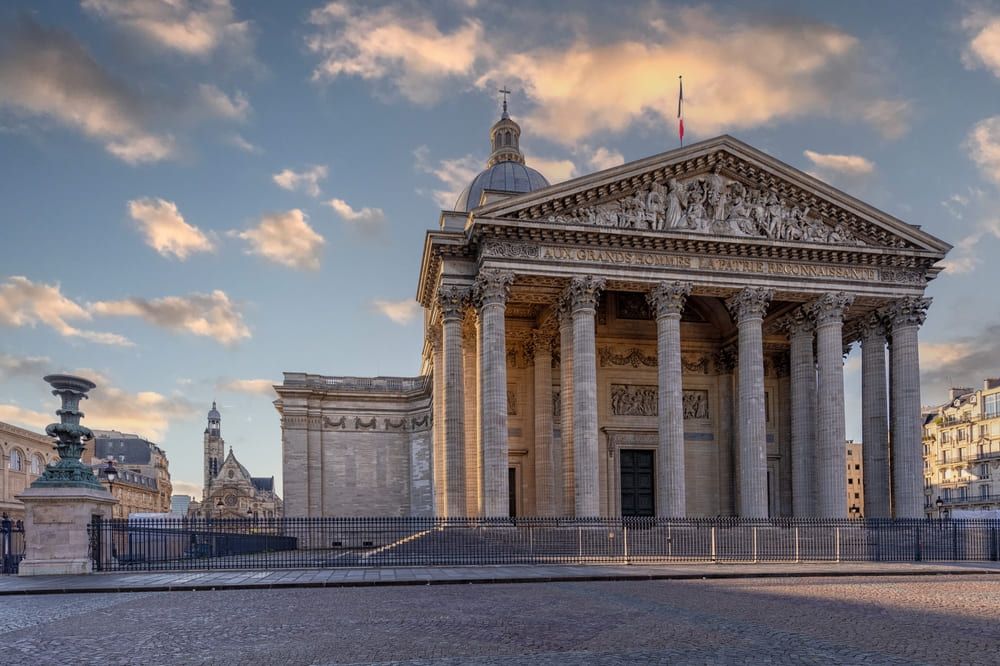
The Paris audio-guided tour leads you before the imposing Panthéon, which rises proudly on the Sainte-Geneviève hill. A place of memory and contemplation, it holds the tombs of great figures of French history, who are honoured with respect.
When Louis XV fell gravely ill in 1744, he promised, if he recovered, to rebuild the church of Sainte-Geneviève, the favourite saint of Parisians, and to place her relics there. Restored to health, the king kept his promise and launched the construction of an imposing church, funded by lotteries. During the Revolution, the building was turned into the Panthéon, intended to honour the great figures of the nation.
The Panthéon impresses with its dome, its columned peristyle and its scale. In the crypt rest, among others, great figures of the arts, the sciences and public life. The famous Foucault pendulum, suspended beneath the dome, illustrates the rotation of the Earth. The place invites contemplation and remembrance, in a solemn setting.
The Panthéon is on Place du Panthéon, on the Sainte-Geneviève hill, in the 5th arrondissement of Paris. It can be visited according to its own schedule, with the respect owed to this place of memory; admission is charged and opening times vary with the season.
Originally, it was a church dedicated to Saint Geneviève, wanted by Louis XV after a serious illness. During the Revolution, it became a temple intended to honour the great figures of the nation.
The crypt of the Panthéon holds the tombs of great figures of French arts, sciences and public life, honoured by the nation.
Aucun avis pour le moment
