



Walk
Between Sea and Light
Honfleur, France
Walk
Between Sea and Light
Honfleur, France
Distance
2.6 kmDurée
1h00Audios
20Parcours
Loop
Shutterstock
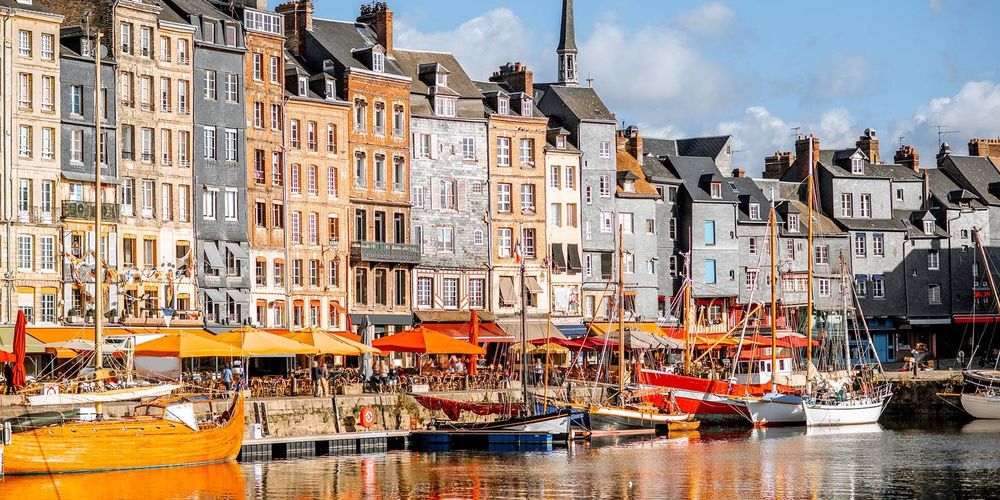
The Honfleur audio-guided tour takes you to the Vieux Bassin, the beating heart of the city, with its tall narrow houses with slate roofs that reflect in the water.
More than three centuries ago, Honfleur was only a rudimentary port where boats were beached at low tide. In 1681, Colbert ordered Abraham Duquesne to transform this medieval port into a true wet dock; three years later was born the Vieux Bassin, able to accommodate large ships. The port knew founding adventures, such as the departure of Samuel de Champlain on 13 April 1608 towards the foundation of Quebec, but also a dark page: between 1783 and 1791, Honfleur actively took part in the triangular trade, deporting thousands of enslaved people, a painful memory that it is important not to forget. In the nineteenth century, Eugène Boudin gathered there Monet, Jongkind and Courbet: it is here that Impressionism was born.
The Vieux Bassin offers one of the finest pictures of Normandy: narrow houses with bluish slates, shifting reflections, moored boats and lively terraces. It is the setting that inspired the Impressionist painters and that continues to charm visitors. To stroll on its quays is to feel the maritime and artistic soul of Honfleur, rich in more than three centuries of history.
The Vieux Bassin is in the heart of Honfleur. Its quays can be walked freely on foot at all hours and on the level; the restaurants and galleries that border it follow their own hours.
Around 1684, after Colbert had ordered in 1681 Abraham Duquesne to transform the medieval port into a wet dock.
It is around it that Eugène Boudin gathered Monet, Jongkind and Courbet, giving birth to the Impressionist movement.
Aucun avis pour le moment
