





Walk
The Pinkest of the Pink Cities
Montauban, France
Walk
The Pinkest of the Pink Cities
Montauban, France
2.8 km
Distance
1h10
Durée
19
Audios
Loop
Parcours
Shutterstock
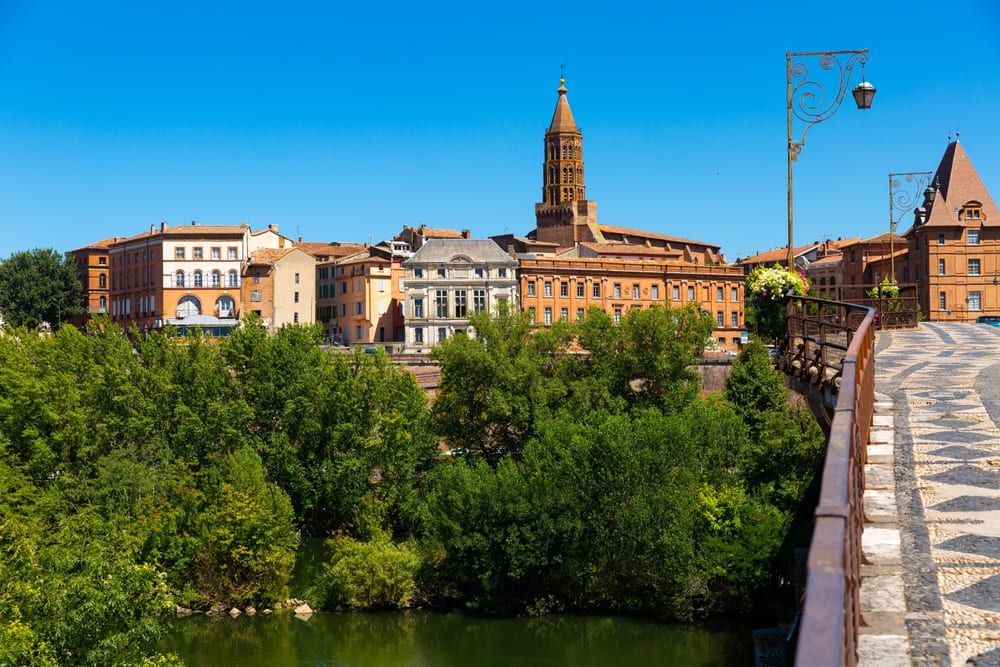
The Montauban audio-guided tour has you cross the Pont Vieux towards the Villebourbon district, a former suburb at the edge of the Tarn, whose brick houses are aligned prettily along the river.
Named in honour of Henri de Navarre, future Henri IV, Villebourbon was long an industrial district, turned towards the tile works, the dye works and the flour mills, the nearby Tarn being a precious ally. Wealthy merchants had fine private mansions built there in the seventeenth and eighteenth centuries. The district also knew dark hours: in March 1930, a devastating flood of the Tarn engulfed entire neighbourhoods, causing numerous victims; this tragedy remains one of the most striking of the history of Montauban, evoked with emotion by the elders.
The district reveals its colourful façades at the edge of the river and its private mansions, such as the Bonnafé mansion. Villebourbon is also the scene of a tradition born of an episode of 1621: besieged by the troops of Louis XIII, the people of Montauban are said to have organised a banquet to defy the king, giving rise to the festival of the 400 coups. Do not miss the covered market, inaugurated in 1935 and listed as a historic monument, which overflows with local products.
The Villebourbon district is on the bank of the Tarn opposite the historic centre of Montauban, beyond the Pont Vieux. It can be walked freely on foot at all hours and on the level. The covered market is generally open several mornings a week, according to its own hours.
It was named in honour of Henri de Navarre, future King Henri IV; it was long an industrial and merchant suburb at the edge of the Tarn.
A Montauban tradition born of an episode of 1621, where the besieged inhabitants are said to have defied the king with a banquet; it is celebrated every year.
Aucun avis pour le moment
