





Walk
On the other side of the wall
Berlin, Germany
Walk
On the other side of the wall
Berlin, Germany
6.5 km
Distance
2h40
Durée
31
Audios
Loop
Parcours
©Jörg Zägel CC BY-SA 3.0. https://creativecommons.org/licenses/by-sa/3.0/deed.fr
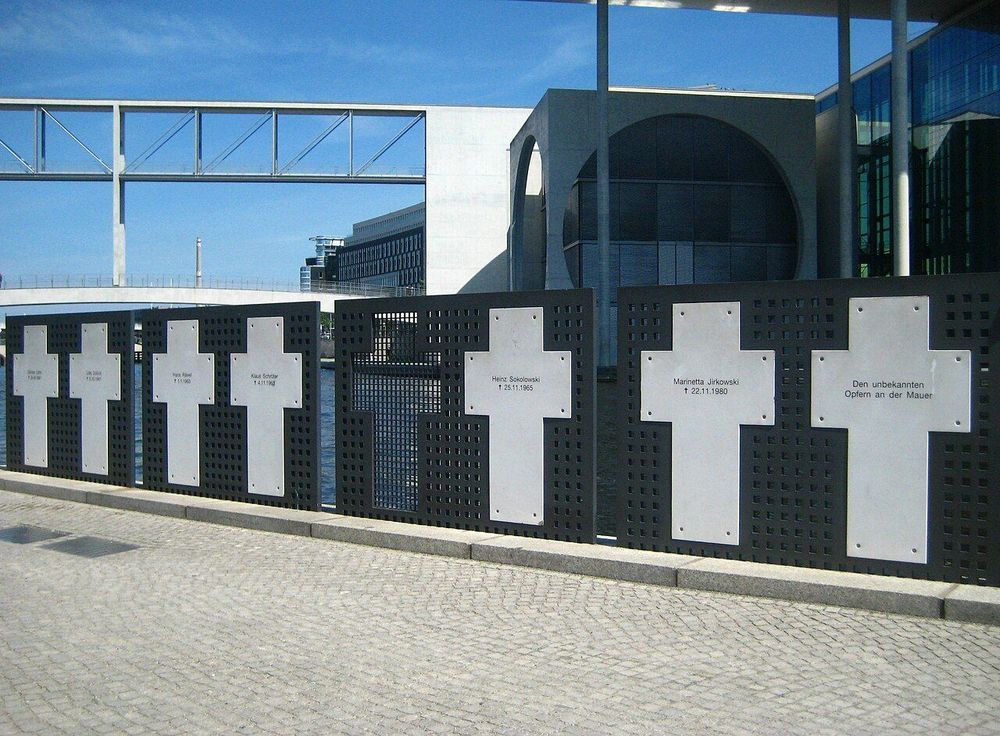
The white crosses memorial pays tribute to the people who died trying to cross the Berlin Wall. The Berlin audio-guided tour stops here, with respect and contemplation, to evoke this place of memory, near the Spree.
The white crosses discovered on railings, near the Spree and the Reichstag, commemorate, with gravity, the people who lost their lives trying to cross the Berlin Wall to pass to the West. Originally, crosses were placed at each place of the Wall where someone had been killed. During the decades of division, men, women and children tried to flee at the risk of their lives, and many were shot in the border zone. This discreet but poignant memorial recalls the human drama of the town cut in two and the price of freedom. You discover it with respect, in memory of the victims.
Here you discover, with respect and contemplation, the white crosses that commemorate the people who died trying to cross the Berlin Wall, near the Spree and the Reichstag, a testimony of the drama of the divided town. The memorial recalls the price of freedom. It is a stop to be discovered with respect.
The white crosses memorial lies near the Spree and the Reichstag, in Berlin, reachable on foot. It is an open-air place of memory, freely accessible. It is best to observe the respect due to the victims of the Wall.
It commemorates, with gravity, the people who lost their lives trying to cross the Berlin Wall to pass to the West, during the decades of division of the town.
Near the Spree and the Reichstag, in Berlin, in Germany.
Aucun avis pour le moment
