



Walk
A Maze of Pirates and Heroines
Mykonos, Grèce
Walk
A Maze of Pirates and Heroines
Mykonos, Grèce
Distance
2 kmDurée
1h00Audios
19Parcours
Loop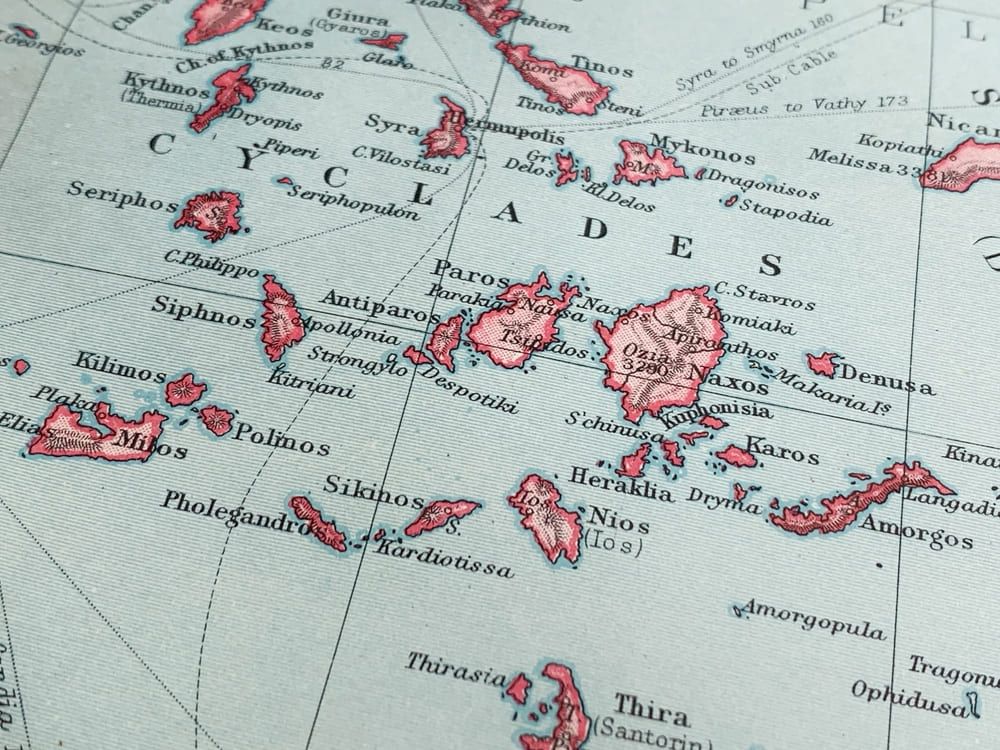
Shutterstock
Mykonos is one of the most famous islands in the Cyclades. But what exactly are the Cyclades? Today, the name immediately brings to mind picture-perfect Greek islands, but there's a much older story behind those familiar images. During the Bronze Age, these islands were home to a remarkable civilization, famous for its marble figurines. And to understand their history, you also have to enter the world of Greek mythology, where geography and legend are so closely intertwined that every mountain and rocky coastline seems to have been shaped by the gods themselves. Even the name "Cyclades" reflects this connection between the landscape and the mythical world. In Greek, it refers to islands arranged in a circle, forming an enormous sacred ring around one small island at the center: Delos. According to mythology, the Cyclades haven't always existed. The story goes that Poseidon, the mighty god of the sea, became so furious with a group of nymphs that he turned them to stone, transforming them into islands. It was the ancient Greeks' poetic way of explaining how this extraordinary archipelago, lying between mainland Greece and Asia Minor, came into being. And at the heart of this mythical circle lies Delos, the birthplace of so many Cycladic legends. To the ancient Greeks, Delos was no ordinary island. It was sacred ground, and its story begins with Leto, a Titaness loved by Zeus and pregnant with his divine twins. But Hera, Zeus's jealous wife, was determined to make her suffer. She forbade Leto from giving birth on solid land. Fortunately, Delos offered an unusual loophole! At the time, it was said to be nothing more than an unstable, floating rock, detached from the rest of the world. Zeus asked Poseidon to anchor the island to the seabed, giving Leto a safe place to take refuge. And it was here, on the newly anchored island, that she gave birth to Artemis, followed by Apollo. From then on, Delos became so sacred that even birth and death were forbidden there. No one was allowed to be born or die on the island, so anyone nearing death, along with women about to give birth, was taken to neighboring Rhenia. This sacred status helped turn Delos into a major religious, political, and commercial center in antiquity. But the mythology of the Cyclades extends far beyond Delos, reaching every island in the archipelago. That includes Mykonos, which today ranks among the best-known destinations alongside Santorini, Naxos, Paros, Milos, Ios, and Tinos. According to tradition, Mykonos takes its name from a mythical hero called Mykonos, a grandson of Apollo. Another legend claims that the island's enormous, distinctive boulders mark the burial places of giants defeated by Heracles. So when you travel through the Cyclades, you're exploring much more than a beautiful group of islands. You're entering a sacred landscape where every rock, every gust of wind, and every wave still seems to whisper stories from the age of the gods.
Aucun avis pour le moment
