





RyoCity
The Parthenopean City
Naples, Italy
RyoCity
The Parthenopean City
Naples, Italy
5.7 km
Distance
2h15
Durée
19
Audios
Boucle
Parcours
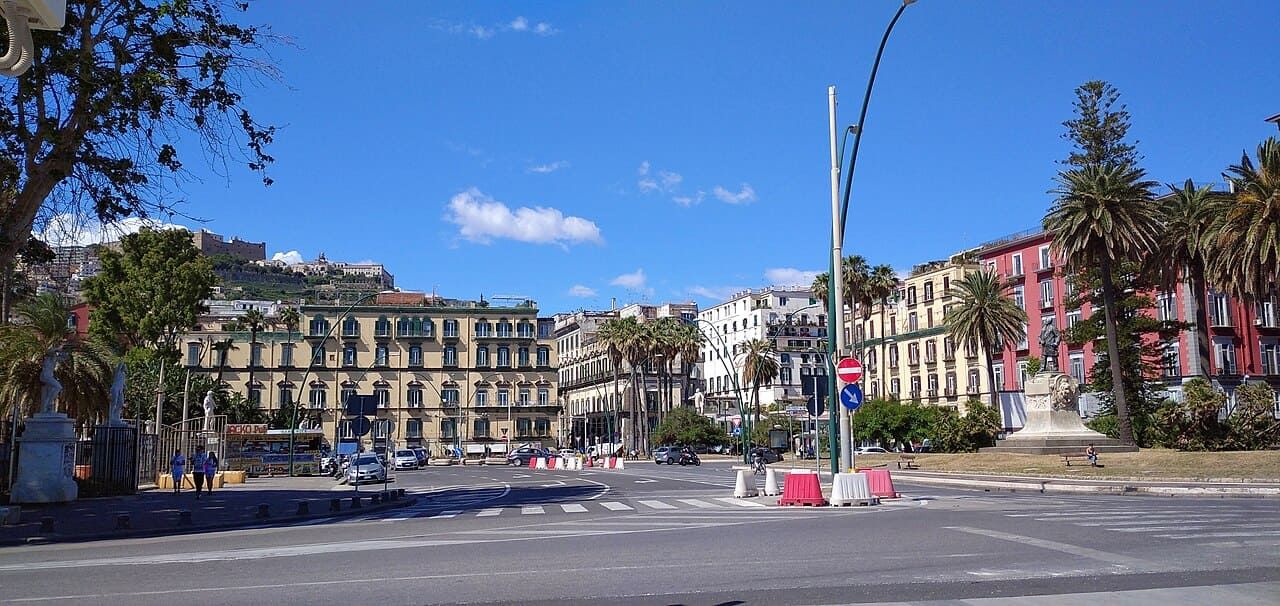
©Baku CC BY-SA 4.0. <https://creativecommons.org/licenses/by-sa/4.0/deed.fr>via Wikipedia Commons
Stepping out of Villa Comunale Park, you arrive in Piazza Vittoria—Victory Square—named for the famous Battle of Lepanto, fought in 1571 between Christian forces and the Turks. At first, it might sound like just another distant 16th-century battle, but in reality, the Christian coalition’s victory over the Ottomans had enormous consequences across Europe. It marked the end of Ottoman expansion and effectively split the Mediterranean in two. For the Christian side, the win was seen as nothing short of divine intervention. In Naples, as thanks to the Madonna for her help, the Church of Santa Maria della Vittoria was built, giving the square its name. You might not see a church around you, but it’s here—look behind the statue at the block of buildings with two beige façades and one red. The beige building on the far left, right on the corner, is actually the church. If you don’t believe it, step inside and see for yourself. As for the statue in front of you, it depicts Nicola Amore, who served as a magistrate, head of the police, and most famously, as mayor of Naples, overseeing major urban redevelopment. The statue originally stood at the crossroads of two main streets, in today’s Piazza Nicola Amore. It was moved in May 1938, ahead of Adolf Hitler’s visit to Naples to greet the Italian Royal Navy—a show of unity between the two regimes. To ensure the dictator’s parade route was perfectly clear, anything that could obstruct the procession was removed, including Amore’s statue. And on that note, let’s keep moving.
