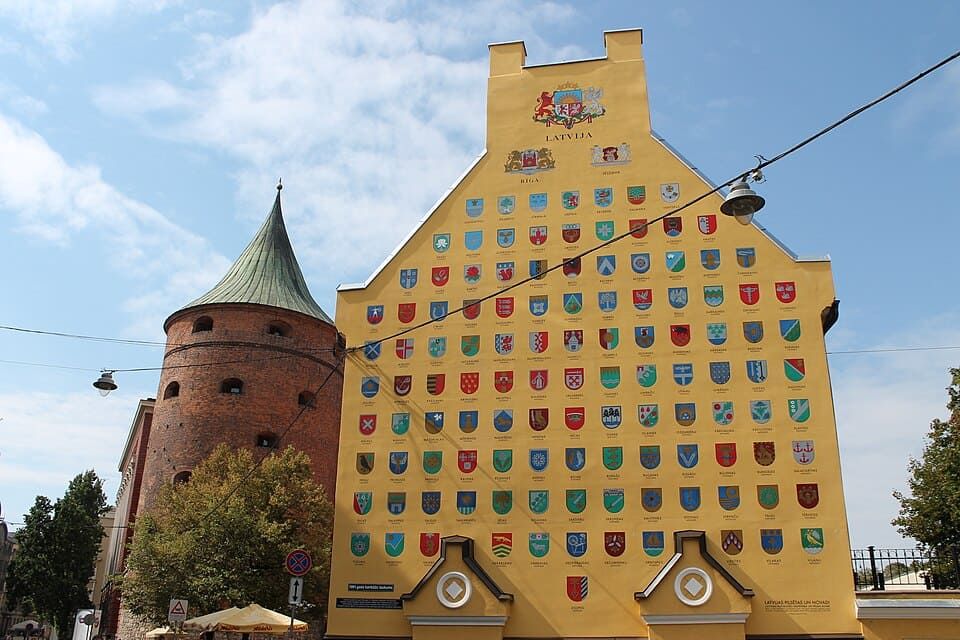
Coat of Arms Wall

©John Samuel CC BY-SA 4.0. <https://creativecommons.org/licenses/by-sa/4.0/deed.fr>via Wikipedia Commons

This impressive wall, decorated with the coats of arms from all the cities and "Novads" (municipalities) of Latvia, forms a patriotic fresco. Created by artist Leonards Laganovskis, the first version was painted in 2005, and the fresco was renovated in 2018 to mark the centenary of Latvia’s independence. Each coat of arms represents a community in Latvia, symbolizing both national unity and regional diversity. The designs are varied, ranging from warrior symbols to natural motifs, agricultural and maritime elements, each reflecting the unique traits of the region it represents. Not far from here, to your left, you’ll see the Powder Tower, another piece of Riga’s rich history. Built in the 14th century, it was part of the city's old fortifications and used to store gunpowder. Today, it houses the War Museum, where you can explore Latvia’s military history and the battles that shaped its past. While we’re at this historical site, let’s take a moment to revisit the key moments in the history of Latvia and its capital. Founded in the early 13th century by the Teutonic Knights, Riga quickly became a thriving commercial center thanks to its strategic location on the Baltic Sea. In 1282, the city joined the Hanseatic League, a confederation of merchant cities in Northern Europe, making Riga a crucial trade hub for goods like salt, fish, furs, and grain. After the League’s collapse, Riga came under Polish control in 1581, a period of cultural and artistic growth but also military tensions with Sweden. In 1621, after the Polish-Swedish war, the city fell under Swedish rule, and later, following the Great Northern War in the early 18th century, it became part of the Russian Empire. Under Russian rule, the city transformed into a major industrial hub and a key port in the Empire. In 1918, Riga became the capital of newly independent Latvia, though it soon fell under Soviet occupation, which lasted until 1991. The location of the fresco is also significant, it’s on the façade facing Barricades Square, a historic site tied to the events of 1991 when Latvian civilians built barricades to protect their institutions from Soviet forces. Once Latvia regained its freedom, Riga modernized while still honoring its historical roots. Today, it’s a dynamic capital blending medieval architecture, Art Nouveau, and modern infrastructure, and it remains the economic and cultural heart of Latvia after a long and turbulent history. So, did you have time to pick your favorite coat of arms on this journey through history?

+1 million de voyages avec Ryo

Explore cities with our audio guides. Wander the most beautiful streets, savor every story.

Google Play

Your pace, our audio guides

Google Play