






Walk
The Capital disguised as a village
Luxembourg, Luxembourg
Walk
The Capital disguised as a village
Luxembourg, Luxembourg
5.5 km
Distance
2h15
Durée
19
Audios
Loop
Parcours
Shutterstock
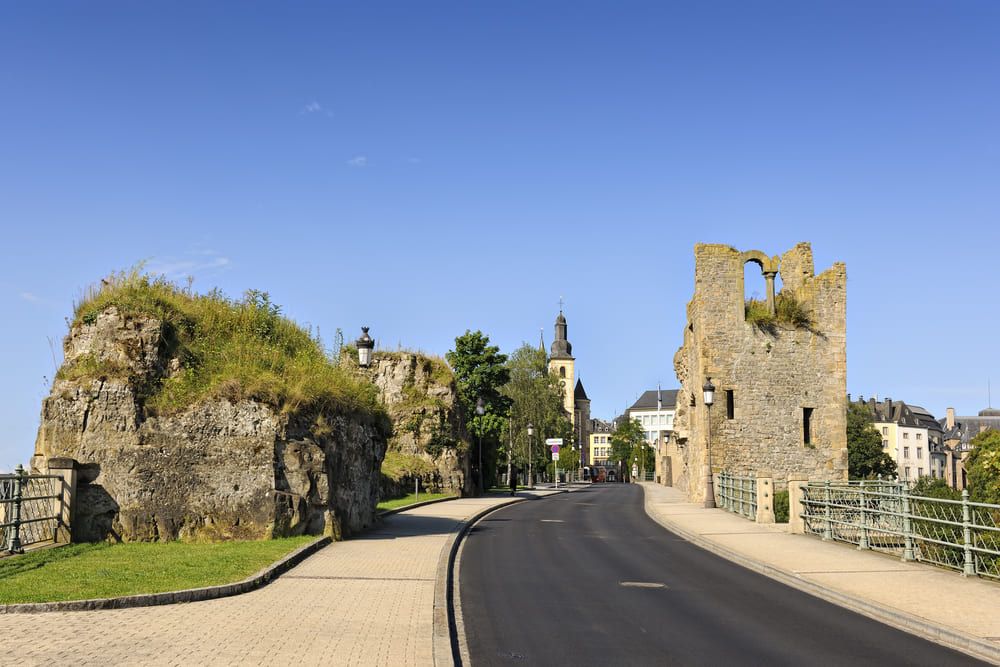
The Luxembourg audio-guided tour begins where it all started: the Hollow Tooth, in Luxembourgish Huelen Zant. In the year 963, Count Siegfried, a descendant of Charlemagne, acquired this rocky promontory from the abbey of Saint Maximin of Trier and established his castle there.
There stood a small Roman-era fort named Lucilinburhuc, meaning little castle. It is from this name that Luxembourg takes its own: the name of the fort became that of the castle, then of the city and finally of the whole country. The position, hard to attack, had an obvious defensive value. The Hollow Tooth is one of the oldest remains of the fortress.
The Hollow Tooth corresponds to the remains of one of the towers of a gate of the fortress, whose hollowed shape earned it its nickname. These ruins rest on a bridge overlooking the lower town. The place offers a fine viewpoint and helps you understand the thousand-year origins of Luxembourg, on the Bock rock.
The Hollow Tooth is on the Bock rock, in the heart of the old town of Luxembourg, listed as World Heritage. The site can be seen freely at all hours, from the surroundings; it offers a viewpoint over the lower town. The area, on a height, calls for good shoes.
It comes from Lucilinburhuc, the small Roman fort that stood on the Bock rock. The name of the fort became that of the castle, the city, then the country.
Count Siegfried, a descendant of Charlemagne, acquired the Bock promontory in 963 and established his castle there, at the origin of the city.
Aucun avis pour le moment
