




Walk
A humble Arabia
Muscat, Oman
Walk
A humble Arabia
Muscat, Oman
10.4 km
Distance
4h00
Durée
29
Audios
Loop
Parcours
Shutterstock
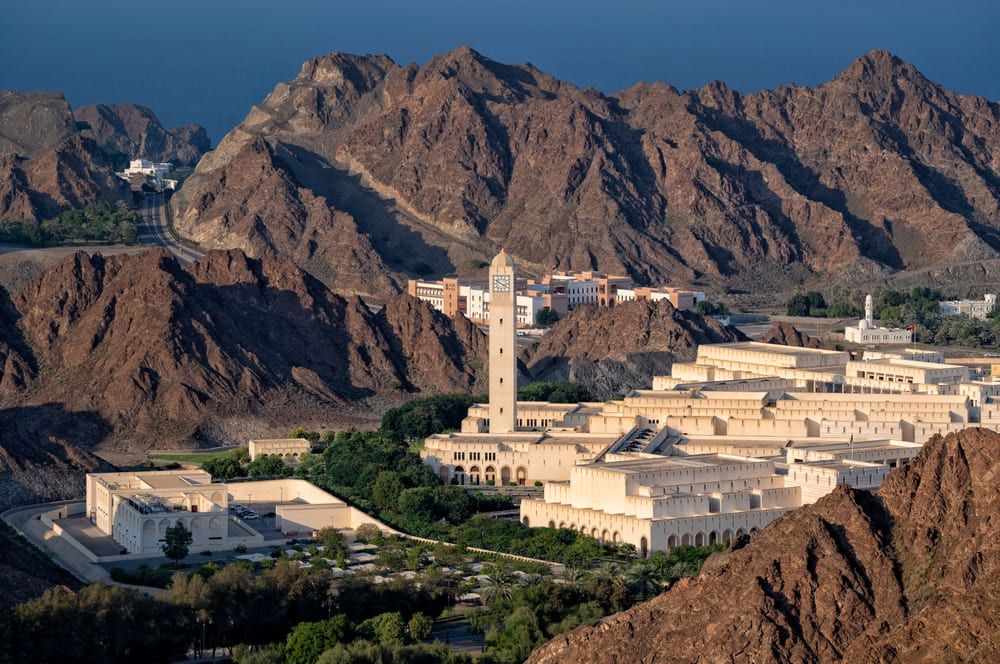
The rocky setting of Muscat, made of arid mountains that plunge into the sea, gives the town its unique character. The Muscat audio-guided tour stops here to evoke this spectacular landscape, where the capital nestles between the stone and the water.
In Muscat, there is the blue of the water, the white of the dwellings and, above all, this dominant brown in the background. In the image of the saying to live happily, let us live hidden, Muscat is nestled in the heart of a spectacular geographic ensemble. The town indeed developed in the folds of the arid Hajar mountains, these steep and bare rocky reliefs that encircle the capital and plunge directly into the sea of Oman. This situation, which once offered a natural protection and shelters for the ports, gives today Muscat a unique character: the town curls up in the valleys and along the coast, following the terrain, without being able to extend freely. The contrast between the brown of the rock, the white of the low houses and the intense blue of the sea composes striking landscapes, especially in the golden light of the evening. A grandiose backdrop and the very identity of the town, the rocky setting of Muscat is a contemplative stop to savour.
Here you contemplate the spectacular landscape that makes the identity of Muscat: the arid Hajar mountains, these steep rocky reliefs that encircle the town and plunge into the sea of Oman, and the striking contrast between the brown of the rock, the white of the low houses and the intense blue of the sea, magnificent in the golden light of the evening. The rocky setting is the very soul of Muscat. It is a contemplative stop, to be explored on foot.
The rocky setting of Muscat is contemplated from the whole town, in particular from the heights, the belvederes and the corniche, reachable on foot and by public transport. They are open-air landscapes, freely visible. The light is particularly beautiful at sunset, which adorns the rock with golden hues.
The town developed in the folds of the arid Hajar mountains, these steep rocky reliefs that encircle the capital and plunge into the sea of Oman; the contrast between the brown of the rock, the white of the houses and the blue of the sea composes striking landscapes.
From the whole town, in particular the heights, the belvederes and the corniche of Muscat, in Oman.
Aucun avis pour le moment