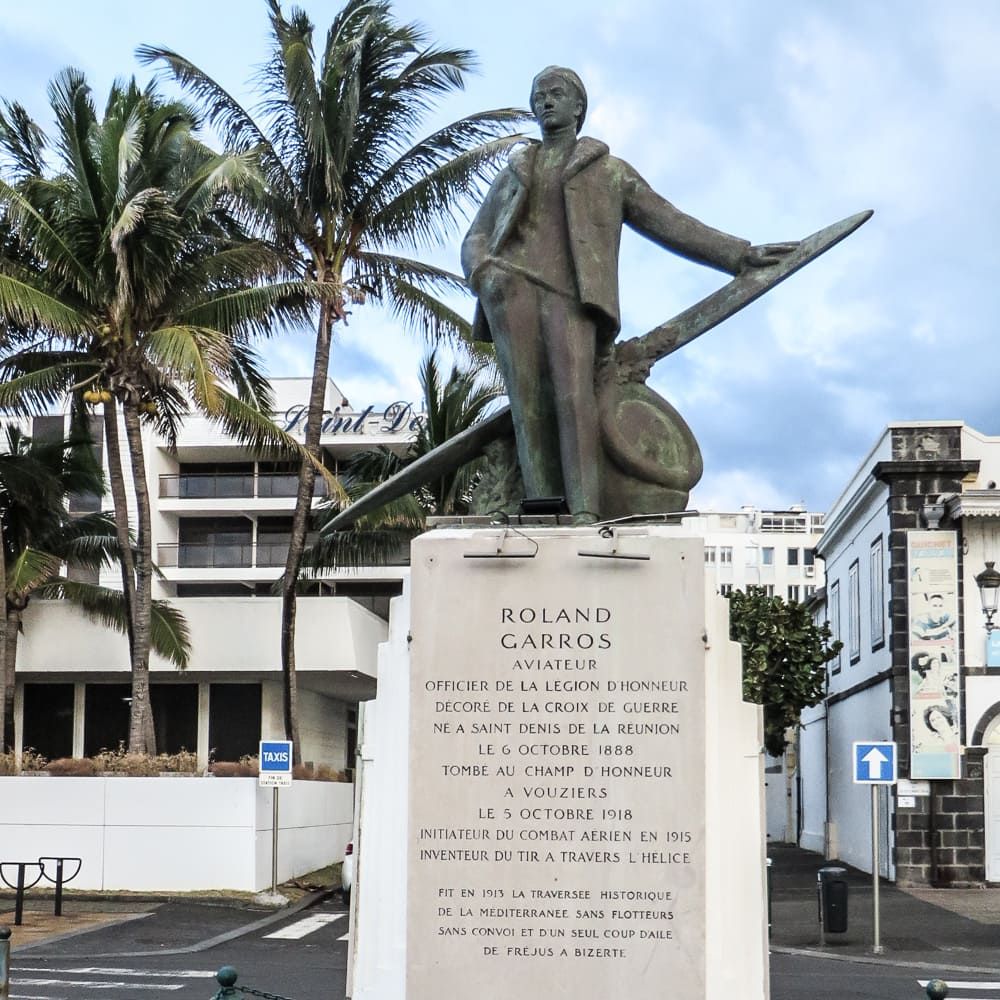






Roland Garros's statue
©BBCLCD- CC BY-SA 4.0 <https://creativecommons.org/licenses/by-sa/4.0/deed.fr>via Wikipedia Commons
As we pass Roland Garros's statue, let me tell you about this remarkable Saint-Denis native who, believe it or not, played rugby, not tennis! Young Roland was born here in 1888. When he was four years old, his father opened a law firm in Saigon (now Ho Chi Minh City), and Roland spent much of his childhood in Vietnam. His parents later sent their twelve-year-old son alone to France for secondary school. Imagine this journey, after nearly two months of travel, he had a life of his own in mainland France at such a young age. Perhaps that's what made him so incredibly resourceful later in life! In France, he developed a love for sports, especially cycling and rugby. After graduating from the prestigious HEC business school, he became fascinated with mechanics and motor racing. When he decided against following the family tradition of becoming a lawyer, his father was so disappointed that he cut off Roland's allowance. However, Roland designed his own sports car, became a company director at twenty-one, and became financially independent. In 1909, everything changed. At the great aviation week in Champagne, Roland discovered his life's true passion: flying. With the profits from his successful car business, he bought the cheapest (and most dangerous) flying machine available: the Demoiselle Santos-Dumont, nicknamed "the man-killer." Flying schools simply didn't exist back then. Enthusiasts and daredevils risked their lives with every flight. Roland proved both gifted and fearless. He hadn't even earned his pilot's license when organisers hired him to give demonstrations on Bastille Day. He was soon travelling to the United States and Mexico for air shows, earning the nickname "the cloud kisser." A major South American tour gained him international recognition, and back in France, he became a hero after winning the Grand Prix of the Anjou circuit, beating the country's best aviators. His place in history was secured after completing the first successful crossing of the Mediterranean by air. Fame brought fascinating friendships: Jean Cocteau dedicated a poem to him, and Bugatti created a car in his honor. When war erupted in 1914, Roland enlisted and excelled as a military pilot. But on April 18th, 1915, his plane was hit and he became a prisoner in Germany. He was kept under close surveillance and regularly moved between camps to prevent escape attempts, which is exactly what he managed to do! With a German-speaking friend, they disguised themselves as officers and made it back to France. He received the Legion of Honor for his heroism, but on October 5th, 1918 (five weeks before the Armistice and one day before his thirtieth birthday), his plane tragically exploded mid-flight before crashing in the French Ardennes, near Vouziers, where he is now buried. A short life, but incredibly full! You're probably wondering, why is France's most famous tennis tournament named after this aviator? It all comes down to friendship and loyalty. Roland's old business school classmate from France, Émile Lesieur, became president of the prestigious Stade Français association. When they needed to build a new tennis stadium to host the Davis Cup, Lesieur declared it would bear his late friend's name. That's how one of France's greatest aviators became forever linked to tennis. Now you know the story behind the name!