





Walk
The City of a Thousand Palaces
Bratislava, Slovakia
Walk
The City of a Thousand Palaces
Bratislava, Slovakia
6.5 km
Distance
3h40
Durée
20
Audios
Loop
Parcours
Shutterstock
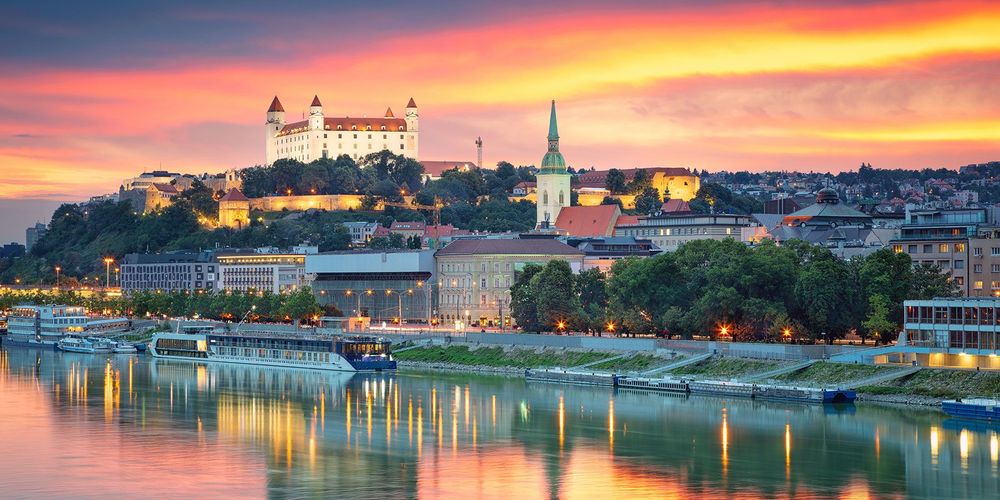
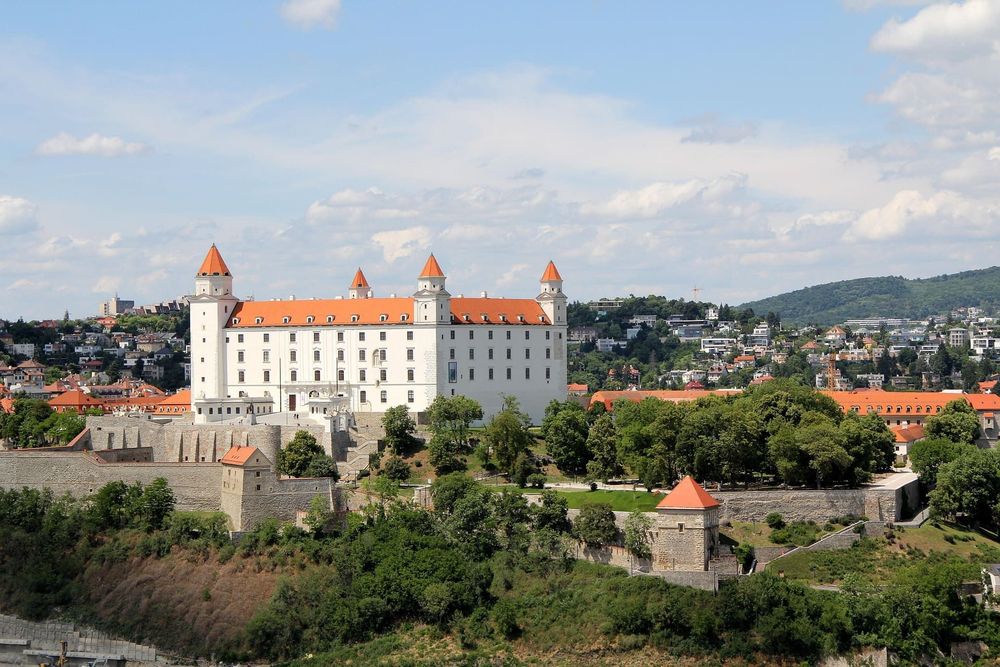
Bratislava Castle is the flagship monument of the city. Perched on a hill that dominates the Danube, inhabited for millennia, it watches over the Slovak capital. The Bratislava audio-guided tour stops here to evoke this emblematic fortress, a symbol of the city and its history.
Standing on the heights of a hill dominating the Danube, Bratislava Castle occupies a site inhabited for millennia, already fortified in Antiquity. Built, destroyed and rebuilt several times over the centuries, it today presents its characteristic outline, a large white building flanked by four corner towers. It houses collections and testifies to the rich past of the city and of Slovakia.
You admire the white fortress and its four towers, the ramparts, the gardens and the collections of the museum it houses. From the hill, the view of the Danube and the city is spectacular. It is the must-see site of Bratislava, at once a historic monument, a museum and a belvedere over the capital.
Bratislava Castle lies on a hill dominating the Danube, above the old town, reachable on foot by a climb. The surroundings, ramparts and gardens can be freely admired; access to the interior museum has a fee and follows its own hours, which vary with the season. It is best to check them before coming.
Because it is the flagship monument of the city, a millennial fortress dominating the Danube, a symbol of Bratislava and the history of Slovakia.
On a hill dominating the Danube, above the old town of Bratislava.
Aucun avis pour le moment
