





Walk
The Land of the Morning Calm
Seoul, South Korea
Walk
The Land of the Morning Calm
Seoul, South Korea
7.2 km
Distance
3h00
Durée
20
Audios
Loop
Parcours
Shutterstock
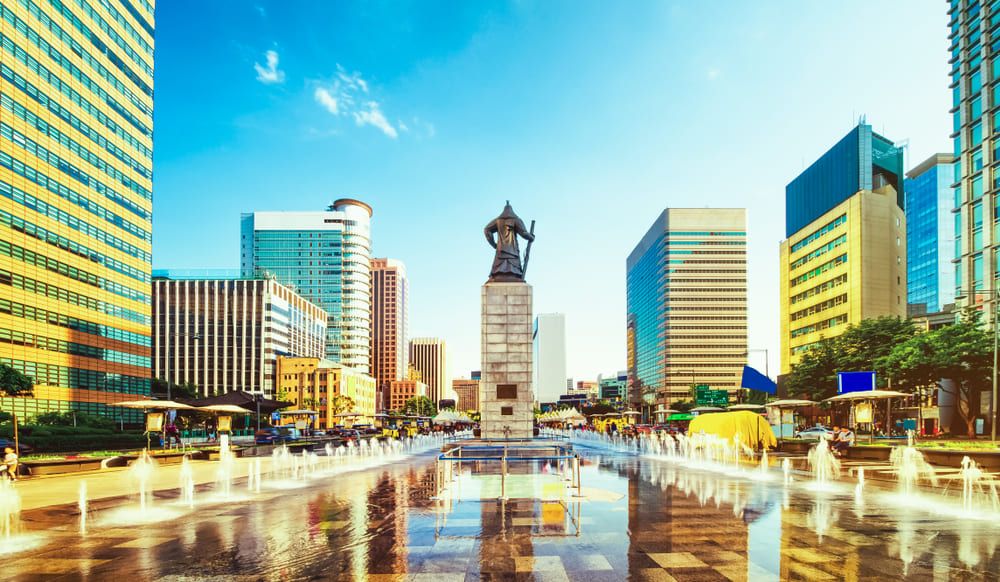
The Seoul audio-guided tour takes you to Gwanghwamun Square, one of the most important in the city. It leads straight to Gyeongbokgung Palace and offers an unobstructed view of Mount Bukhansan, considered the protective mountain of the capital.
Inaugurated in 2009, the square takes its name from the Gwanghwamun gate, the main gate of the former royal palace. It extends along the former main street of Seoul, laid out at the time when King Taejo took power in the fourteenth century. A place of meeting, of walking but also of gatherings for the inhabitants, it now beats to the rhythm of the city and forms one of its symbolic hearts.
The square is adorned with two large statues. At its end stands that of Admiral Yi Sun-sin, a national hero who, in the sixteenth century, saved the country many times from Japanese invasions and conceived the turtle ship, an armoured vessel of which a reproduction stands just in front of the statue. Higher up, the statue of King Sejong the Great dominates the esplanade. Fountains and water installations animate this vast space open onto the palace and the mountain.
Gwanghwamun Square is in the heart of Seoul, in the extension of Gyeongbokgung Palace. It is a public space freely accessible at all hours and on the level. A much-frequented gathering place, it regularly hosts events and demonstrations.
It refers to the Gwanghwamun gate, the main gate of the former royal palace, towards which the square leads directly.
Two national heroes: Admiral Yi Sun-sin, victor over the Japanese invasions of the sixteenth century, and King Sejong the Great, inventor of the Korean alphabet.
Aucun avis pour le moment
