



Walk
The Story of a Promised Land
Salt Lake City, United States
Walk
The Story of a Promised Land
Salt Lake City, United States
Distance
4.8 kmDurée
2h00Audios
23Parcours
Loop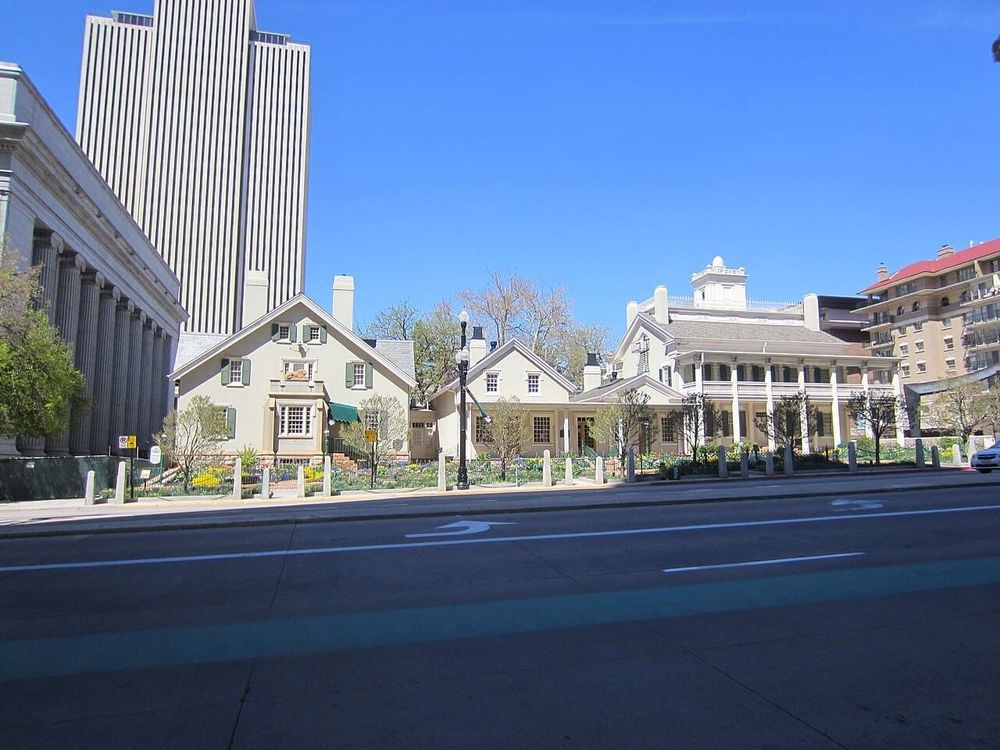
©Another Believer, CC BY-SA 4.0 <https://creativecommons.org/licenses/by-sa/4.0/deed.fr>via Wikipedia Commons
The group of historic buildings in front of you is known as the Brigham Young Complex, named after the Mormon leader who guided the pioneers to the Great Salt Lake Valley. And the building on your right, at the corner, was actually his main residence. Known as the Beehive House, it was built in 1854 in the Greek Revival style and takes its name from the beehive perched on its roof. Far from being just a decorative detail, the beehive symbolizes hard work and cooperation, values that were central to the pioneer community and would later become an emblem of Utah. This was where Brigham Young received important visitors and conducted much of his public life. After his time, the house became the residence of other Church presidents before eventually being turned into a museum. Just to its left stands the Lion House, which tells a rather different side of the story. Built between 1855 and 1856, it takes its name from the stone lion above the entrance. Longer, more functional, and almost austere in appearance, this building housed several of Brigham Young's wives and their children. And its interior reflected the practical needs of such a large household, with a shared kitchen, laundry facilities, a classroom, and rows of small bedrooms. Rather than a luxurious mansion, it was a place designed around the demands of everyday family life. Between the two houses stood Brigham Young's offices, where he handled both religious affairs and, for a time, the political administration of the territory. Together, these buildings formed something of a small center of power, combining family life, Church leadership, and government business in one place. And if you'd like to discover another side of Salt Lake City's religious heritage, there's an interesting stop just a little farther along South Temple Street. A few hundred yards (a few hundred meters) from here, you'll find the Cathedral of the Madeleine, one of the city's most important Catholic landmarks. Built in the early 20th century, its Romanesque Revival architecture incorporates Gothic influences, creating a striking contrast with the buildings you've just seen. Its twin towers make it easy to recognize, while inside, stained-glass windows, frescoes, and colorful vaulted ceilings create a richly decorated interior.
Aucun avis pour le moment
