





Walk
From a Historic Pueblo to Contemporary Art
Los Angeles, United States
Walk
From a Historic Pueblo to Contemporary Art
Los Angeles, United States
4.5 km
Distance
2h00
Durée
29
Audios
Loop
Parcours
Shutterstock
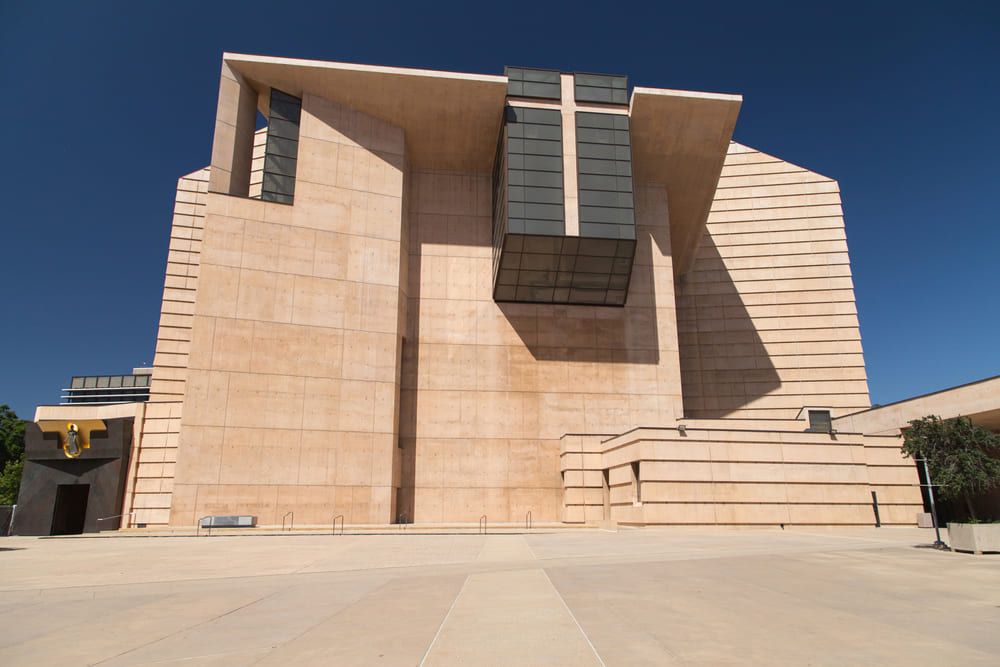
The Cathedral of Our Lady of the Angels resembles no other cathedral. The mother church of the Catholic archdiocese of Los Angeles, it deploys a resolutely contemporary architecture. The Los Angeles audio-guided tour stops here to evoke this modern and bold monument, at once a place of worship and a major architectural work of the city.
Located at 555 West Temple Street, the Cathedral of Our Lady of the Angels is the mother church of the Los Angeles archdiocese. The work of Spanish architect Rafael Moneo, its postmodern, angular and controversial architecture deliberately breaks with traditional models. It succeeded a former cathedral and embodies the contemporary face of Catholicism in the Californian metropolis.
The building strikes by its geometric volumes, its worked light and its stripped interior, worlds away from Gothic cathedrals. Here you discover tapestries, contemporary artworks and a great organ. It is an astonishing stop for lovers of architecture, showing a radically modern approach to the place of worship, in the heart of Los Angeles.
The Cathedral of Our Lady of the Angels lies at 555 West Temple Street, in the Civic Center, in the centre of Los Angeles, reachable on foot and by public transport. A working Catholic place of worship, it can be visited with respect for services; entry is generally free, but hours vary with the season and celebrations. It is best to check them before coming.
The Spanish architect Rafael Moneo, in a bold postmodern style; it is the mother church of the Catholic archdiocese of Los Angeles, at 555 West Temple Street.
Its postmodern, angular and resolutely contemporary architecture, which breaks with traditional models and makes it a monument apart in the landscape of cathedrals.
Aucun avis pour le moment
