



Walk
A city of ideas, art and memory
Philadelphia, United States
Walk
A city of ideas, art and memory
Philadelphia, United States
Distance
7 kmDurée
3h00Audios
26Parcours
Loop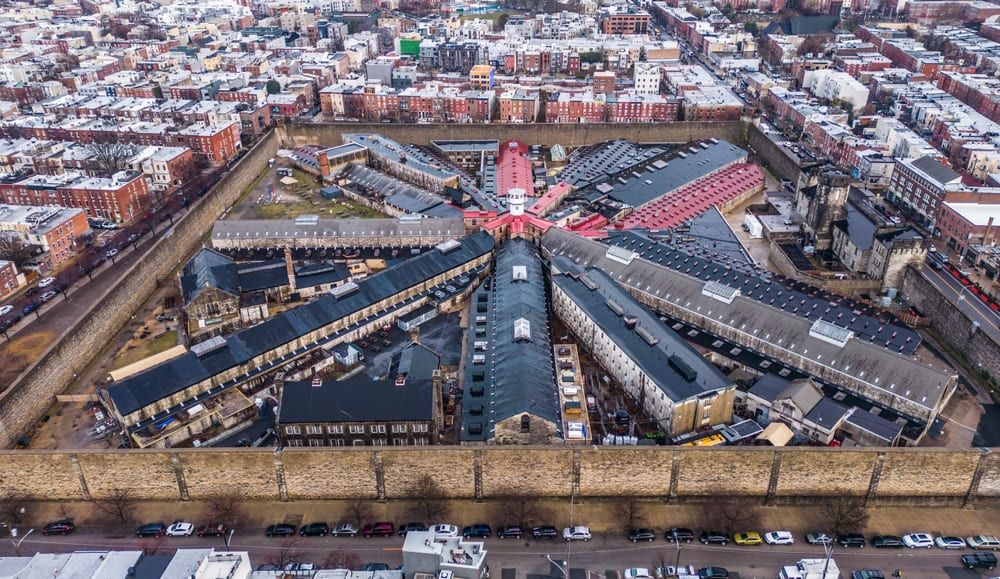
Shutterstock
This building looks like a castle, but it’s actually the Eastern State Penitentiary, a striking prison whose history becomes even more fascinating when you hear the stories behind it. Opened in 1829, it introduced a completely new idea: the goal wasn’t just to punish, but to encourage repentance. The principle was simple but radical—each inmate was kept alone in their own cell with a tiny private yard, meant to reflect in silence on their actions. This became known as the “Pennsylvania System.” Critics were quick to speak out. In 1842, Charles Dickens visited and called the isolation cruel and damaging. Still, the system influenced hundreds of prisons around the world. The architecture was built around this idea, with a radial “hub-and-spoke” design: wings stretching from a central point made it easier to keep inmates separated while supervising efficiently. But over time, the reality of overcrowding took over. Originally built for about 250 people, it held up to 1,700 by the early 20th century. Isolation became impossible, rules loosened, and the system was abandoned in 1913. It was during these later years that some of the prison’s most famous stories happened. One involves Al Capone, nicknamed “Scarface,” one of America’s most notorious gangsters, who spent just seven months here in 1929 for carrying a weapon. His cell was said to be more comfortable than most, with rugs and furniture, though that image was likely exaggerated. Another unforgettable story is the escape of Willie Sutton, “Slick Willie,” one of the country’s most infamous bank robbers. In 1945, he and accomplices dug a tunnel from their cell to break out. Sutton, known for his cleverness and calm under pressure, had pulled off multiple escapes before, often using disguises or clever tricks. This breakout cemented his reputation as elusive, though he was caught a few years later. Eastern State stayed in operation until the 1960s and officially closed in 1970. Abandoned for years, it narrowly avoided demolition before being turned into a historic site. Today, its walls are deliberately left in ruins, letting visitors feel the weight of the prison. Walking through the corridors, you can sense both the bold experiment in prison reform, its limits, and the many human stories that played out here.
Aucun avis pour le moment
