
Créé par Camille, le 17 nov. 2026
Votre guide Ryo
Philadelphia, United States
The birth of a nation
Parcours audioguidé pour visiter Philadelphia en 1 jour
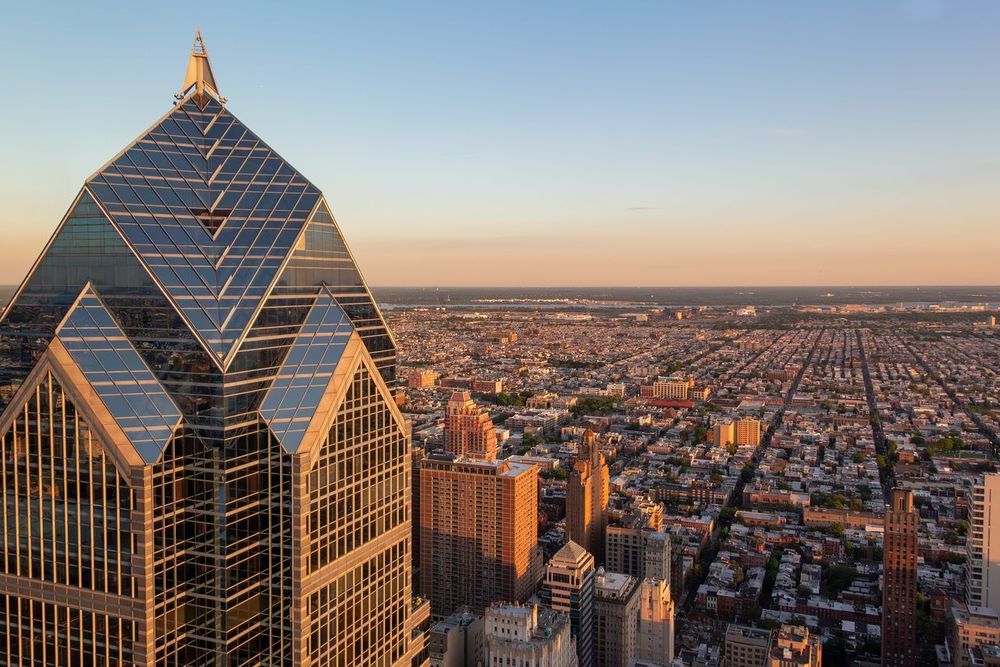
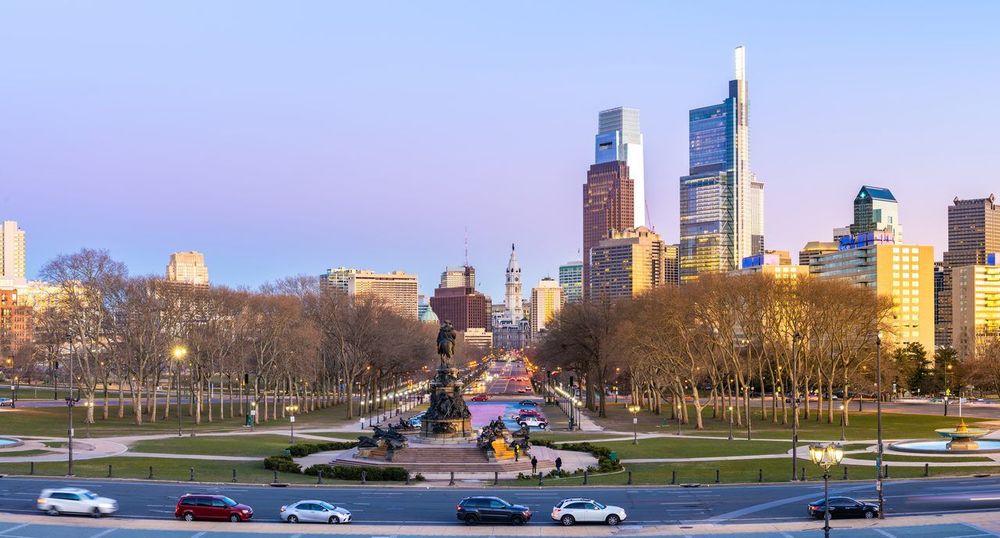
This tour of Philadelphia takes you right into the heart of a city where American history comes alive at every turn, with colonial buildings, lively public squares, and iconic landmarks that shaped the nation. As you walk along, you’ll discover the energy of Independence Hall, the Liberty Bell, and the very streets where the Declaration of Independence was born, places that capture the city’s unique identity as the birthplace of American democracy.
Quand partir à Philadelphia ?
Jan.
1°
7
Feb.
2°
7
March
6°
8
April
12°
9
May
18°
10
June
23°
10
July
26°
11
Aug.
24°
10
Sept.
21°
8
Oct.
14°
7
Nov.
8°
7
Dec.
3°
8
Philadelphia has a humid continental climate, with four distinct seasons. Summers are hot and often humid, with temperatures that can climb above 30°C, while winters are cold, with temperatures around 0°C and occasional snowfall. Spring and fall are generally more pleasant, with temperatures between 10°C and 25°C and a lighter, more comfortable feel in the air. Rain is spread fairly evenly throughout the year, so there’s no real dry season. The best times to visit are spring, from April to June, and fall, from September to October, when the weather is at its most comfortable and the city looks its best. Summer is lively but can feel quite heavy because of the humidity, while winter is quieter and can be a good option if you don’t mind the cold and want to avoid the crowds.
Départ conseillé
We design our tours as loops so you can easily start from the point closest to you, with the guidance adjusting automatically along the way. If you’re nearby, a great place to begin is Independence Hall
Parking à proximité
Old City Parking, 304 Race St, Philadelphia, PA 19106, United States.
To explore downtown Philadelphia, the easiest option is to park near the main sites. A convenient choice is Old City Parking, which puts you within easy walking distance of places like Independence Hall and the Liberty Bell, while helping you avoid heavier traffic in the city center. You can also use other public parking lots, or park a bit farther out and reach downtown on foot or by public transport.
À savoir
Parking rules are strict and closely enforced, so it’s important to always check the signs to avoid a ticket. Tipping is a standard part of everyday life in the United States: in restaurants, bars, and taxis, people usually leave between 18 and 22 percent of the bill, as staff depend on it for a large part of their income.
Découvrez 24 lieux d'intérêt pour visiter Philadelphia




What to see in Philadelphia on your 2h tour?
This 4.7 km loop takes about 2 hours and links 23 sights across Philadelphia's old town. It starts at Independence Hall and the Liberty Bell, winds through the colonial lanes of Elfreth's Alley, reaches the Delaware riverfront and the Benjamin Franklin Bridge, then loops back past Carpenters' Hall, historic churches and Washington Square to Congress Hall. With the Ryo app, the story weaves the birth of the United States together with the often-silenced histories of slavery and the communities who built the city.
Information checked in October 2026 and subject to change.
1 - Independence Hall
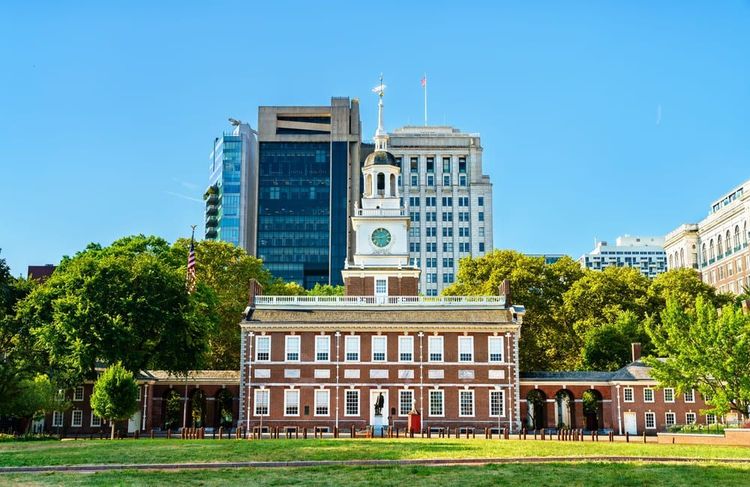
This red-brick building, raised between 1732 and 1753 as a plain colonial administrative seat, hosted the Second Continental Congress from 1775. George Washington was named commander of the continental army here, and delegates voted for independence in July 1776. In 1787 the Constitutional Convention drafted the Constitution still in force today. UNESCO-listed, it owes its weight to the ideas born inside more than to its architecture.
Free entry
2 - Liberty Bell
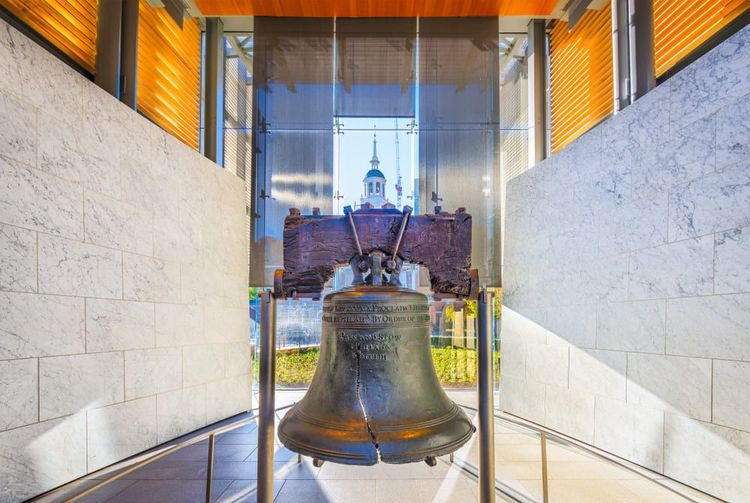
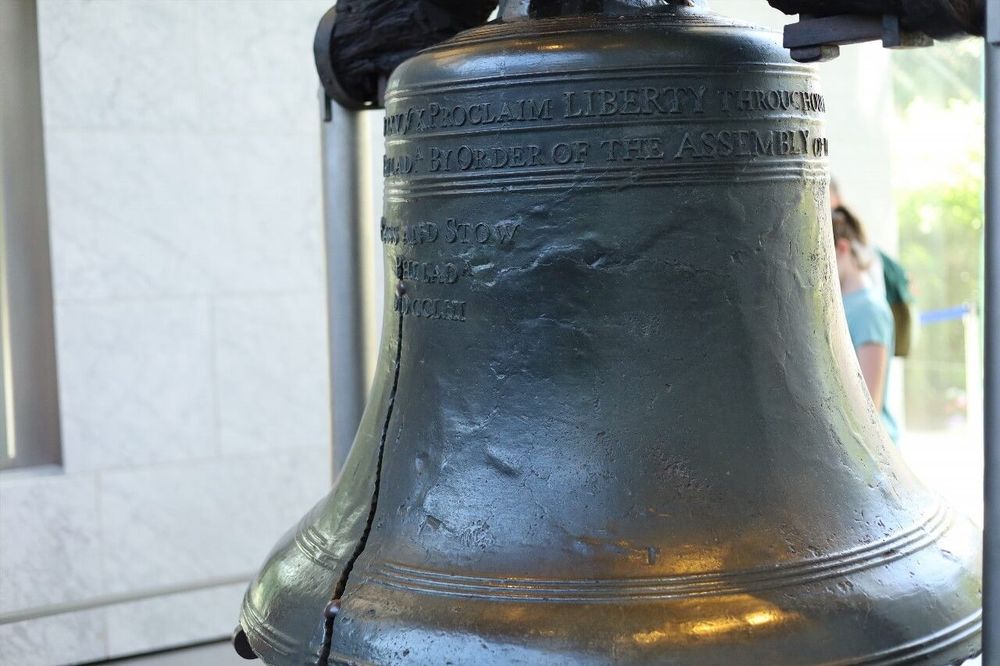
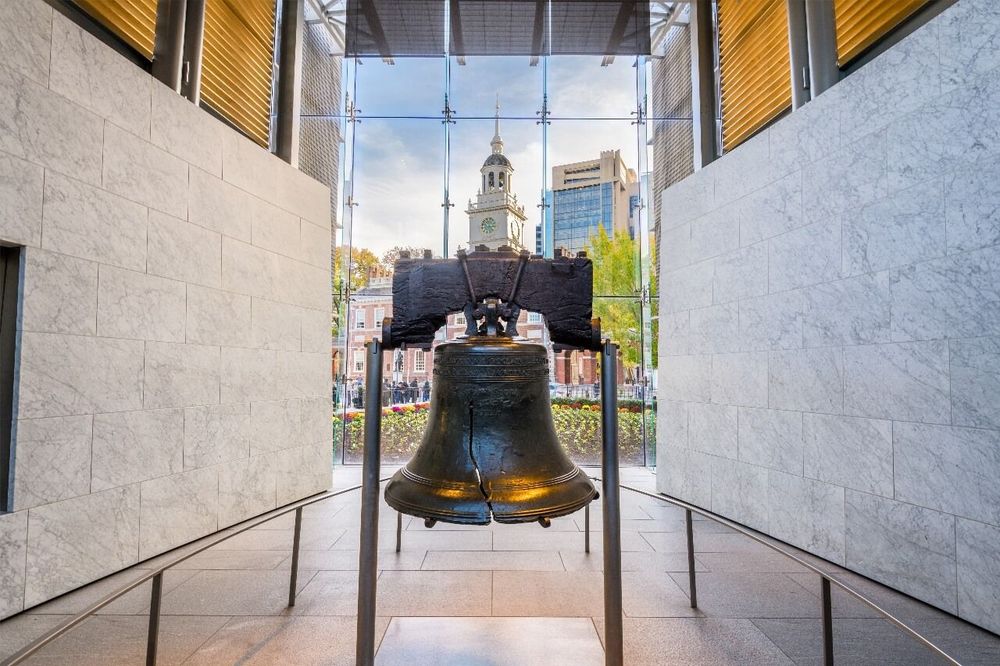
Ordered in 1751 for the bell tower of what is now called Independence Hall, this bell cracked on arrival from London and had to be recast on site in 1753. It long served to call assemblies, before 19th-century abolitionists adopted its biblical inscription as a symbol of freedom. Left silent after a botched repair in 1846, it can now be viewed free of charge at the Liberty Bell Center.
Free entry
3 - The history of slavery in the United States
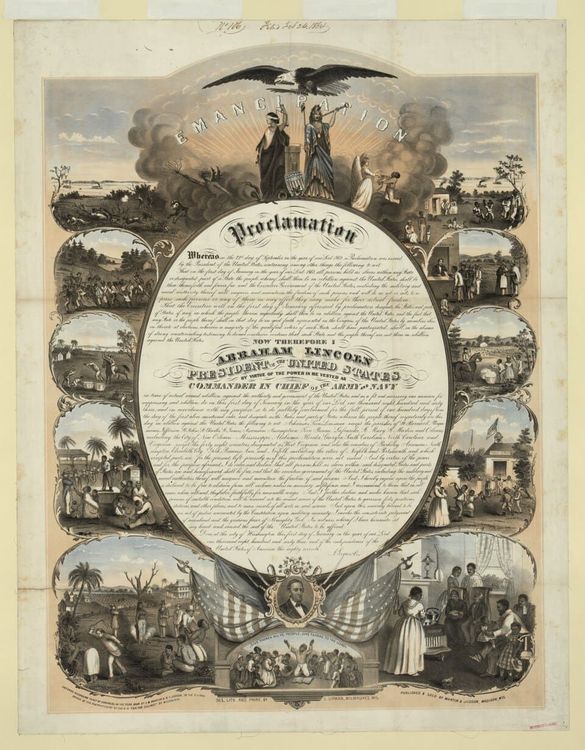
From the early 17th century, slavery took root in what would become the United States, intensified a century later by the cotton boom. Enslaved people resisted constantly, sometimes through networks such as the Underground Railroad. The Civil War officially ended the system: Lincoln proclaimed emancipation in 1863, and the 13th Amendment abolished it in 1865. Equality, though, remained to be built, and this past still shapes the country today.
Free entry
4 - President's House
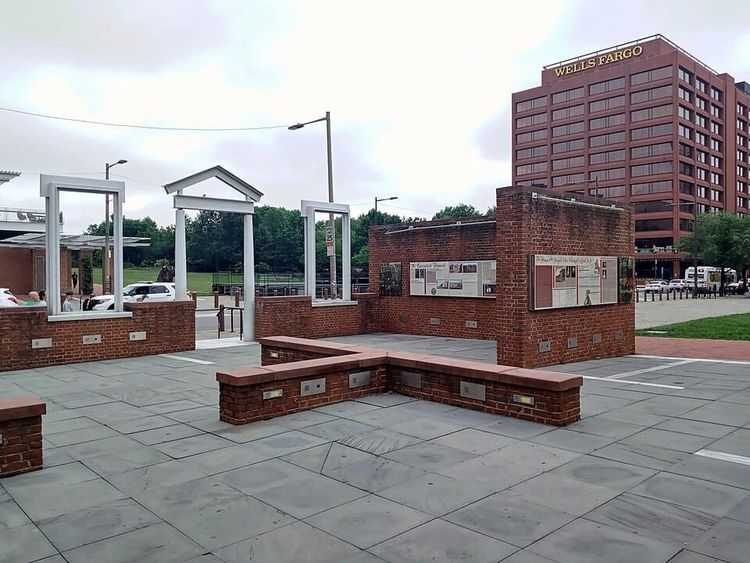
In the 1790s, while Philadelphia served as temporary capital, this site held the residence of the first two presidents, George Washington and John Adams. Washington received diplomats and cabinet officers there, yet several people he held in bondage lived and worked in that same house, steps from the very texts proclaiming liberty. Demolished in 1832, it survives only as open-air foundations, inviting reflection on that founding contradiction.
Free entry
5 - Different waves of immigration
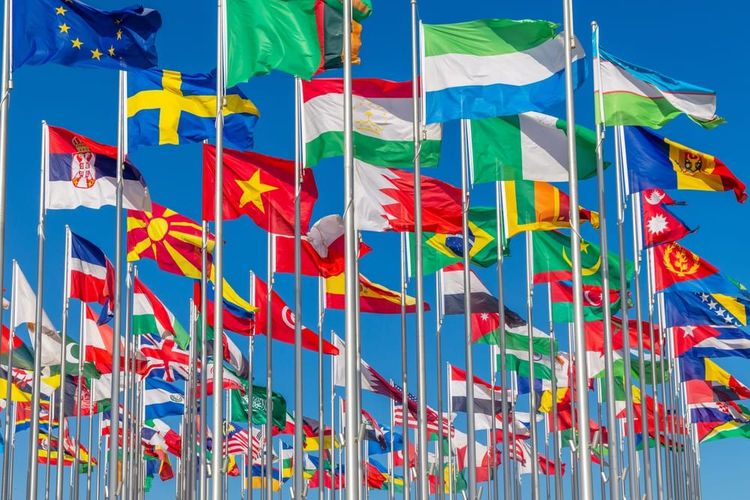
Facing you stands Weitzman National Museum of American Jewish History, where you trace more than 3 centuries of Jewish presence, from early colonial port settlements to the integration enabled by the Constitution. But Philadelphia itself grew through successive waves: the Lenni Lenape, William Penn's Quakers, then Irish, Italian and African American communities, and more recently Puerto Ricans and Asian newcomers. These layered stories recall that the whole country was shaped by continuous migration.
Free entry
6 - Franklin Family Grave
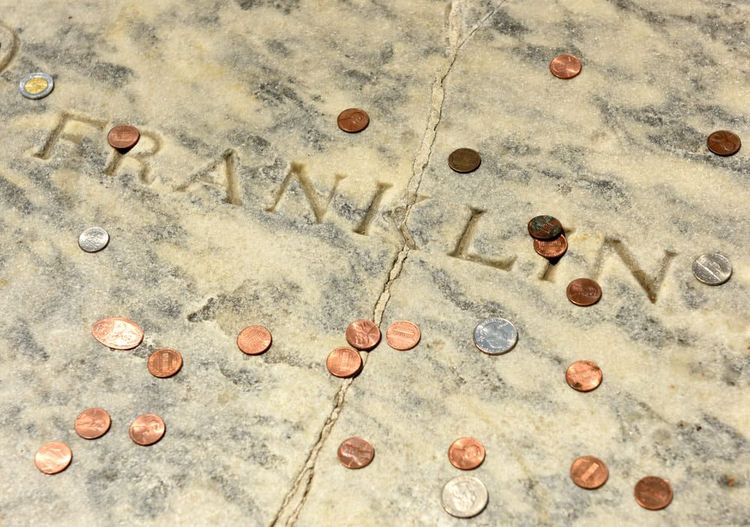
Behind this fence at Christ Church Burial Ground lies Benjamin Franklin, buried here since 1790 beside his wife Deborah and 2 of their children. His grave, a plain marble slab, nonetheless draws a popular custom: tossing a coin onto it, echoing his saying about a penny saved. That habit eventually damaged the stone, restored in the 21st century. Opened in 1719, the cemetery holds roughly 1,400 graves, including other signers of independence.
Free to see from outside
7 - Betsy Ross House
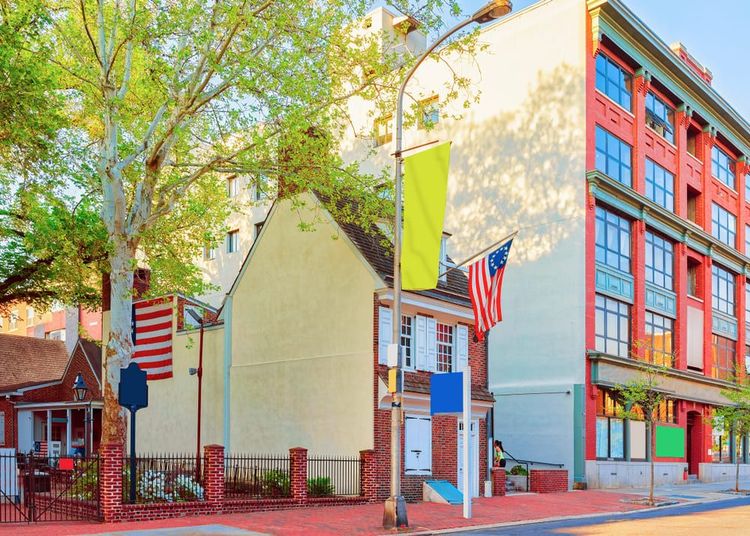
In this 18th-century house, legend holds, lived the seamstress credited with the first American flag, its 13 stars arranged in a circle. Historians remain cautious: no evidence confirms she designed it, though she did sew flags afterward, for the Pennsylvania navy from 1777 onward. Beyond the tale, the house mostly tells the everyday story of a widowed businesswoman making her way in colonial America.
Paid entry (about $12)
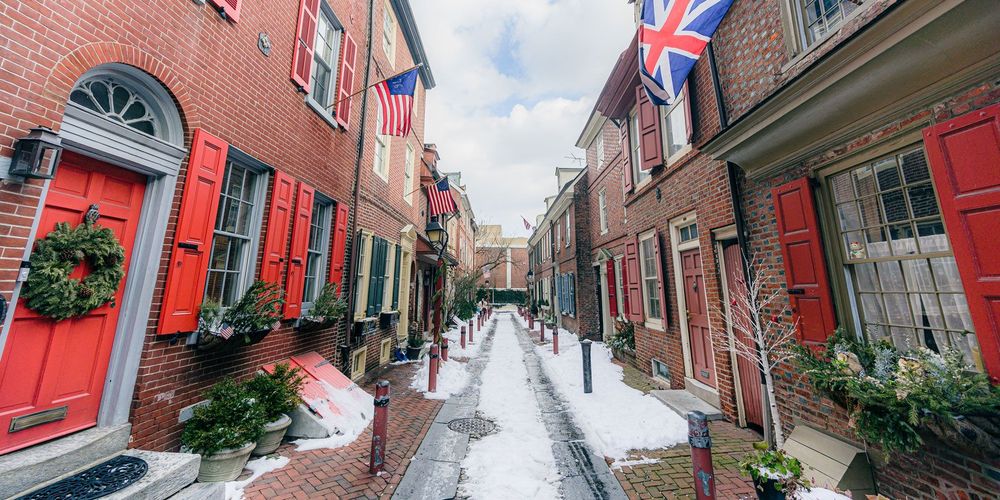
8 - Elfreth's Alley
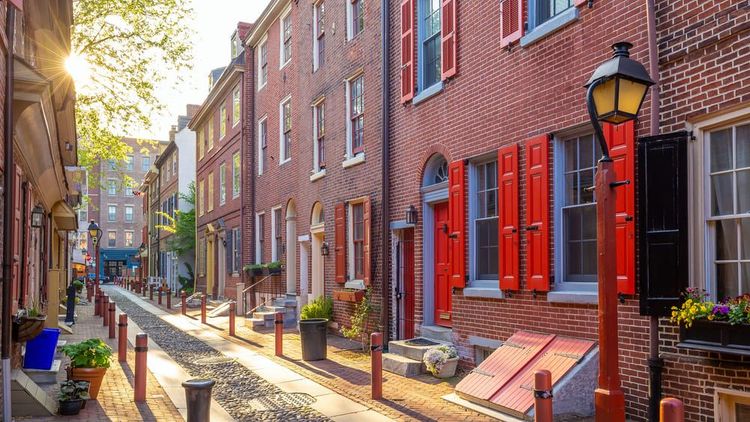
Born around 1703 from a simple passage cut between two streets for dockside craftsmen, this cobbled lane ranks among America's oldest streets still lived in today. Its houses, built between 1720 and 1836, long sheltered cobblers, carpenters and tailors, sometimes as many as 8 families across two neighbouring homes. A small museum at numbers 124 and 126 revives that everyday craft life, far from the great political names.
Free to see from outside · Allow 40 min
9 - Mural and History
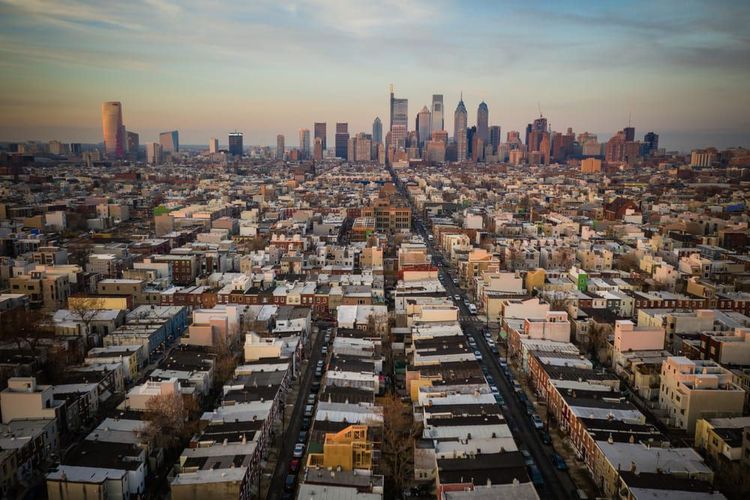
This mural, blending magnolias with a city skyline, echoes the balance William Penn already pictured when he founded the city in 1682, with its gridded streets and open spaces. Before him, the region belonged to the Lenni Lenape; after his arrival, Swedes, Dutch and then English settlers moved in. Penn gave his name to Pennsylvania and coined Philadelphia, brotherly love, which by the 18th century had become a leading colonial political hub.
Free entry
10 - Benjamin Franklin Bridge
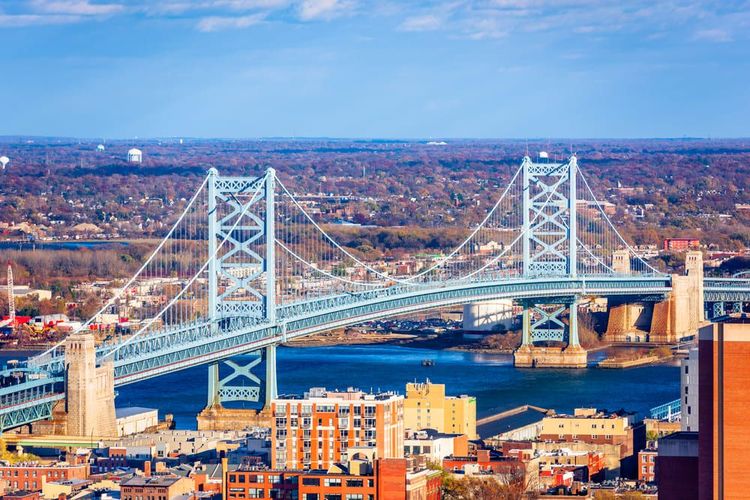
This suspension bridge, completed in the 1920s as the Delaware River Bridge and later renamed for Benjamin Franklin, links Philadelphia to Camden across the Delaware River. On opening it briefly ranked as the world's longest suspension span, and today carries cars, trains and pedestrians alike. Across the water sits the USS New Jersey, the nation's most decorated battleship, now a museum after service from the Second World War to the Gulf War.
Free entry
11 - Fire escapes
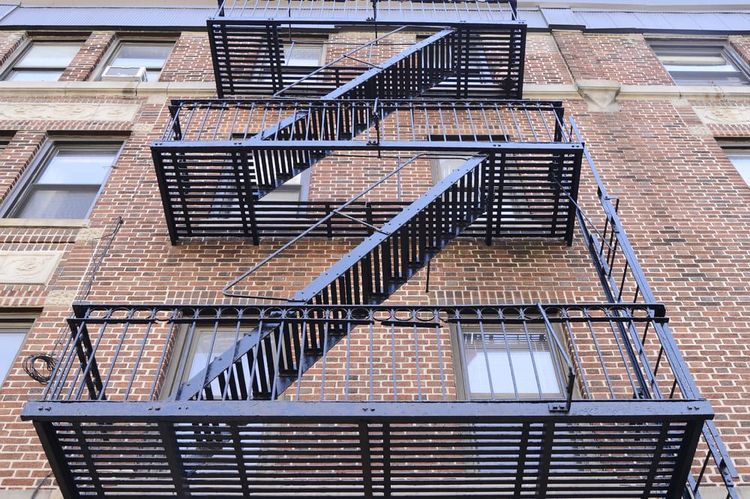
These zigzagging metal staircases bolted onto the façades were never part of the buildings' original design: they only appeared once American cities started climbing higher from the 19th century onward, and fire risks climbed with them. Fitted on the outside, they provided a second way out without rebuilding anything. Philadelphia passed one of the country's first laws requiring such exits as early as 1876, and they have since become an almost emblematic detail of the east-coast skyline.
Free entry
12 - Corn Exchange National Bank
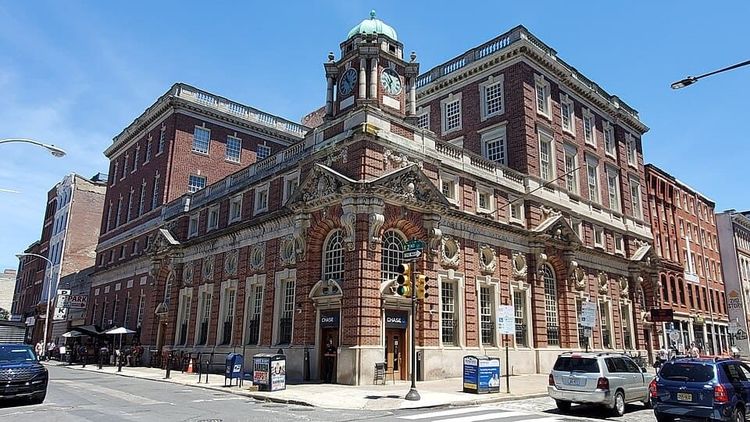
This corner building once housed the Corn Exchange National Bank, founded in 1858 by grain merchants in a district then oriented toward the docks. The current structure, raised at the turn of the 20th century, carries an off-centre tower added under architect Horace Trumbauer. The bank vanished in 1951 after several mergers, yet its name still stands carved on the façade, a trace of a corner that saw dockside trade give way to financial power.
Free to see from outside
13 - Custom House
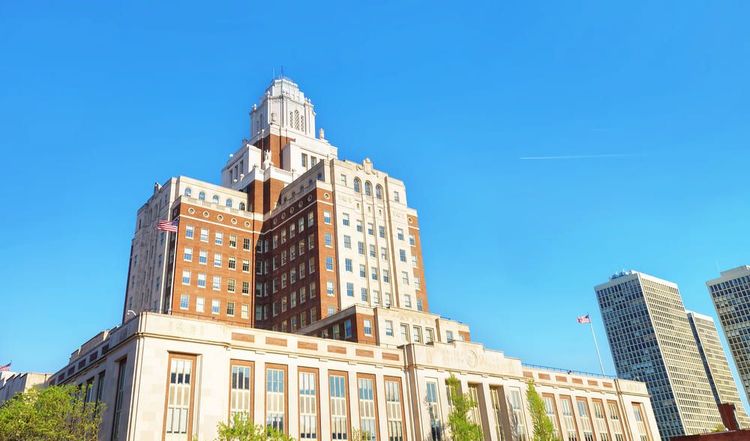
This imposing federal building, raised between 1932 and 1934 in the depths of the Great Depression, houses the United States Custom House, where incoming goods have long been inspected and taxed. The large public project also aimed to create jobs amid the crisis sparked by the 1929 crash. Nearby was born Charles Brockden Brown, a pioneer of the American novel, whose work Wieland went on to influence writers such as Edgar Allan Poe.
Free to see from outside
14 - Museum of the American Revolution
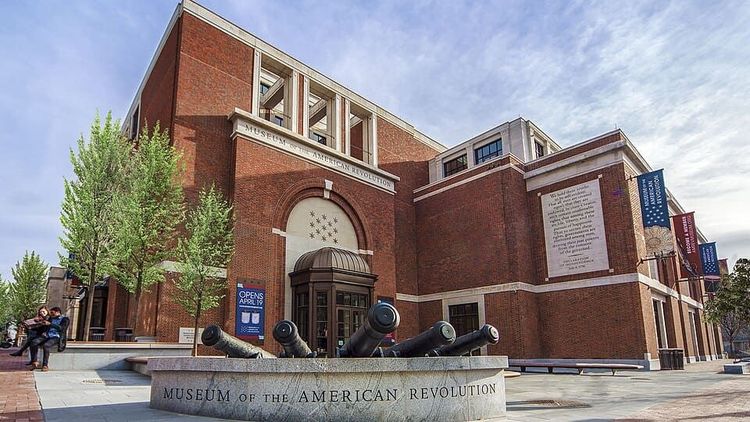
Facing these cannons stands the Museum of the American Revolution. Inaugurated in 2017, it tells the story of the 1775-1783 war of independence and the birth of a state built on popular sovereignty. Its façade bears an inscription drawn from the 1776 Declaration proclaiming that all men are equal. Among several thousand objects, George Washington's campaign tent remains the collection's most striking piece.
Paid entry
15 - Second Bank of the United States
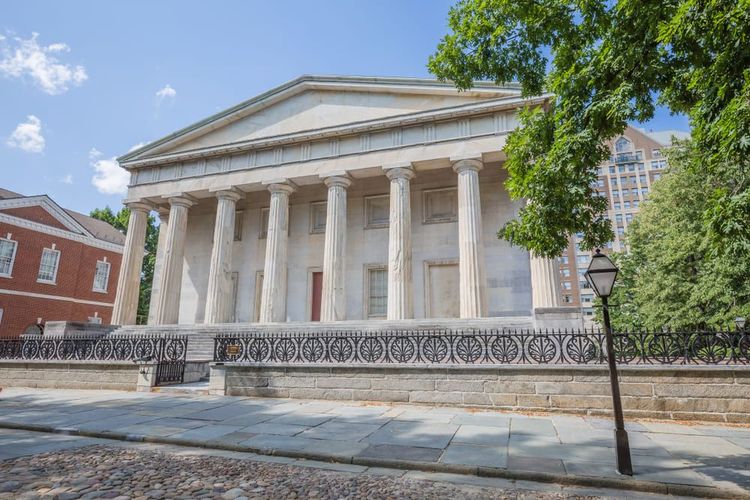
With marble columns recalling a Greek temple, this bank, created in 1817, was meant to stabilise the young country's finances once the 1812 war with Britain ended. It is best remembered for the Bank War, the clash between its president Nicholas Biddle and Andrew Jackson, who believed it favoured financial elites far too much. The presidential veto and withdrawal of federal deposits led to its demise in 1836, a key moment in the ties between politics and finance.
Free entry
16 - Carpenters' Hall
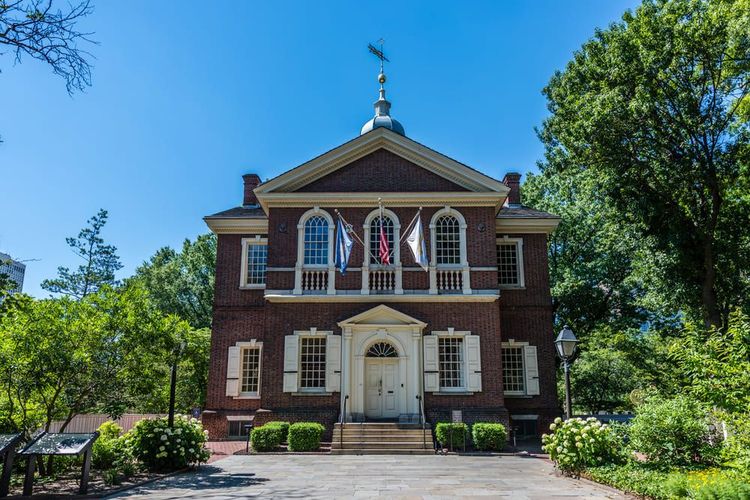
Built from 1770 for a guild of building craftsmen, Carpenters' Hall hosted the First Continental Congress as early as 1774, where the colonies coordinated their first common response to Britain. As a private rather than official space, it allowed freer discussion, and Benjamin Franklin quietly met a French envoy there in 1775. Over the following decades it also served in turn as a library, an infirmary and a hospital.
Free entry
17 - Old Saint Mary's Church
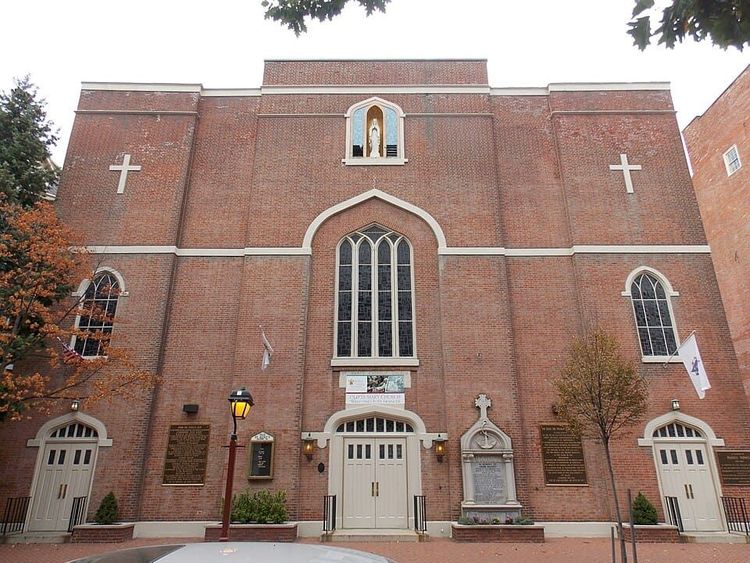
Founded in 1763, this Catholic church became the diocese's first cathedral in the early 19th century, in a country still largely Protestant and wary of Catholicism. In 1779 it hosted the first public commemoration of the Declaration of Independence, attended by Washington and Adams, a diplomatic gesture toward the colonies' Catholic allies, France and Spain. Its cemetery, opened in 1759, holds John Barry, regarded as the father of the American navy.
Free entry
18 - James Madison's House
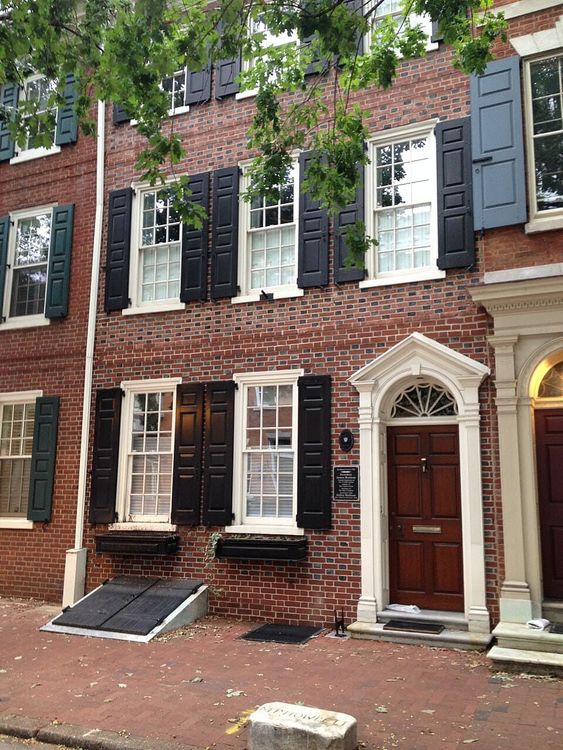
A simple plaque marks that James Madison, future Father of the Constitution, lived here with his wife Dolley between 1794 and 1797, before becoming the fourth president of the United States. Dolley Madison, widowed by an earlier marriage struck by yellow fever, later became one of the most influential First Ladies, known for gatherings that eased political tensions, and for saving a portrait of Washington during the 1814 burning of the White House.
Free to see from outside
19 - Memory of an epidemic and portraits
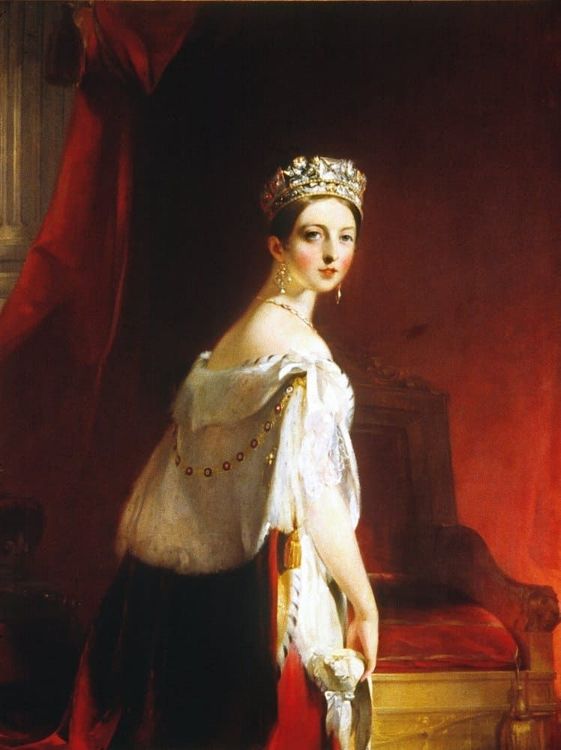
Founded in 1789 for the German-speaking community, Holy Trinity Church keeps the memory of the 1790s yellow fever epidemics, which killed roughly 5,000 people in 1793 alone and left many children orphaned; in 1797 the church founded what is considered the country's first Catholic orphanage. Across the street lived the painter Thomas Sully, born in 1783, whose thousands of portraits, from Jefferson to Queen Victoria, gave a face to America before photography.
Free entry
20 - Mother Bethel AME Church
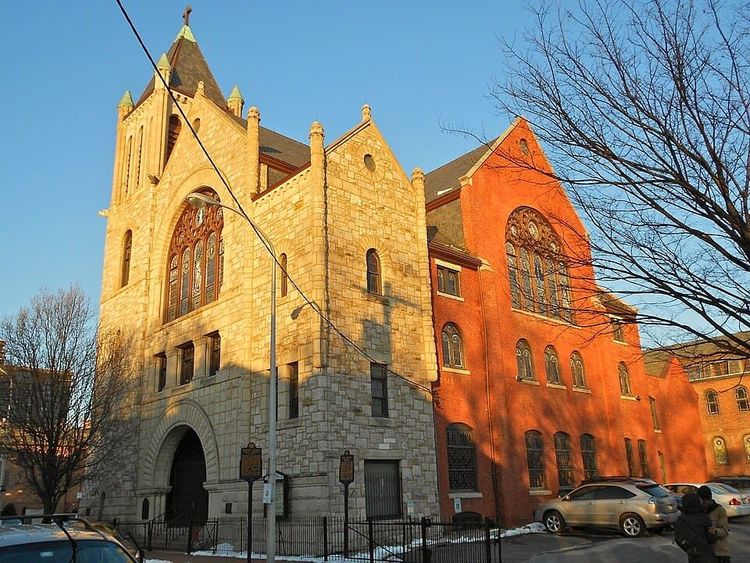
Facing you stands Mother Bethel A.M.E. Church, born from the Free African Society founded in 1787 by Richard Allen and Absalom Jones to organise a Black community confronted with exclusion despite the city's professed ideals of freedom. Philadelphia became a hub of abolitionism, then a site of struggles for voting and civil rights, up to the election of its first Black mayor in 1984, a milestone in a story still central to America's own.
Free entry
21 - Tomb of the unknown soldier
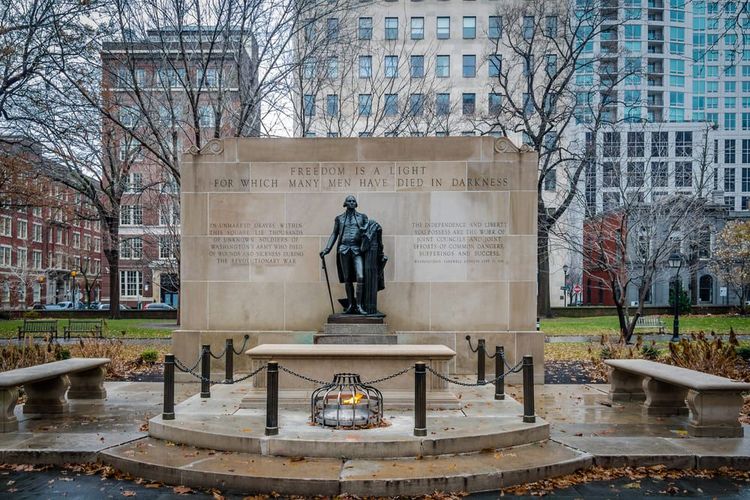
This quiet garden, one of five parks envisioned by William Penn, served in the 18th century as a public burial ground for the unnamed, for enslaved people and soldiers of the independence war, then for victims of the yellow fever epidemics. A monument has honoured these nameless soldiers since 1957. Renamed in George Washington's honour, the square invites reflection on a man born a Virginia planter who became the first president before willingly stepping down.
Free entry
22 - Independence Square
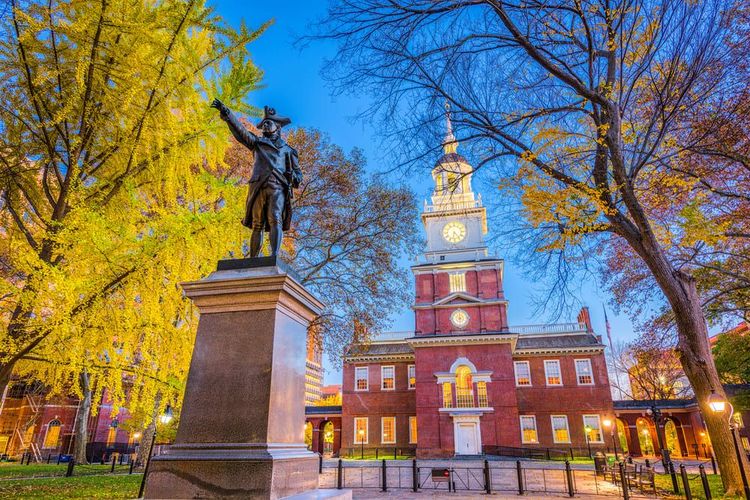
This former public ground, laid out from 1732 around Independence Hall, quickly became a political stage where residents gathered in support of independence. Around the square, Old City Hall housed the Supreme Court between 1791 and 1800, Philosophical Hall shelters the learned society founded by Franklin, and a statue honours John Barry. Together these buildings sum up the birth of the United States: political power, justice, knowledge and military commitment.
Free entry
23 - Congress Hall
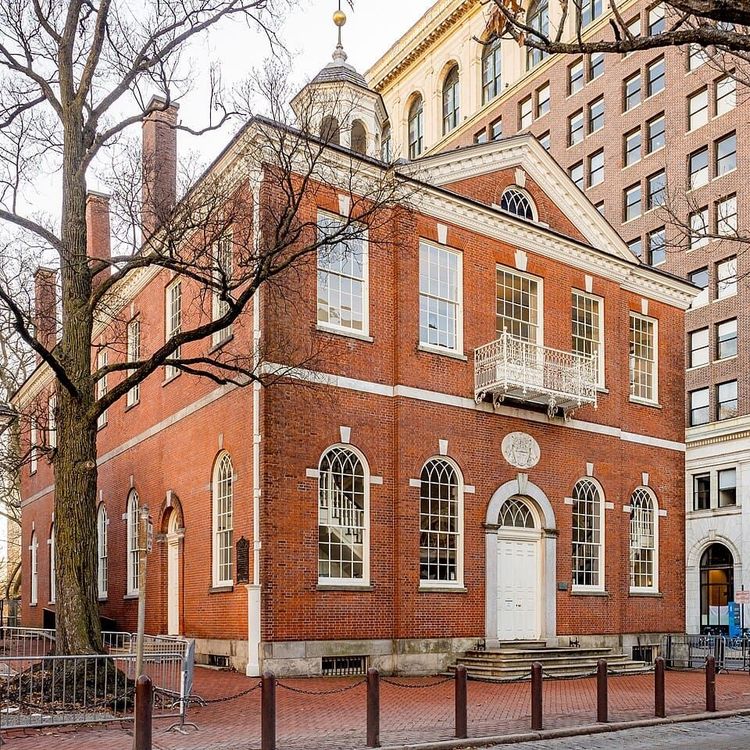
Built in the 1780s as a courthouse, Congress Hall served from 1790 to 1800 as the seat of Congress, with the House of Representatives on the ground floor and the Senate upstairs. George Washington was sworn in here for his second term, and John Adams succeeded him in the country's first peaceful transfer of power. Less famous than its neighbour Independence Hall, it represents the logical sequel: putting power into practice after the ideas were declared.
Free entry
What to do in Philadelphia in 2 or 3 days?
Half a day is enough to link the 23 stops on this route: 4.7 km and about 2 hours, from Independence Hall and the Liberty Bell to Congress Hall. With 2 or 3 days in the city, Philadelphia opens up well beyond Old City.
The next day, head toward the Philadelphia Museum of Art to climb its steps at sunrise, before the tour groups arrive, then wander through the Reading Terminal Market, which has filled the same aisles since 1893. Our pick of the best things to do in Philadelphia digs into these ideas and plenty more.
Day three suits the old prison where Al Capone once served time, before heading south to try a cheesesteak among the rowhouses of South Philly. The full day-by-day plan is laid out in our 3-day Philadelphia itinerary.
Which neighbourhoods does the tour cross?
Laid out as a loop, the route links pockets of old Philadelphia that each tell a different chapter of its history, from colonial lanes to federal halls.
It starts at Independence Hall and the Liberty Bell, passes markers on the history of slavery in the United States and the waves of immigration that shaped the city, then reaches the graveyard where Benjamin Franklin rests, the Betsy Ross House and the cobblestones of Elfreth's Alley, one of the oldest residential streets in the country, still lived in today (stops 1 to 8).
The path climbs toward the Delaware waterfront and the Benjamin Franklin Bridge, then loops back past the row of federal and financial buildings on Chestnut Street, from the Corn Exchange National Bank to Carpenters' Hall, where the First Continental Congress met in 1774 (stops 9 to 16).
The loop closes past the historic churches of the area, Old Saint Mary's Church and Holy Trinity, then Mother Bethel AME Church and Washington Square, before returning by Independence Square to Congress Hall (stops 17 to 23).
How much does it cost to visit Philadelphia?
Of the 23 stops on the route, 17 can be visited freely, and 4 more, like the graveyard where Benjamin Franklin rests or the small Elfreth's Alley museum, can be admired from the street at no cost. Only 2 require a ticket:
- the Betsy Ross House, where admission costs $12;
- the Museum of the American Revolution, which charges for entry.
Information checked in October 2026 and subject to change.
Where to stop for a bite along the tour?
The route doesn't pass directly through a covered market, but it does offer a genuine break by the water, near the Benjamin Franklin Bridge.
At stop 10, take a moment facing the Delaware River, with the USS New Jersey docked on the far bank. When hunger strikes, the cheesesteak, Philadelphia's own beef-and-melted-cheese sandwich, remains the city's signature bite, and our guide to things to do in Philadelphia points out just how much of a civic institution its late-night counters have made it.
What should you know before visiting Philadelphia?
A few practical points are worth sorting out before you go, from booking ahead to local customs and basic caution.
Independence Hall is free to enter, but the indoor visit requires a timed ticket: book it online at recreation.gov for a $1 fee, or pick one up on-site the same day.
As elsewhere in the United States, tipping is part of daily life: plan for 18 to 22 percent of the bill in restaurants, bars and taxis, since staff depend on it directly. Parking, meanwhile, is closely enforced, so it's worth always checking the signs to avoid a ticket.
On safety, North Philadelphia is flagged as a higher-risk area, especially at night: avoid leaving any ID or payment method in a parked car, and keep your passport somewhere secure.
What's on in Philadelphia right now?
As the year winds down, two events give Philadelphia's calendar its rhythm.
From November 20 to 22, the Philadelphia Marathon Weekend brings a marathon, a half-marathon and related races through downtown. From November 19 to January 3, Holidays in Franklin Square lights up with winter illuminations and a pop-up holiday market, including the Electrical Spectacle.
Information checked in October 2026 and subject to change.
Le plein d'inspirations
Explorez le monde en totale liberté, à pied au cœur des villes ou au fil des routes. Nos guides audios transforment chaque destination en une découverte culturelle immersive et unique.
FAQ for visiting Philadelphia
What is there to do in Philadelphia, from the Liberty Bell to the Rocky Steps?
The historic core is free: the Liberty Bell, cast in London in 1752, needs no ticket, while Independence Hall, where the Declaration of Independence was adopted and the Constitution drafted, requires timed tickets from March to December. Nearby, Elfreth's Alley is often called the country's oldest continuously inhabited residential street.
Climb the Philadelphia Museum of Art's steps at sunrise, then explore its 240,000 works and the world's largest Duchamp collection. Lunch at Reading Terminal Market, open since 1893, and don't miss Eastern State Penitentiary, where Al Capone once served time.
Explore more ideas in our 25 things to do in Philadelphia and our 25 unforgettable Philadelphia experiences.
How should you spend three days in Philadelphia?
Day one stays in Old City: book your Independence Hall tour on Recreation.gov ($1 fee, up to 30 days ahead), see the Liberty Bell, then Elfreth's Alley, lived in since 1702. Lunch at Reading Terminal Market before noon, take the City Hall tower tour up to the William Penn statue and end at Rittenhouse Square.
Day two follows the Benjamin Franklin Parkway to the Philadelphia Museum of Art. The plan also takes in the prison where Al Capone did his time and the rowhouses of South Philly.
Follow the day-by-day plan in our 3-day Philadelphia itinerary.
Can you visit Philadelphia without a car, and how do you get around?
Yes, for a stay centered on Center City and the historic district, a car isn't needed. William Penn's street grid makes the oldest neighborhoods very walkable: Rittenhouse Square to Independence Hall takes about 25 minutes on foot.
To go farther, you have the SEPTA subway, Regional Rail (the airport is 20 to 25 minutes away for $8.75), Indego bikes, and the PHLASH loop bus at $5 a day. Weekend service is less frequent, and rideshares quickly get expensive.
To compare your options and pick the best neighborhoods, read our guide to Philadelphia without a car.
Vos commentaires, idées et suggestions
Aucun avis pour le moment