



Walk
From Pacific Royalty to the Aloha Spirit
Honolulu, United States
Walk
From Pacific Royalty to the Aloha Spirit
Honolulu, United States
Distance
4.8 kmDurée
2h00Audios
25Parcours
Loop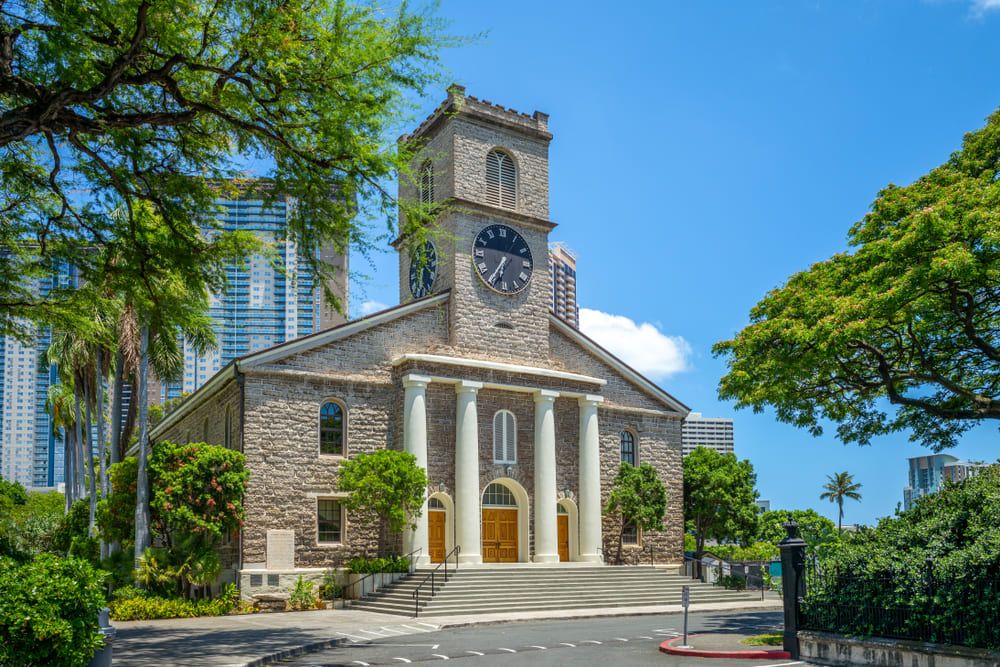
Shutterstock
To understand why this place is so important, we need to go back to a time long before Christianity arrived in Hawaii. The ground you're standing on was already considered a wahi pana, a sacred place of remembrance with deep roots in Hawaiian spiritual tradition. In fact, the name Kawaiahaʻo means "the water of Haʻo," and according to local legend, a sacred freshwater spring once flowed right here. Its waters were reserved for the ritual bathing of a high chiefess named Haʻo. The original spring no longer exists as it once did, but a small part of its history has been preserved. Look at the memorial on your left. It contains an authentic stone from the spring, a tangible reminder of the sacred waters that once flowed through this site. Now turn your attention to the church itself, inaugurated in 1842. At first glance, you might not realize just how extraordinary its construction was. Those massive walls aren't made of ordinary stone. They're built from 14,000 enormous blocks of coral, each weighing nearly a ton! To gather them, Hawaiian converts dove into the reefs off Oʻahu's southwestern coast, brought the blocks ashore by canoe, and then carried them here by hand. Just imagine the work involved in raising a building this size, one heavy coral block at a time. As the years went by, Kawaiahaʻo Church became closely associated with the Hawaiian monarchy. Kings were baptized and married here, and after their deaths, their bodies were laid out inside the church for public mourning. But one king chose to make this sacred ground his final resting place. His name was Lunalilo, and he was the first Hawaiian ruler to be democratically elected by the people. You'll find his mausoleum near the entrance to the church grounds, and there's a touching reason why it stands here. When Lunalilo died prematurely, he had already made his wishes clear. He didn't want to be buried alongside the royal dynasty in the grand Royal Mausoleum. Instead, out of loyalty to the people who had elected him, he asked to be laid to rest here, so that even in death, he could remain "among his people."
Aucun avis pour le moment
