






Walk
From a Historic Pueblo to Contemporary Art
Los Angeles, United States
Walk
From a Historic Pueblo to Contemporary Art
Los Angeles, United States
4.5 km
Distance
2h00
Durée
29
Audios
Loop
Parcours
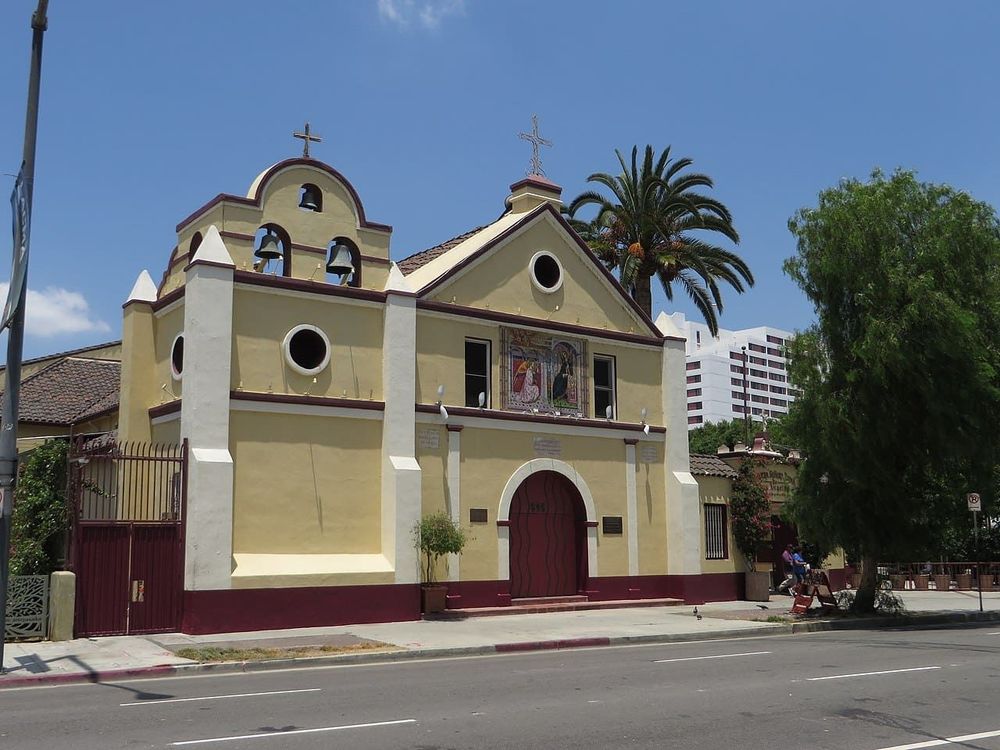
©Ken Lund CC BY-SA 2.0. <https://creativecommons.org/licenses/by-sa/2.0/deed.fr>via Wikipedia Commons
In the heart of El Pueblo, the church of Nuestra Señora la Reina de los Ángeles marks the birthplace of Los Angeles. It is here that the city was founded in 1781, under a much longer name. The Los Angeles audio-guided tour stops here to evoke the spiritual and Hispanic origins of the City of Angels, around this church full of memory.
In 1781, the village bore a much longer name: El Pueblo de Nuestra Señora la Reina de los Ángeles del Río de Porciúncula. It is from this name that the city inherited its own, Los Angeles, the city of angels. The church, dedicated to Our Lady Queen of the Angels, perpetuates the memory of this founding. Nicknamed the little church of the Pueblo, it remains a living place of worship in the heart of the historic district.
The church, modest and warm, is discovered facing the Plaza, in the Hispanic atmosphere of El Pueblo. A place of worship still frequented by the local community, it keeps an atmosphere of contemplation and a simple setting. It is an essential stop to understand the founding identity of Los Angeles, a stone's throw from Olvera Street.
The church lies facing the Plaza de Los Angeles, in the El Pueblo district, in the centre of the city, reachable on foot. A working Catholic place of worship, it can be visited with respect for services; entry is generally free, but hours vary with celebrations and the season. It is best to check them before coming.
Because it lies in the heart of El Pueblo, where the city was founded in 1781 under the name of Nuestra Señora la Reina de los Ángeles, from which Los Angeles inherited its name.
From the full name of the pueblo founded in 1781, El Pueblo de Nuestra Señora la Reina de los Ángeles, whose memory the church perpetuates.
Aucun avis pour le moment
