




Walk
A city of ideas, art and memory
Philadelphia, United States
Walk
A city of ideas, art and memory
Philadelphia, United States
Distance
7 kmDurée
3h00Audios
26Parcours
Loop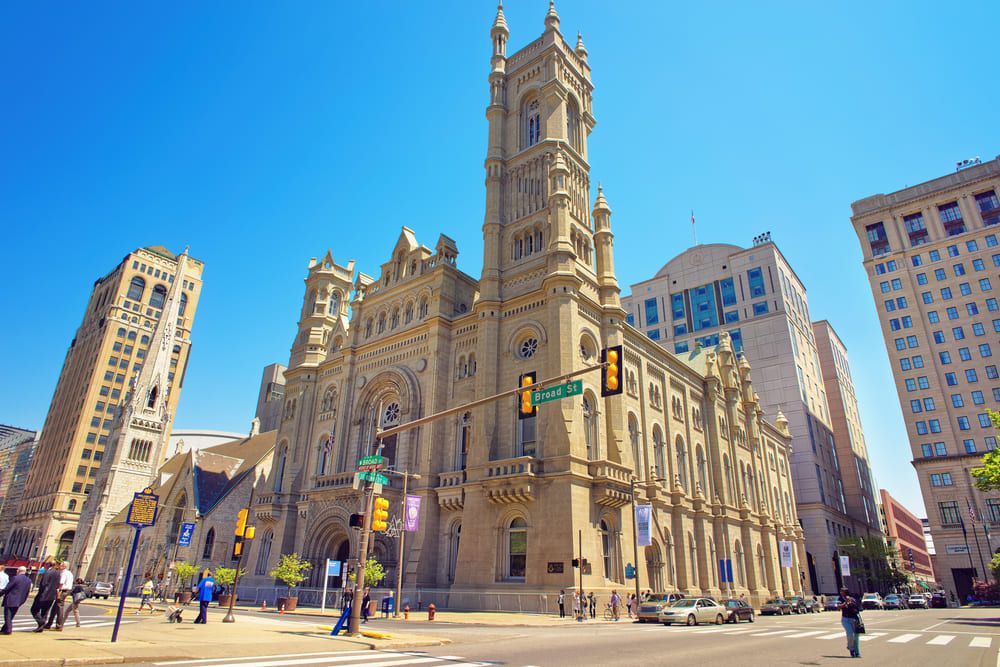
Shutterstock
Just across from Philadelphia City Hall, at 1 North Broad Street, stands a building that immediately stands out despite its imposing surroundings: the Masonic Temple. Built between 1868 and 1873, it serves as the headquarters of the Grand Lodge of Pennsylvania and is now listed as a National Historic Landmark, recognizing both its historical and architectural importance. To understand this place, it helps to know that Freemasonry has deep roots in Philadelphia. As early as the 18th century, figures such as Benjamin Franklin were members, and the city became one of the most influential Masonic centers in the United States. Take a moment to look just in front of you. At the street corner, you’ll see a modern sculpture called The Bond. It shows George Washington and Benjamin Franklin gathered around a central object: a Masonic apron. In Masonic tradition, this apron represents work and brotherhood. In the most common interpretation, Washington is presenting it to Franklin. It is said to have been a gift from Marquis de Lafayette, symbolizing a broader alliance, that between France and the United States during the War of Independence. The title The Bond takes on its full meaning here. It reflects a personal connection, a political alliance, and an exchange of ideas, not only between Washington and Franklin, but also between two nations, at a time when Franklin was deeply involved in intellectual circles in Europe, blending science, philosophy, and new ideas about government. This sculpture is not placed here by chance. It directly echoes the history of the temple, its collections, and the values carried by Freemasonry in Philadelphia. Now, take a closer look at the building itself. From the outside, its style resembles a Norman medieval castle, with a slightly mysterious feel. But it’s inside that the building truly reveals its richness. Visiting it is less like entering a single structure and more like moving through a series of rooms, each designed in a different style, almost like a journey through different civilizations and symbols. One of the most impressive spaces is the Egyptian Hall, inspired by ancient Egypt, with hieroglyphs, massive columns, and symbolic motifs. Another is the Corinthian Hall, with its very high ceiling and monumental scale, evoking an open-air Greek temple. The Ionic Hall offers a different atmosphere, with a painted ceiling showing a radiant sun surrounded by zodiac signs. Everywhere you look, the details stand out: grand staircases, stained glass windows, frescoes, sculptures… The temple even houses an extensive art collection. Today, the building is still active, but it’s also open to visitors. Guided tours give you the chance to explore these unique spaces and better understand their symbolism.
Aucun avis pour le moment
