



Walk
From Pacific Royalty to the Aloha Spirit
Honolulu, United States
Walk
From Pacific Royalty to the Aloha Spirit
Honolulu, United States
Distance
4.8 kmDurée
2h00Audios
25Parcours
Loop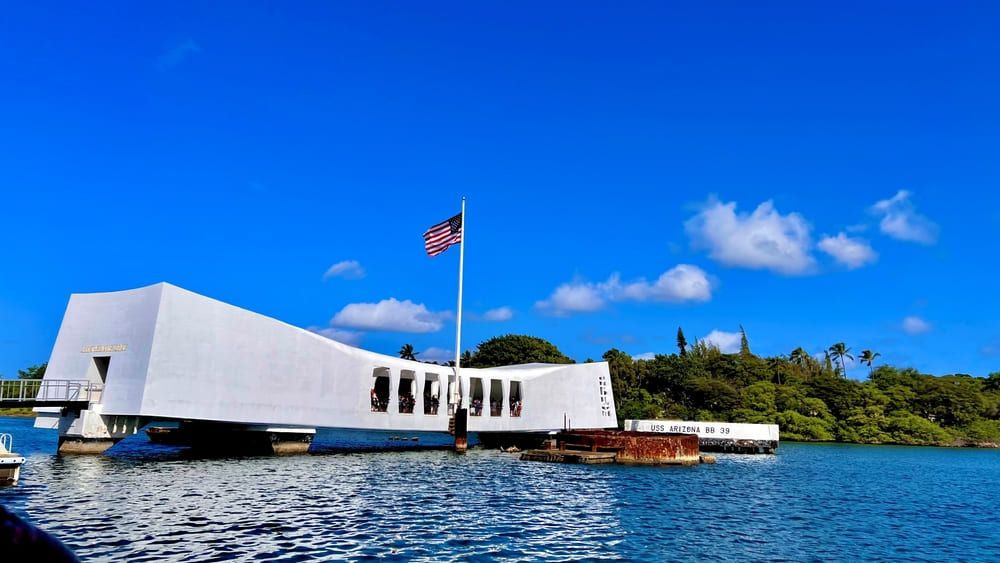
Shutterstock
Before we leave Chinatown, there's one more chapter of Honolulu's history we need to talk about, one whose impact was felt far beyond Hawaii: the attack on Pearl Harbor. The naval harbor lies about 6 miles (10 kilometers) from where you're standing, but what happened there on December 7, 1941, changed the course of Honolulu's history forever. That morning, at 7:55 a.m., Japanese military aircraft launched a surprise attack on the U.S. Pacific Fleet. In two successive waves, they unleashed a devastating bombardment that killed 2,403 people and left much of the harbor in ruins. The following day, President Franklin D. Roosevelt addressed Congress, describing December 7 as "a date which will live in infamy." The United States declared war on Japan, officially entering World War II. Today, Pearl Harbor is a place of remembrance, where visitors can reflect on the lives lost and the importance of peace. One of its most moving sites is the USS Arizona Memorial, a striking white structure built above the sunken battleship. The Arizona went down in just nine minutes, taking more than 900 sailors with it. Their remains still rest inside the wreck. If you take the boat out to the memorial and look down at the water, you might notice something unusual. Tiny drops of oil are still rising from the ship, spreading across the surface in shimmering, rainbow-colored patterns. They're known as the "black tears" of the USS Arizona, as though the ship were still mourning the sailors it lost more than 80 years ago. But the consequences of the attack reached well beyond the military harbor. They also transformed life for thousands of civilians in Honolulu, particularly those of Japanese descent. At the time, nearly 40% of Hawaii's residents had Japanese ancestry. Many had lived on the islands for generations, yet almost overnight, they found themselves under suspicion, treated as potential enemies simply because of their heritage. Radios were confiscated, curfews were imposed, and people were arrested without proper legal procedures. On the U.S. mainland, more than 120,000 people of Japanese descent were forcibly removed from their homes and confined in internment camps. Hawaii faced a different situation. Its Japanese community was so large and so deeply involved in the local economy that imprisoning everyone would have brought the islands to a standstill. Instead, Honolulu was placed under martial law for nearly two years. The military carried out selective, politically motivated internments, arresting and imprisoning more than 2,000 prominent community members across 13 detention sites throughout the islands. Fear and suspicion also created painful divisions among Honolulu's Asian communities. People were increasingly judged by their ancestry, with some groups regarded as acceptable and others treated as threats. To avoid being mistaken for Japanese residents and becoming targets of violence, many Chinese, Korean, and Filipino residents began wearing badges identifying their ethnic backgrounds. And there was another striking contradiction. Because China was now an American ally in the war, Congress repealed the longstanding Chinese Exclusion Act in 1943, finally allowing Chinese immigrants to become naturalized U.S. citizens. At the very same time, their Japanese neighbors were being deprived of their civil rights. It's a troubling part of Honolulu's history, one that shows how deeply the events of Pearl Harbor affected the people of Hawaii, far beyond the destruction of the naval base itself. If you'd like to explore this history further, you can visit Pearl Harbor later in your stay. Admission to the national memorial is free, although some museums and attractions charge admission. Be sure to reserve your boat shuttle to the USS Arizona Memorial online in advance, and remember that bags are strictly prohibited for security reasons.
Aucun avis pour le moment
