





Walk
From the Golden Dome to the Blue Bear
Denver, United States
Walk
From the Golden Dome to the Blue Bear
Denver, United States
4.7 km
Distance
2h00
Durée
21
Audios
Loop
Parcours
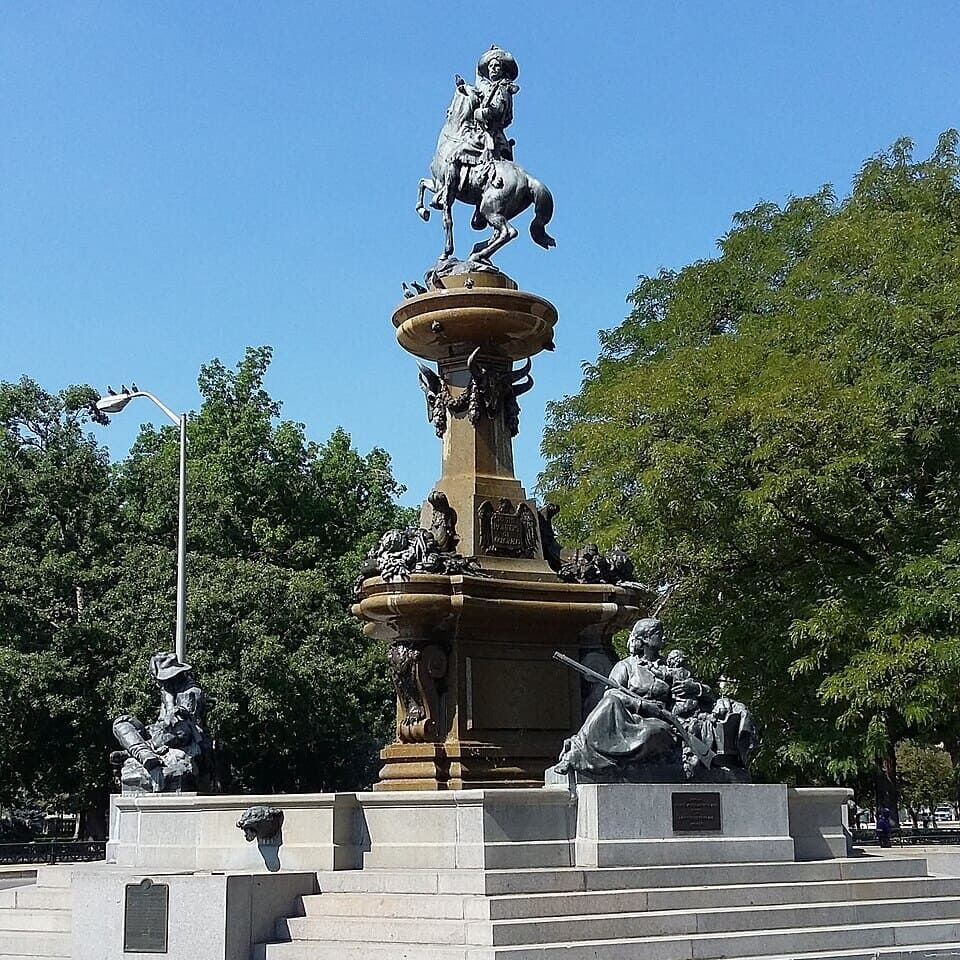
©Xnatedawgx CC BY-SA 4.0. <https://creativecommons.org/licenses/by-sa/4.0/deed.fr>via Wikipedia Commons
A stop on the Denver audio-guided tour, this monument stands on Cheyenne Place. Contrary to what one might think, the square already bore this name at the end of the nineteenth century, in tribute to the people of the Cheyenne nation, a rare thing for the time.
The ensemble celebrates the figure of the pioneer in an idealised vision of the conquest of the West. The monument symbolically marks the end of the Smoky Hill Trail, a perilous six-hundred-kilometre route linking Kansas to Denver. Nicknamed the starvation route, it drew thousands of adventurers towards the Pike's Peak gold fever in 1859; many never reached their destination.
In 1905, the elites of Denver decided to honour these pioneers, and the Pioneer Monument Fountain was installed here in 1911. The work, by the sculptor Frederick MacMonnies, aroused in its time a fascinating controversy revealing the tensions of the era. Observe this monument with the perspective that history invites us to bring to the conquest of the West.
The Pioneer Monument is on Cheyenne Place, in the centre of Denver. Freely accessible, it can be seen at any time.
The end of the Smoky Hill Trail, a perilous route linking Kansas to Denver during the gold rush.
Because many adventurers did not survive it, victims of storms, dangers and thirst.
Aucun avis pour le moment
