





Walk
From a Historic Pueblo to Contemporary Art
Los Angeles, United States
Walk
From a Historic Pueblo to Contemporary Art
Los Angeles, United States
4.5 km
Distance
2h00
Durée
29
Audios
Loop
Parcours
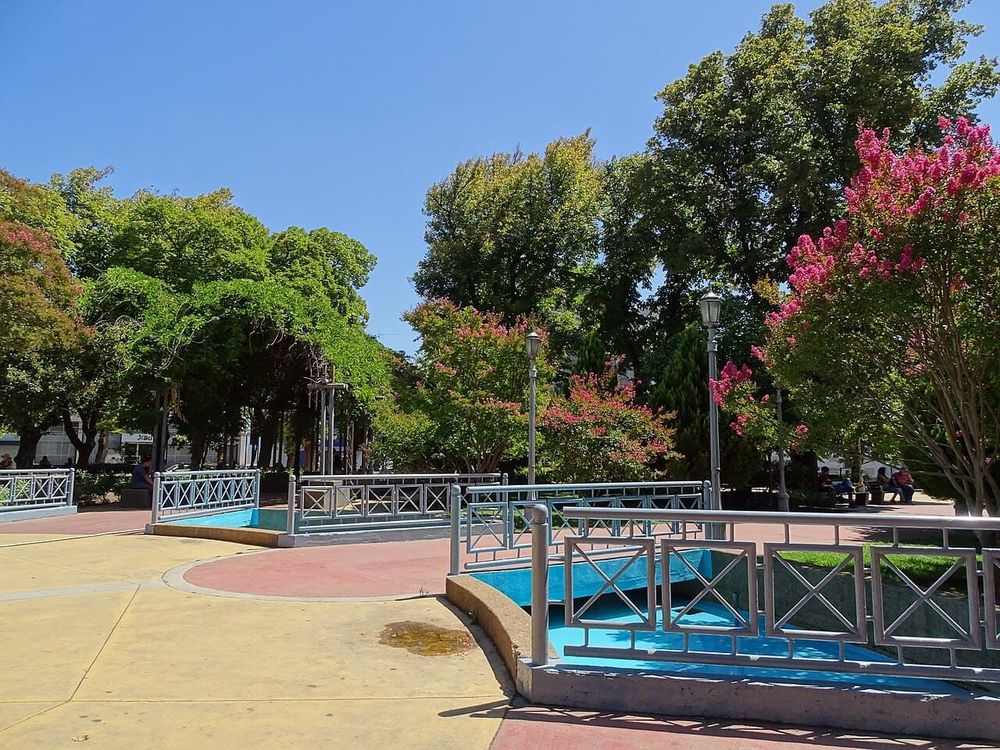
©LuisCG11 BY-SA 4.0. <https://creativecommons.org/licenses/by-sa/4.0/deed.fr>via Wikipedia Commons
The Plaza de Los Angeles is the starting point of the city's history. It is here, around a central square, that the Spanish pueblo at the origin of Los Angeles was born. The heart of the city's historic district, this memory-laden place tells the Hispanic origins of the City of Angels. The Los Angeles audio-guided tour stops here to go back to the very first hours of the metropolis.
In 1781, eleven families come to found a Spanish pueblo and settle around this central square, according to an urban model typical of the Hispanic world, where civic, religious and commercial life is organised around a single space. For decades, the Plaza is the political and social heart of the young city, in the Spanish then Mexican era. In the nineteenth century, Los Angeles expands rapidly and its centre shifts, but the Plaza remains the founding place of the city.
In the heart of the historic Plaza district, you discover the round, tree-lined square, its bandstands and the old buildings surrounding it, witnesses of the Los Angeles of the origins. Nearby stretches a market lane that perpetuates the Mexican atmosphere and traditions of the city. It is a dive into the Hispanic past of the City of Angels, against the grain of its resolutely modern image.
The Plaza de Los Angeles lies in the heart of the city's historic district, the Los Angeles Plaza Historic District, reachable on foot and by public transport. It is a public space open at all times, freely accessible and on the level. The historic buildings and surrounding shops have their own hours; it is best to enquire to visit the district's sites.
Because it is the founding place of Los Angeles: in 1781, eleven families established a Spanish pueblo there around this central square, the heart of the city's origins.
The round, tree-lined square, its bandstands, the old buildings of the historic district and the neighbouring market lane that perpetuates the Mexican traditions of the city.
Aucun avis pour le moment
